Maravis v CEPA & Northern Forest Products Limited [2026] OS 52
National Court decision on the suspension of an Environmental Permit
Concessions mentioned in this document:
                          PAPUA NEW GUINEA
                     [IN THE NATIONAL COURT OF JUSTICE]

                     OS (JR) NO. 52 OF 2026 (IECMS)


                               BETWEEN:
CHRISTIAN MARAVIS on behalf of himself and other concerned customary
landowners of WANIGELA (SEMORER) VILLAGE, TUFI LLG,
IJIVITARI DISTRICT, ORO PROVINCE whose names appear in schedule
"A" to the originating summons
                               -Plaintiffs-

                         AND:
JUDE TUKULIYA as Chairman of Environment Council and Acting Managing
Director of the CONSERVATION AND ENVIRONMENT PROTECTION
AUTHORITY
                         − First Defendant-

                         AND:
                     ENVIRONMENT COUNCIL

                          − Second Defendant-
                     AND:
          CONSERVATION AND ENVIORNMENT PROTECTION
          AUTHORITY
                     − Third Defendant -

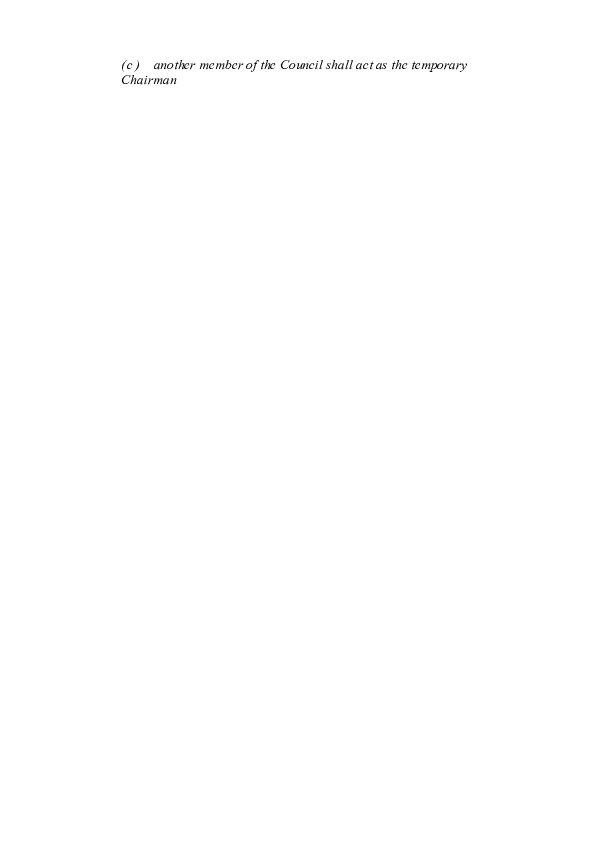
                      AND:
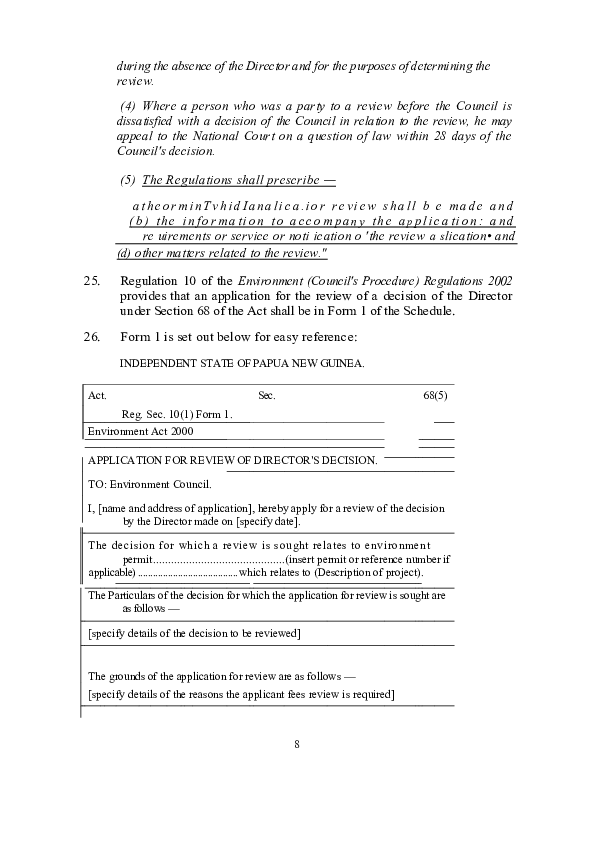
          THE INDEPENDENT STATE OF PAPUA NEW GUINEA
                      -Fourth Defendant —
                          AND:

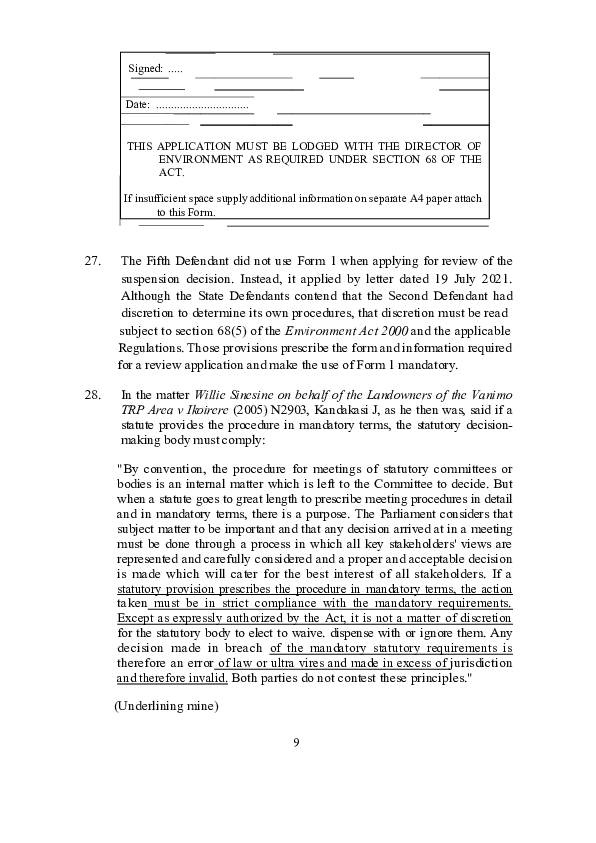
          NORTHERN FOREST PRODUCES LIMITED
                      − Fifth Defendant -


                          Waigani: Dowa J
                          2026: 21st May & 14 August


                                 1
JUDICIAL REVIEW – substantive review application-under the Environment Act 2000-
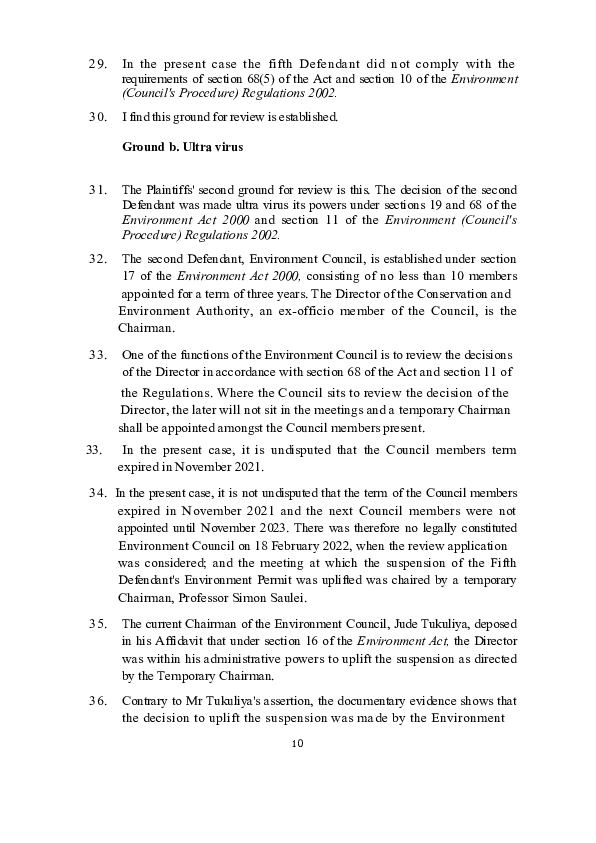
Plaintiffs' application to review the decision of the Environment Council who uplifted
Director's suspension decision without authority and without following procedure under
the Environment and Its Regulations— Whether the Plaintiffs are entitled to judicial
review of the decision of the Defendants–
Held: Although Defendants committed errors of both substantive and procedural law an
order in Certiorari was refused as it would be detrimental to good administration of the
office of Conservation and Environment Protection Authority-Judicial review was refused.

Cases cited:
    1. Kekedo v Burns Philip (PNG) Ltd [1988-1989] PNGLR 122
    2. Dwayne Job & Ors v Dr Kaul Gena & Ors (2020) N8737
    3. Amenda Kiap v Gena (2023) N10117
    4. Mao Zeming v The State (2006) N2998
    5. Tau Kamahuta v Sode (2006) N3067
    6. Willie Sinesine on behalf of the Landowners of the Vanimo TRP Area v lkoirere (2005)
       N2903
    7. Ombudsman Commission v Yama (2004) SC747.


Counsel:


V Amoko lawyer for the Plaintiffs
Z Rekeken for the I st,2nd, 3rd & 4th Defendants
T Tape for the fifth Defendant

                                       DECISION
14th August 2026

   1. Dowa J: The Plaintiffs apply for judicial review of a decision made by
      the second Defendant, the Environment Council, in uplifting the
      suspension of the fifth Defendants Environment Permit EP-L2 (543).

      THE FACTS

2. The Plaintiffs are from Wanigela village, Tuffi LLG, Oro Province. They are
   customary owners of the forest resources, water, and river system where the
   Fifth Defendant is currently conducting forest clearing activities under Forest
   Clearing Authority FCA 05-06 for the Wanigela Agro-Forestry Projects. The
   Plaintiffs are concerned citizens and affected customary landowners of the
   land over which the Environment Permit styled as EP-L2 (543) was issued to
   the Fifth Defendant.
3. The Environment Permit was issued on 18 February 2017 for a 10-year tenure,
    commencing on 20 March 2017 and ending on 18 March 2027. Since its
    commencement, the Fifth Defendant's operations have caused ongoing
    destructions and pollution to the river systems and water sources that the
    Plaintiffs rely on for daily survival.

4. The Plaintiffs raised their concerns in a letter dated 24th May 2021 to the
   Minister for Conservation and Environment Protection and Climate change,
   and to their Governor, Hon. Garry Juffa, MP, requesting action to address the
   environmental damage caused by the forest clearing activities.


5. On 30 June 2021, a Notice of Suspension of an Environmental Permit under
   Section 72 (2) (b) and (c) of the Environment Act 2000 was issued to the Fifth
   Defendants by the First Defendant. The suspension was based on two grounds:

          a) Misleading and false information submitted during the permit
             application stage.
          b) Environmental destruction and pollution complaints raised by the
             Plaintiffs.

6. On 19 July 2021, the Fifth Defendant applied by letter to the Environment
   Council to review the suspension decision. It was addressed to the Chairman
   of the Environment Council. The Plaintiffs contend that this informal
   application was irregular.

7. On 12th August 2021, the Second Defendant convened a Special Environment
   Council Meeting ECD01/2021 and on deliberated on the review application.
    In that special meeting ECD01/2021, the Second Defendant requested the
   Fifth Defendant to provide further information and documents to assist in
   determining the review.

8. On 24 August 2021, the Fifth Defendant submitted the further information and
   documents requested by the Second Defendant. On 1 December 2021, the
   Second Defendant convened a Council meeting and maintained the
   suspension of the Fifth Defendant's Environment Permit EP-L2 (543), again
   citing insufficient information and non-compliance with the permit conditions.

9. Around November 2021 the second Defendant's term of Office expired. A new
    Council was not appointed until 9th November 2023.


                                       3
10.0n 18 February 2022, the Second Defendant issued Council Decision No.
  EDCO2/2022, uplifting the suspension of Environment Permit EP-L2(543).
  The Environment Council was satisfied with the information provided by the
  fifth Defendant that it met the conditions of the Environment Permit and
  rectified the noncompliance issues raised by the Plaintiffs.

11.0n 21 February 2022, the Second Defendant wrote to the Fifth Defendant
  enclosing Council Decision No. ECD02/2022 and advised that the suspension
  of Environment Permit EP-L2 (543) has been uplifted.

12. The Plaintiffs allege the Defendants did not follow due process and procedures
   under the Environment Act 2000 in dealing with their complaints and
   deliberated on the fifth Defendant's review application without authority.

  Plaintiffs' Review Application
13. By Notice of Motion, the Plaintiffs apply for judicial review, seeking the
    following orders:


  I. Pursuant to the leave of this Court granted on 11th August 2024 and ORDR
     16 Rule 51) of the National Court Rules, this Honourable Court review the
     decision of the Second Defendant made on the 18th day of February 2022,
     registered as decision No. ECD02/2022, referred to as Items No. 5.2 and
     headed, Response by NFRL to EC Decision ECD04/2021 to uplift the
     suspension of the environment Permit EP-L2 (543) for Wanigela Integrated
     Agro-Industry Project.

  2. A DECLEARATION pursuant to Order 16 Rule 1(2) and/or Order 16 Rule
     5 (1) of the National Court Rules and Section 155 (4) of the Constitution
     be made that the Decision of the Second Defendant made on the 18th day
     of February, 2022, registered as Decision No. ECD02/2022, referred to as
     Item No.5.2 and headed, by NFRL to EC Decision ECD04/2021 to uplift
     the suspension of the Environment Permit EP-L2 (543) for the Wanigela
     Integrated Agro-Industry Project was made contrary to the section 17 and
     section 68 (4) of the Environment Act 2000 (as amended) and is unlawful,
     null and void; and


                                       4
    3. A DECLARATION pursuant to order 16 Rule 1 (2) and/or Order 16 Rule
        5(1) of the National Court Rules and Section 155 (4) of the Constitution be
        made that the decision of the Second Defendant made on the 18' h day of
        February 2022, registered as Decision No. ECD02/2022, referred to as
        Item No. 5.2 and headed, Response by NFRL to EC Decision ECD04/2021
       to uplift the suspension of the Environment Permit EP-L2 (543) for
       Wanigela Integrated Agro-Industry was made without a legally appointed
       Environmental Council and/or environment Council Members and it is
       ultra vires, unreasonable, null and void and of no effect; and

    4. An Order in the nature of the CERTIORARI pursuant to Order 16 Rule I (1)
        and/or Order 16 Rule 5(1) of the National Court Rules and Section 155 (4)
       of the Cons, itidi on be made to bring into this Honourable Court and quash
        the decision of the Second Defendant made on the 18th day of February
    2022, registered as Decision No. ECD02/2022, referred to as Item No. 5.2
       and headed, Response L2 (543) for the Wanigela Integrated Agro-Industry
       Project; .

14. The Plaintiffs rely on materials in the Review Book.
          a) Statement under Order 16 Rule 3(2) (a) of the National Court Rules
          b) Court Orders granting leave to Judicial Review of 11 August 2024
          c) Notice of Motion filed 28th August 2024.
          d) Affidavit verifying statement of Christian Maravis filed 5th July
             2024
          e) Affidavit in Support of Christian Maravis filed 5th July 2024
          f) Affidavit in Support of John Bethrome Wafor filed 5th July 2024
          g) Affidavit in Support of Paul Gambud filed 5th July 2024
          h) Affidavit in Support of John Jnr Ule 5th July 2024
          i) Affidavit in Support of Adelbert Gangai filed 7th August 2024
          j) Affidavit in Support of Christian Maravis filed 28th August 2024
         k) Affidavit in Support of Christian Maravis filed 18th September 2024
         1) Affidavits of John Jnr Ules filed 4th October 2024

15. The Defendants rely on their respective Affidavits filed in response.
    Grounds for Review

16. The grounds for judicial review set out in the statement of facts are:
    a) Errors of procedural law


                                         5
     b) Ultra virus

      Issues

17. The issues for consideration are:

     a)       Whether the Plaintiffs have established grounds for review
     b)       Whether the Plaintiffs are entitled to the reliefs sought

     Law

18. The relevant law for judicial review is Order 16 of National Court Rules.
    Order 16 Rule 1 of the National Court Rules caters for cases appropriate for
    application for judicial review and provides in this manner:

       (1)      An application for an order in the nature of mandamus, prohibition, certiorari
                or quo warranto shall be made by way of an application for judicial review in
                accordance with this Order.

       (2)      An application for a declaration or an injunction may be made by way of an
                application for judicial review, and on such an application the court may grant
                the declaration or injunction claimed if it considers that, having regard to:

                 (a)    the nature of the matters in respect to which relief may be granted by
                        way of an order of mandamus, prohibition or certiorari; and

                 (b)    the nature of the persons and bodies against whom relief may be granted
                        by way of such an order; and

                 (c)    all the circumstances of the case,

             it would be just and convenient for the declaration or injunction to be granted on
             an application for judicial review "

19. The law on judicial review is settled. In Kekedo v Burns Philip (PNG) Ltd
      [1988-1989] PNGLR 122, the Supreme Court stated that:

              "The circumstances under which judicial review may be available are where the
             decision-making authority exceeds its powers, commits an error of law, commits a
             breach of natural justice, reaches a decision which no reasonable tribunal could
             have reached or abuses its powers".

20. The Supreme Court in that case further stated that:


                                               6
          "The purpose ofjudicial review is not to examine the reasoning of the subordinate
          authority with the view to substituting its own opinion. Judicial review is
          concerned not with the decision but with the decision-making process."


      Ground One:          Errors of Law

21.   Errors of Law identified in the application are Section 68 (5) of the
      Environment Act 2000 and Environment (Council's Procedure)
      Regulations 2002.

22.    Counsel for the Plaintiffs submits that the fifth Defendant's application for
       review of the suspension decision by letter dated 19t h July 2021 was
      irregular and did not comply with section 68(5) of the Environment Act
      2000 and Rule 10(1) of the Environment (CP) Regulations 2002.

23.    Counsel for the State Defendants conceded that the proper Form for the
       review application was not used but contends that Section 68 (3) of the Act
       allows the second Defendant the discretion in determining its own
       procedures.

24.    Section 68 of the Environment Act is relevant, and it reads as follows:


       68. REVIEW OF DIRECTOR'S DECISIONS.


       (1) A person who is dissatisfied with a decision of the Director under this
      Act in relation to an application made by that person or in relation to an
      activity carried on by that person may apply for a review of the decision
      by the Council.
        (2) An application for review of a decision must be lodged with the
      Director within 21 days after the day on which the decision was notified to
      the person or to the public and the operation of the decision of the Director
      may be suspended on receipt of the application until the review is
      determined.

       (3) In determining an application for review under Subsection (1) —
       (a) the Council shall determine its own procedures;
       and
       ( b ) the Director shall absent himself from consideration of the review;
       and
                                           7
( c ) another member of the Council shall act as the temporary
Chairman
       during the absence of the Director and for the purposes of determining the
       review.
        (4) Where a person who was a party to a review before the Council is
       dissatisfied with a decision of the Council in relation to the review, he may
       appeal to the National Court on a question of law within 28 days of the
       Council's decision.

        (5) The Regulations shall prescribe —
          atheorminTvhidIanalica.ior review shall b e made and
         (b) the information to accom pany the application: and
            re uirements or service or noti ication o 'the review a slication• and
       (d) other matters related to the review."

25.     Regulation 10 of the Environment (Council's Procedure) Regulations 2002
        provides that an application for the review of a decision of the Director
        under Section 68 of the Act shall be in Form 1 of the Schedule.
26.     Form 1 is set out below for easy reference:

        INDEPENDENT STATE OF PAPUA NEW GUINEA.

Act.                                         Sec.                                        68(5)
      Reg. Sec. 10(1) Form 1.
Environment Act 2000

APPLICATION FOR REVIEW OF DIRECTOR'S DECISION.

TO: Environment Council.

I, [name and address of application], hereby apply for a review of the decision
       by the Director made on [specify date].

The decision for which a review is sought relates to environment
        permit ............................................ (insert permit or reference number if
applicable) ........................................ which relates to (Description of project).

The Particulars of the decision for which the application for review is sought are
       as follows —

[specify details of the decision to be reviewed]


The grounds of the application for review are as follows —
[specify details of the reasons the applicant fees review is required]


                                                       8
        Signed: .....


        Date: ...............................


        THIS APPLICATION MUST BE LODGED WITH THE DIRECTOR OF
             ENVIRONMENT AS REQUIRED UNDER SECTION 68 OF THE
             ACT.

       If insufficient space supply additional information on separate A4 paper attach
               to this Form.


27.    The Fifth Defendant did not use Form 1 when applying for review of the
       suspension decision. Instead, it applied by letter dated 19 July 2021.
       Although the State Defendants contend that the Second Defendant had
       discretion to determine its own procedures, that discretion must be read
      subject to section 68(5) of the Environment Act 2000 and the applicable
      Regulations. Those provisions prescribe the form and information required
      for a review application and make the use of Form 1 mandatory.

28.    In the matter Willie Sinesine on behalf of the Landowners of the Vanimo
       TRP Area v Ikoirere (2005) N2903, Kandakasi J, as he then was, said if a
       statute provides the procedure in mandatory terms, the statutory decision-
       making body must comply:

      "By convention, the procedure for meetings of statutory committees or
      bodies is an internal matter which is left to the Committee to decide. But
      when a statute goes to great length to prescribe meeting procedures in detail
      and in mandatory terms, there is a purpose. The Parliament considers that
      subject matter to be important and that any decision arrived at in a meeting
      must be done through a process in which all key stakeholders' views are
      represented and carefully considered and a proper and acceptable decision
      is made which will cater for the best interest of all stakeholders. If a
      statutory provision prescribes the procedure in mandatory terms, the action
      taken must be in strict compliance with the mandatory requirements.
      Except as expressly authorized by the Act, it is not a matter of discretion
      for the statutory body to elect to waive. dispense with or ignore them. Any
      decision made in breach of the mandatory statutory requirements is
      therefore an error of law or ultra vires and made in excess of jurisdiction
      and therefore invalid. Both parties do not contest these principles."

      (Underlining mine)

                                                9
29.   In the present case the fifth Defendant did not comply with the
      requirements of section 68(5) of the Act and section 10 of the Environment
      (Council's Procedure) Regulations 2002.
30.   I find this ground for review is established.

      Ground b. Ultra virus


31.   The Plaintiffs' second ground for review is this. The decision of the second
      Defendant was made ultra virus its powers under sections 19 and 68 of the
      Environment Act 2000 and section 11 of the Environment (Council's
      Procedure) Regulations 2002.
32.   The second Defendant, Environment Council, is established under section
      17 of the Environment Act 2000, consisting of no less than 10 members
      appointed for a term of three years. The Director of the Conservation and
      Environment Authority, an ex-officio member of the Council, is the
      Chairman.

33.   One of the functions of the Environment Council is to review the decisions
      of the Director in accordance with section 68 of the Act and section 11 of
       the Regulations. Where the Council sits to review the decision of the
      Director, the later will not sit in the meetings and a temporary Chairman
      shall be appointed amongst the Council members present.
33.    In the present case, it is undisputed that the Council members term
      expired in November 2021.

34. In the present case, it is not undisputed that the term of the Council members
     expired in November 2021 and the next Council members were not
     appointed until November 2023. There was therefore no legally constituted
     Environment Council on 18 February 2022, when the review application
     was considered; and the meeting at which the suspension of the Fifth
     Defendant's Environment Permit was uplifted was chaired by a temporary
     Chairman, Professor Simon Saulei.

35.   The current Chairman of the Environment Council, Jude Tukuliya, deposed
      in his Affidavit that under section 16 of the Environment Act, the Director
      was within his administrative powers to uplift the suspension as directed
      by the Temporary Chairman.
36.   Contrary to Mr Tukuliya's assertion, the documentary evidence shows that
      the decision to uplift the suspension was made by the Environment
                                         10
      Council, chaired at the time by the temporary Chairman, Professor Simon
      Saulei. The notice of that decision was communicated to the Fifth
      Defendant by the then Managing Director, Gunther Joku. In my view, an
      application for review of the Director's decision to suspend an
      Environment Permit fall within the jurisdiction of the Environment
      Council under sections 17(1)(e) and 68 of the Environment Act 2000. It
      does not remain within the Director's administrative functions. Section
      11(3) of the Environment (Council's Procedure) Regulations expressly
      prohibit the Director from taking part in the review applications.
37.   On the undisputed facts and the documentary evidence, I find that the
      Environment Council was not legally constituted at the time it purported to
      uplift the suspension. It therefore lacked the statutory authority to make
      that decision. The decision was made without lawful authority and is,
      accordingly, unlawful.
38.   If the Court were to accept Mr Tukuliya's contention, the former Managing
      Director would have acted beyond his powers by determining the review
      application. That conclusion follows because the power to review a
      suspension decision is vested exclusively in the Environment Council.
39.   In the end, I find, for reasons given above, the decision to uplift the
      suspension of the fifth defendant's Environment Permit was made without
      lawful authority.

      b. Whether the Applicant is entitled to the reliefs sought

40.   What orders should the Court make. In the statement and the substantive
      notice of motion, the Plaintiffs seek the following reliefs:

             a. review of the second defendant's decision of le February 2022
                uplifting the suspension decision.
             b. A declaration that the second defendant's decision of 18 th
                February 2022 is null and void
             c. An order that the second defendant's decision of 18th
                February'2022 be quashed.

41.   Although the Court has found that the decision to uplift the suspension
      of the Fifth Defendant's Environment Permit was made without lawful
      authority, that finding does not automatically entitle the Plaintiffs to all the
      reliefs sought. The grant of Certiorari remains discretionary, even where a
                                         11
      breach of procedure has been established. The Court must therefore
      consider whether, in all circumstances, the Second Defendant's decision
      should be quashed. The relevant authorities include Mao Zeming v
      Hinchiffe (2006) 1V2998; Tau Mavaru Kamuta v David Sode (2006) N3067;
      Sabako v Commissioner for Police (2006) N2975; and Ombudsman
      Commission v Yama (2004) SC747.
42. In Mao Zeming, Injia DCJ as he then was said at page 12 of his judgment.
             "At the same time, the question of whether the tribunals decision ought to be
            quashed by way of judicial review of certiorari for this fundamental breach of
            procedure is discretionary. This discretion is exercised with caution and in
            appropriate cases, taking into account the sum effect of all relevant
            considerations. In relation to application for judicial review of decisions of
            leadership tribunals on grounds of breach of prescribed procedure designed to
            afford natural justice to parties, the decision should not be readily quashed
            unless the procedural manner in which the entire proceedings were conducted
            by the tribunal resulted in some real and substantive injustice caused to the
            Plaintiff in terms of denying natural justice.

43. Order 16 Rule 4(1) of the National Court Rules gives the Court the
    discretion to refuse any relief sought in the application if in the opinion of
    the Court, the granting of the relief sought would be detrimental to good
    administration.

44. The facts are clear. The Plaintiffs were concerned about environmental
    damage and water pollution brought about by logging activities of the fifth
    Defendant, who had an Environment Permit EP-L2(543). In June 2021
    Acting on the Plaintiffs' complaints, the Director suspended the fifth
    Defendant's Environment Permit. The third Defendant, Conservation and
    Environment Protection Authority carried out investigations to verify the
    allegations. The fifth Defendant was asked to provide additional information
    and rectify the noncompliance issues. In February 2018, the Environment
    Council, though not legally constituted, uplifted the suspension after being
    satisfied that the environmental and compliance issues were resolved. The
    decision was made more than four (4) years. Things have moved on. The
    Environment Permit was granted on 20th March 2017 for ten (10) years and
    will expire on 18th March 2027, with just eight (8) months remaining. I am
    not convinced there is merit for an order for quashing the decision of 18th
    February 2022 as it would cause unnecessary inconvenience and be
    detrimental to good administration.


                                          12
 45. Despite the finding that the decision of 18th February 2022 was made by a
     statutory body not legally constituted and without authority, the application
     for an order in Certiorari shall be declined.

 46. Should the Plaintiff's then be left without remedy. I note the pleadings do not
     seek damages. That is a matter for the Plaintiffs to take it up in other avenues.
     In my view the Plaintiffs be compensated by the Defendants by paying their
     costs of the proceeding.

     Costs

 47. The Plaintiffs have been successful in the review application even though the
     primary relief shall not be granted. They are, nevertheless, entitled to the
     costs of the proceedings to be taxed, if not agreed.

Orders

The Court orders that:

      1. The Plaintiffs' application for judicial review is successful in part.
      2. The Plaintiff's application for an order in Certiorari is declined.
      3. For clarity, the application for an order to remove into this Court for the
         quashing of the Environment Council's decision of 18th February 2022 is
         refused.
      4. The Defendants shall pay the Plaintiffs' costs of the proceedings to be
         taxed, if not agreed.
      5. Time is abridged.


Centre for Environmental Law and
 Community Rights Lawyers .       Lawyer for the Plaintiff
Solicitor General       .     Lawyer for P',2"(1,3' and 4th Defendants
Kandawalyn Lawyers :       Lawyer for the fifth Defendant


                                         13