Report of the Inquiry into Log Export Monitoring (2026)
Special Parliamentary Committee on Public Sector Reform
Logging companies mentioned in this document:
Concessions mentioned in this document:
REPORT OF INQUIRY INTO LOG EXPORT
           MONITORING


REPORT TO THE 11TH PARLIAMENT

  SPECIAL PARLIAMENTARY
COMMITTEE ON PUBLIC SECTOR
 REFORM & SERVICE DELIVERY

             MARCH 2026
Report to Parliament - March 2026                       Special Parliamentary Committee on Public Sector Reform and Service Delivery


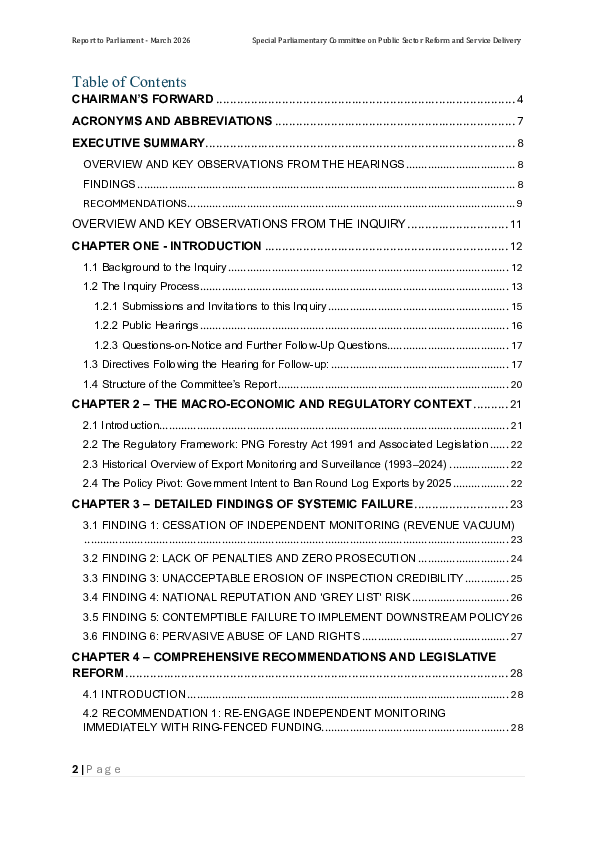
Table of Contents
CHAIRMAN’S FORWARD ...................................................................................... 4
ACRONYMS AND ABBREVIATIONS ..................................................................... 7
EXECUTIVE SUMMARY ......................................................................................... 8
   OVERVIEW AND KEY OBSERVATIONS FROM THE HEARINGS ................................... 8
   FINDINGS ......................................................................................................................... 8
   RECOMMENDATIONS......................................................................................................... 9
OVERVIEW AND KEY OBSERVATIONS FROM THE INQUIRY ............................. 11
CHAPTER ONE - INTRODUCTION ...................................................................... 12
   1.1 Background to the Inquiry .......................................................................................... 12
   1.2 The Inquiry Process ................................................................................................... 13
      1.2.1 Submissions and Invitations to this Inquiry .......................................................... 15
      1.2.2 Public Hearings ................................................................................................... 16
      1.2.3 Questions-on-Notice and Further Follow-Up Questions....................................... 17
   1.3 Directives Following the Hearing for Follow-up: ......................................................... 17
   1.4 Structure of the Committee’s Report .......................................................................... 20
CHAPTER 2 – THE MACRO-ECONOMIC AND REGULATORY CONTEXT .......... 21
   2.1 Introduction................................................................................................................ 21
   2.2 The Regulatory Framework: PNG Forestry Act 1991 and Associated Legislation ...... 22
   2.3 Historical Overview of Export Monitoring and Surveillance (1993–2024) ................... 22
   2.4 The Policy Pivot: Government Intent to Ban Round Log Exports by 2025 .................. 22
CHAPTER 3 – DETAILED FINDINGS OF SYSTEMIC FAILURE ........................... 23
   3.1 FINDING 1: CESSATION OF INDEPENDENT MONITORING (REVENUE VACUUM)
   ........................................................................................................................................ 23
   3.2 FINDING 2: LACK OF PENALTIES AND ZERO PROSECUTION ............................. 24
   3.3 FINDING 3: UNACCEPTABLE EROSION OF INSPECTION CREDIBILITY .............. 25
   3.4 FINDING 4: NATIONAL REPUTATION AND 'GREY LIST' RISK ............................... 26
   3.5 FINDING 5: CONTEMPTIBLE FAILURE TO IMPLEMENT DOWNSTREAM POLICY 26
   3.6 FINDING 6: PERVASIVE ABUSE OF LAND RIGHTS ............................................... 27
CHAPTER 4 – COMPREHENSIVE RECOMMENDATIONS AND LEGISLATIVE
REFORM .............................................................................................................. 28
   4.1 INTRODUCTION ....................................................................................................... 28
   4.2 RECOMMENDATION 1: RE-ENGAGE INDEPENDENT MONITORING
   IMMEDIATELY WITH RING-FENCED FUNDING............................................................ 28


2|Page
Report to Parliament - March 2026                       Special Parliamentary Committee on Public Sector Reform and Service Delivery


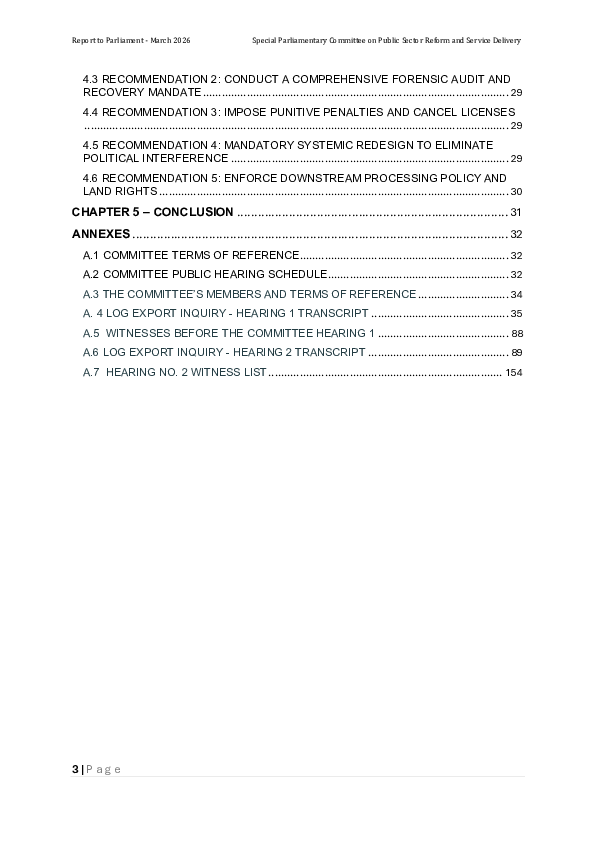
   4.3 RECOMMENDATION 2: CONDUCT A COMPREHENSIVE FORENSIC AUDIT AND
   RECOVERY MANDATE .................................................................................................. 29
   4.4 RECOMMENDATION 3: IMPOSE PUNITIVE PENALTIES AND CANCEL LICENSES
   ........................................................................................................................................ 29
   4.5 RECOMMENDATION 4: MANDATORY SYSTEMIC REDESIGN TO ELIMINATE
   POLITICAL INTERFERENCE ......................................................................................... 29
   4.6 RECOMMENDATION 5: ENFORCE DOWNSTREAM PROCESSING POLICY AND
   LAND RIGHTS ................................................................................................................ 30
CHAPTER 5 – CONCLUSION .............................................................................. 31
ANNEXES ............................................................................................................ 32
   A.1 COMMITTEE TERMS OF REFERENCE................................................................... 32
   A.2 COMMITTEE PUBLIC HEARING SCHEDULE.......................................................... 32
   A.3 THE COMMITTEE’S MEMBERS AND TERMS OF REFERENCE ............................. 34
   A. 4 LOG EXPORT INQUIRY - HEARING 1 TRANSCRIPT ............................................ 35
   A.5 WITNESSES BEFORE THE COMMITTEE HEARING 1 .......................................... 88
   A.6 LOG EXPORT INQUIRY - HEARING 2 TRANSCRIPT ............................................. 89
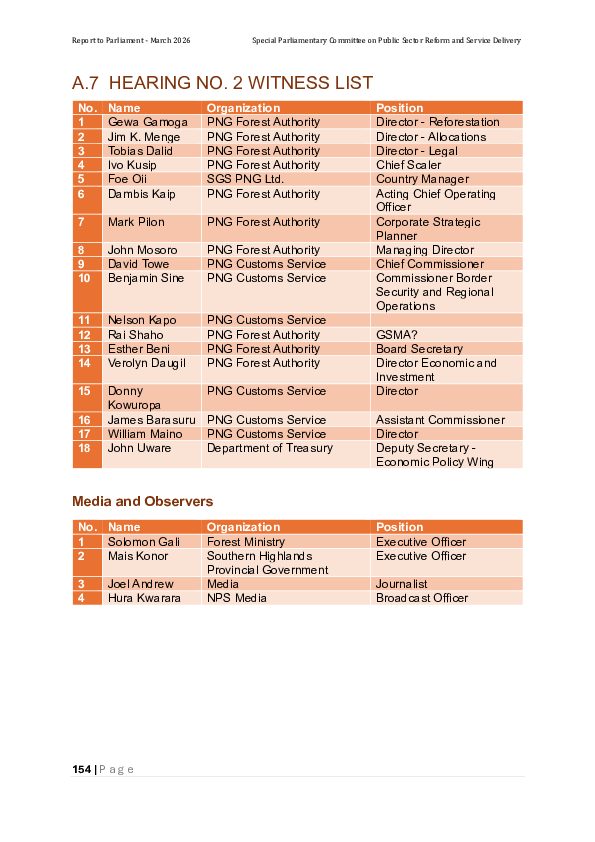
   A.7 HEARING NO. 2 WITNESS LIST ........................................................................... 154


3|Page
Report to Parliament - March 2026   Special Parliamentary Committee on Public Sector Reform and Service Delivery


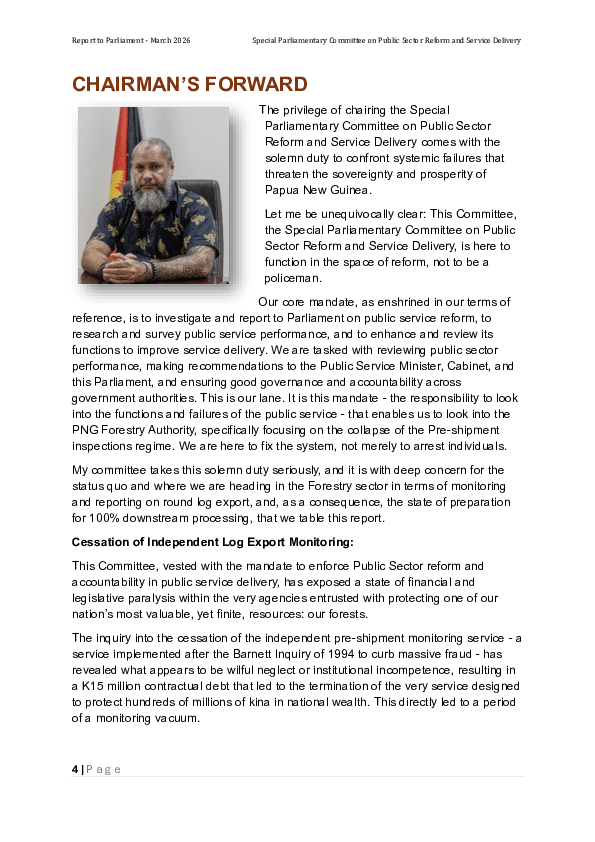
CHAIRMAN’S FORWARD
                                     The privilege of chairing the Special
                                      Parliamentary Committee on Public Sector
                                      Reform and Service Delivery comes with the
                                      solemn duty to confront systemic failures that
                                      threaten the sovereignty and prosperity of
                                      Papua New Guinea.

                                       Let me be unequivocally clear: This Committee,
                                       the Special Parliamentary Committee on Public
                                       Sector Reform and Service Delivery, is here to
                                       function in the space of reform, not to be a
                                       policeman.

                                      Our core mandate, as enshrined in our terms of
reference, is to investigate and report to Parliament on public service reform, to
research and survey public service performance, and to enhance and review its
functions to improve service delivery. We are tasked with reviewing public sector
performance, making recommendations to the Public Service Minister, Cabinet, and
this Parliament, and ensuring good governance and accountability across
government authorities. This is our lane. It is this mandate - the responsibility to look
into the functions and failures of the public service - that enables us to look into the
PNG Forestry Authority, specifically focusing on the collapse of the Pre-shipment
inspections regime. We are here to fix the system, not merely to arrest individuals.
My committee takes this solemn duty seriously, and it is with deep concern for the
status quo and where we are heading in the Forestry sector in terms of monitoring
and reporting on round log export, and, as a consequence, the state of preparation
for 100% downstream processing, that we table this report.

Cessation of Independent Log Export Monitoring:

This Committee, vested with the mandate to enforce Public Sector reform and
accountability in public service delivery, has exposed a state of financial and
legislative paralysis within the very agencies entrusted with protecting one of our
nation’s most valuable, yet finite, resources: our forests.

The inquiry into the cessation of the independent pre-shipment monitoring service - a
service implemented after the Barnett Inquiry of 1994 to curb massive fraud - has
revealed what appears to be wilful neglect or institutional incompetence, resulting in
a K15 million contractual debt that led to the termination of the very service designed
to protect hundreds of millions of kina in national wealth. This directly led to a period
of a monitoring vacuum.


4|Page
Report to Parliament - March 2026   Special Parliamentary Committee on Public Sector Reform and Service Delivery


This vacuum has not only risked the State hundreds of millions in potential revenue
loss but could also facilitate the abuse of customary landowner rights and undermine
the sovereign intent to transition to downstream processing by 2025.

For nearly thirty years, independent monitoring bodies, at a minimal cost to the
State, have reported consistent, egregious discrepancies in log exports, indicating a
systematic evasion of taxes and duties. Yet, in March 2024, the pre-shipment
inspection service ceased from all log monitoring. This gap ushered in an
unmonitored period - a vacuum of enforcement that can only be described as a
potential license for theft, benefiting foreign logging interests operating with absolute
impunity.

My committee firmly asserts that the absence of independent monitoring primarily
benefits a handful of foreign-owned entities engaged in calculated economic crime,
operating with government agency-enforced impunity and the certainty that they face
zero prosecution for forestry crimes.

The findings of this Inquiry into Log Export Monitoring are not merely administrative
observations; they constitute an alarming catalogue of dereliction of duty and willful
negligence that has created a national revenue catastrophe.

    •    The Committee recommends that PNGFA immediately engage an
         independent Pre-shipment inspection of all log exports until the proposed ban
         is in effect and review all log exports in the last 2 years of absence.
    •    The Committee recommends that PNGFA start prosecuting past revenue
         offences as are clearly reported as discrepancies.

State of readiness to ban Log exports and transition to 100% downstream
processing

From the evidence presented at its hearings, the Committee is convinced that
PNGFA is not ready to legislatively or operationally impose the ban of round logs
despite more than 5 years of notice to do so.

    •    The Committee is not convinced that PNGFA is prepared to move into 100%
         downstream processing of PNG’s logs by the due ban date of 31st December,
         2025.
    •    The Committee discourages the downstream log processing business from
         being vested in the Regulator, but rather be structured as a subsidiary under
         an existing State-Owned Enterprise, specifically Kumul Consolidated Holdings
         Limited (KCHL).
    •    The Committee discourages all timber operators or their proxies to be in the
         downstream processing and export of timber business. We need to close off
         transfer pricing, and we now have an opportunity.


5|Page
Report to Parliament - March 2026   Special Parliamentary Committee on Public Sector Reform and Service Delivery


This report is not a set of gentle suggestions; it is a prescription for emergency
surgery.

The recommendations contained within this Report are a prescription for immediate
and comprehensive change. They require not merely administrative tweaks but a
fundamental shift in political will, legislative courage, and the unwavering
commitment to dismantle the structures that encourage corruption that seem to
plague this vital sector.

The time for deliberation is over; the time for resolute action in defense of our
people’s wealth is now.

On behalf of the members of the Special Parliamentary Committee on Public Sector
Reform and Service Delivery, I thank all representatives of government departments
and non-government organisations who prepared submissions to the Inquiry and
who appeared before the Committee to answer questions at the public hearings in
May and August 2025.
I would also like to personally thank my fellow Committee members for their
contribution and cooperative approach to this Inquiry.
The Committee is also very appreciative of the research and administrative support
provided by the Committee Secretariat and Parliament Secretariat staff.

I commend the report to the House.


......................................................

Hon. Gary Juffa, MP

Chairman, Special Parliamentary Committee on Public Sector Reform &
Service Delivery

Governor for Northern Province


6|Page
Report to Parliament - March 2026         Special Parliamentary Committee on Public Sector Reform and Service Delivery


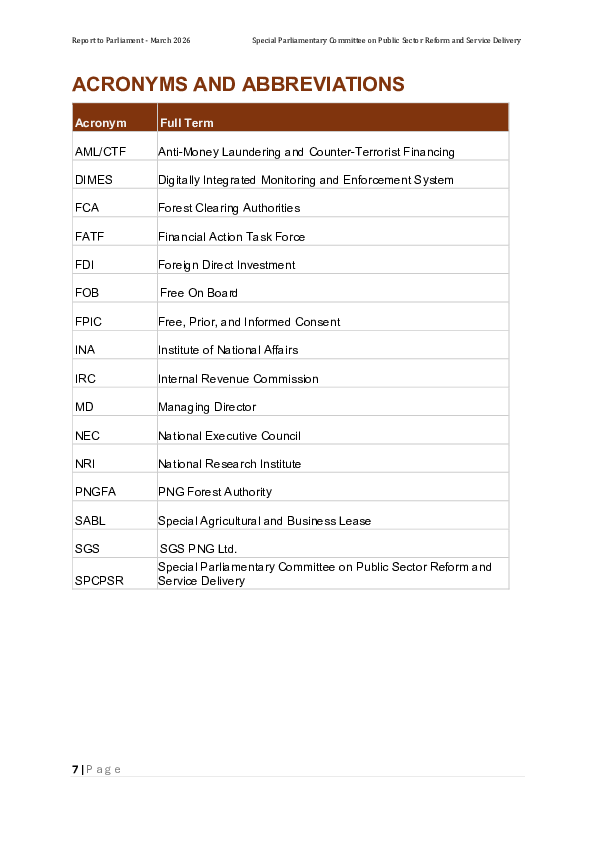
ACRONYMS AND ABBREVIATIONS
Acronym                 Full Term

AML/CTF                Anti-Money Laundering and Counter-Terrorist Financing

DIMES                  Digitally Integrated Monitoring and Enforcement System

FCA                    Forest Clearing Authorities

FATF                   Financial Action Task Force

FDI                    Foreign Direct Investment

FOB                     Free On Board

FPIC                   Free, Prior, and Informed Consent

INA                    Institute of National Affairs

IRC                    Internal Revenue Commission

MD                     Managing Director

NEC                    National Executive Council

NRI                    National Research Institute

PNGFA                  PNG Forest Authority

SABL                   Special Agricultural and Business Lease

SGS                    SGS PNG Ltd.
                       Special Parliamentary Committee on Public Sector Reform and
SPCPSR                 Service Delivery


7|Page
Report to Parliament - March 2026   Special Parliamentary Committee on Public Sector Reform and Service Delivery


EXECUTIVE SUMMARY
This report summarises the findings and critical recommendations of the Special
Parliamentary Committee on Public Sector Reform and Service Delivery (the
Committee) following its inquiry into the termination of independent pre-shipment log
export monitoring services by Société Générale de Surveillance (SGS) PNG Ltd. The
inquiry exposed a dereliction of duty across government agencies, resulting in a
systemic collapse of national revenue protection mechanisms.

The persistent issues are rooted in weak legislative enforcement, possible systemic
corruption, and a fundamental lack of political and bureaucratic will to prosecute
offenders, effectively turning a vital natural resource into an illicit revenue stream for
foreign interests.

OVERVIEW AND KEY OBSERVATIONS FROM THE
HEARINGS
The inquiry was carried out through two public hearings (May 29, 2025, and August
6, 2025), summoning representatives from the PNG Forest Authority (PNGFA), the
Department of Treasury and Customs, the Department of Finance, and SGS PNG
Ltd. The Committee observed a significant lack of accountability, institutional
capacity, and inter-agency coordination. Key testimony confirmed that the PNGFA
lacks the necessary technical system that SGS possesses and that the failure to
establish a secure payment pathway for fulfilling contractual obligations was the
direct cause of the crisis.

FINDINGS
    1. Cessation of Independent Monitoring (Revenue Vacuum): Independent
       log export monitoring services were formally ceased on March 12, 2024, due
       to the State’s egregious failure to settle approximately K15 million in
       accumulating unpaid contractual bills to SGS. This administrative negligence
       or incompetence created an unacceptable, unmonitored period of over 23
       months (and by the time of the inquiry, approximately 18 months), posing an
       explicit, quantifiable, and immediate risk to national revenue and forest stock
       integrity.

    2. Lack of Penalties and Zero Prosecution: Despite nearly 30 years of SGS
       independently monitoring and reporting consistent discrepancies which
       constituted possible economic fraud, the Committee confirms a zero-
       prosecution record for forestry-related offences. The hearing established that
       this profound failure of enforcement by all responsible state agencies has
       resulted in not a single prosecution against companies engaged in possible
       tax evasion, misdeclaration, and illicit activities. This grants foreign operators’


8|Page
Report to Parliament - March 2026    Special Parliamentary Committee on Public Sector Reform and Service Delivery


         absolute impunity. State agencies appear to have fallen short of their
         executive duties.

    3. Unacceptable Erosion of Inspection Credibility: The reliance on an
       internal, self-policing mechanism by the PNG Forest Authority (PNGFA) in the
       absence of SGS since March 2024 constitutes an unacceptable step
       backwards from the mandatory independent oversight established after the
       Barnett Inquiry. The Committee is of the view that the current internal
       monitoring by PNGFA since March 2024 is non-transparent and lacks the
       necessary technical capacity and political and bureaucratic independence.

    4. National Reputation and 'Grey List' Risk: The failure to maintain
       independent pre-shipment inspections, a key anti-corruption function, directly
       risks placing Papua New Guinea on the international 'grey list' (High-Risk
       Jurisdiction) with the Financial Action Task Force (FATF), undermining the
       nation's integrity and access to international finance.

    5. Contemptible Failure to Implement Downstream Policy: Despite the clear
       2025 government directive to cease round log exports and the three-year
       transition window (2022-2025), the committee, through its inquiry, has noted a
       general trend among logging companies that there appears to be limited
       preparation for investment in downstream processing. This observation raises
       concerns about a focus on immediate resource extraction and export rather
       than fostering long-term sustainable practices. Furthermore, the continued
       issuance of permits by PNGFA suggests a need for a more coordinated
       approach to address these crucial matters effectively.
    6.   Pervasive Abuse of Land Rights: The challenges related to illegal logging
         through Forest Clearing Authorities (FCAs) have positioned Papua New
         Guinea as a significant exporter of round logs—a distinction that warrants
         concern. There are potential indications that FCAs may be misused to mask
         illegal logging, often framed as agricultural development, which could
         disenfranchise customary landowners and undermine sustainable forestry
         regulations. It is crucial to foster dialogue and pursue solutions that uphold our
         environmental and social responsibilities.

RECOMMENDATIONS
Given the above findings, the Committee makes the following 5 recommendations;

    1. Re-engaging Independent Monitoring IMMEDIATELY: Immediately Re-
       engage SGS or such other competent monitoring organization, to restore
       independent monitoring services under a new, legally binding terms of
       reference, and mandate the Digitally Integrated Monitoring and Enforcement
       System (DIMES) to ensure real-time data transparency across all regulatory


9|Page
Report to Parliament - March 2026     Special Parliamentary Committee on Public Sector Reform and Service Delivery


         bodies (PNGFA, Customs, Treasury). The funds for this contract must be
         Ring-Fenced to ensure sustainable service continuity.

    2. Conduct a Comprehensive Forensic Audit and Recovery Exercise:

              a. A detailed, non-negotiable forensic audit of round log exports, spanning
                 a minimum of the last ten years, must be commissioned. The Terms of
                 Reference for this audit must underpin the sole purpose of precisely
                 quantifying and recovering all potentially lost State revenue and
                 evaded duty, with a clear mandate to pursue criminal and civil recovery
                 against perpetrators. This exercise must be led by an internationally
                 reputable firm, managed by an interagency Task force reporting to the
                 NEC.

              b. The National Executive Council (NEC) must mandate the introduction
                 of robust, punitive financial penalties (e.g., fines 5x the evaded duty)
                 and establish a dedicated interagency Task Force to prosecute
                 possible corruption and financial irregularities.

    3. Impose Punitive Penalties and Cancel Licenses: In line with
       recommendation 2. The PNGFA, PNG Customs, and IRC must be directed to
       immediately conduct investigations and impose severe, punitive financial
       penalties and sanctions, including license cancellations and asset forfeiture,
       against companies demonstrating habitual non-compliance, thereby
       establishing a legal deterrent.
    4. Redesignation of Current Permitting Process and Data Transparency:

              a. The authority for log export permit approval must be reassigned from
                 the Minister for Forests to the PNGFA Board to eliminate political
                 interference and discretionary abuse.
              b. PNGFA to promptly resume public reporting of the Monthly Log Export
                 data as previously generated by SGS till March 2024.

    5. Independent review of the Viability of Downstream Processing Policy:
               a. Independent Review of all FCAs: A reputable independent firm be
                  engaged through an interagency Task Force to audit all FCAs and
                  determine if the terms of the respective FCA have been met by the so-
                  called agriculture companies and if agriculture projects have actually
                  been established and commitments contained in the FCA to land
                  owners have been honoured.
               b. The PNGFA must be directed to immediately cancel the licenses of
                  companies that have failed to transition or invest in downstream
                  processing, thereby enforcing the 2025 ban. Concurrently, all FCAs
                  and SABLs used for logging must undergo immediate, independent
                  review to confirm legitimate landowner consent.
10 | P a g e
Report to Parliament - March 2026    Special Parliamentary Committee on Public Sector Reform and Service Delivery


               c. NEC to commission NRI and INA report to Parliament through this
                  Committee on the state of readiness by PNGFA to implement the
                  policy of 100% down-stream processing.


OVERVIEW AND KEY OBSERVATIONS FROM
THE INQUIRY
(FINDINGS AND RECOMMENDATIONS)
                                                                                                    Page
FINDINGS AND RECOMMENDATIONS                                                                        Numbers
FINDING 1: CESSATION OF INDEPENDENT MONITORING (REVENUE
VACUUM)
                                                                                                    22

RECOMMENDATION 1: RE-ENGAGE INDEPENDENT MONITORING
IMMEDIATELY WITH RING-FENCED FUNDING                                                                27
FINDING 2: LACK OF PENALTIES AND ZERO PROSECUTION                                                   23
RECOMMENDATION 2: CONDUCT A COMPREHENSIVE FORENSIC AUDIT
AND RECOVERY MANDATE                                                                                28
FINDING 3: UNACCEPTABLE EROSION OF INSPECTION CREDIBILITY
                                                                                                    24
RECOMMENDATION 3: IMPOSE PUNITIVE PENALTIES AND CANCEL
LICENSES                                                                                            28
FINDING 4: NATIONAL REPUTATION AND 'GREY LIST' RISK
                                                                                                    25
RECOMMENDATION 4: MANDATORY SYSTEMIC REDESIGN TO ELIMINATE
POLITICAL INTERFERENCE                                     28
FINDING 5: CONTEMPTIBLE FAILURE TO IMPLEMENT DOWNSTREAM
POLICY                                                                                              25
RECOMMENDATION 5: ENFORCE DOWNSTREAM PROCESSING POLICY
AND LAND RIGHTS                                                                                     29

FINDING 6: PERVASIVE ABUSE OF LAND RIGHTS                                                           26


11 | P a g e
Report to Parliament - March 2026   Special Parliamentary Committee on Public Sector Reform and Service Delivery


CHAPTER ONE - INTRODUCTION
1.1 Background to the Inquiry
The Special Parliamentary Committee on Public Sector Reform and Service Delivery
(SPCPSR) initiated this inquiry in response to the public reports of operational
collapse of the independent log export monitoring regime. This system, established
following the traumatic findings of the 1994 Barnett Inquiry, was the single most vital
tool for protecting national revenue from endemic corruption. Its failure, detailed in
this report, signals a return to the dark days of uncontrolled resource exploitation.
The Special Parliamentary Committee on Public Sector Reform and Service Delivery
(SPCPSR) is established under the authority of the Papua New Guinea National
Parliament to investigate systemic failures and propose reforms within the public
sector that impede national development, erode public trust, and compromise
national revenue.
The current inquiry was initiated in response to the abrupt cessation of the
independent pre-shipment inspection and monitoring service for all round log exports
in March 2024, a service critical to the protection of state revenue and the integrity of
PNG’s Forest resources. The Committee's legislative authority empowers it to
summon witnesses, demand the production of documents, and formulate binding
recommendations to the Parliament and the National Executive Council (NEC).

The inception of the Export Monitoring Agreement was a direct result of the findings
from the Barnett Commission of Inquiry, which highlighted significant issues such as
transfer pricing, under-declaration, and corruption within the sector. It is the
Committee’s view that the State's inability to uphold the independent monitoring
mechanism—deemed essential following the inquiry—represents a missed
opportunity to safeguard the national interest. This situation underscores the ongoing
presence of the fundamental institutional vulnerabilities identified in 1994.
Furthermore, the lack of action regarding past recommendations, including those
stemming from the SABL, has contributed to the current challenges we face.


12 | P a g e
Report to Parliament - March 2026          Special Parliamentary Committee on Public Sector Reform and Service Delivery


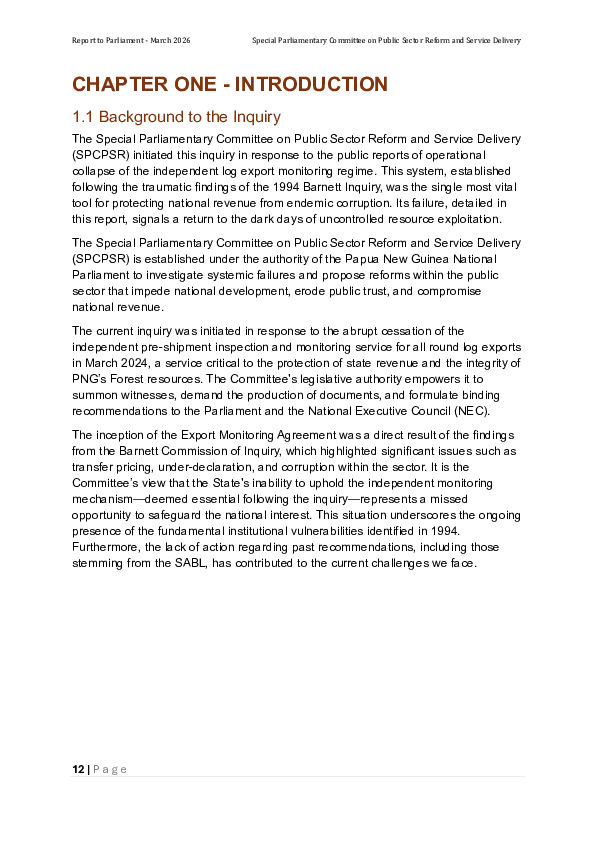
Picture: 1 Log Export Monitoring Hearing


Photo 1 Log Export Monitoring Hearing

1.2 The Inquiry Process
The Committee’s approach to the Inquiry has involved evidence gathering and
analysis of information sourced from government departments and agencies and
non-government organisations.

The SPCPSR conducted the Inquiry primarily through public hearings. Two hearings
were held in the National Capital District. Details of the hearings are as follows.

    •    Public Hearing 1 was held on 29th May 2025 at C Block Private Theatre,
         Parliament House, Port Moresby. Table 1 lists the organizations present as
         witnesses before the Committee at this hearing.


                    Organization                                       Represented by:
 Papua New Guinea Forest Authority                     Magdalene Maihua, Chief Operating
                                                       Officer
                                                       Verolyne Daugil, Director Economic
                                                       and Investments
                                                       Mark Pilon, Corporate Strategic
                                                       Planner
 SGS PNG Ltd.                                          Foe Oii, Country Manager
 Department of Treasury                                Andrew Oaeke, Secretary
                                                       Hans Marbis, First Assistant Secretary
Table 1: List of witnesses present at Hearing No. 1
13 | P a g e
Report to Parliament - March 2026              Special Parliamentary Committee on Public Sector Reform and Service Delivery


In making its findings and recommendations, the Committee considered:

    •    Summon Letters to government departments and non-government
         organizations.

    •    Evidence taken at public hearings held in May and August 2025;

    •    Responses to questions-on-notice and follow-up questions sent to various
         organizations.

    •    Responses to follow-up specific questionnaires;

    •    Information gathered through desktop research

The Committee is appreciative to all parties providing information through
submissions, questionnaire responses and evidence at public hearings. The
information received has greatly assisted the Committee in undertaking the Inquiry.


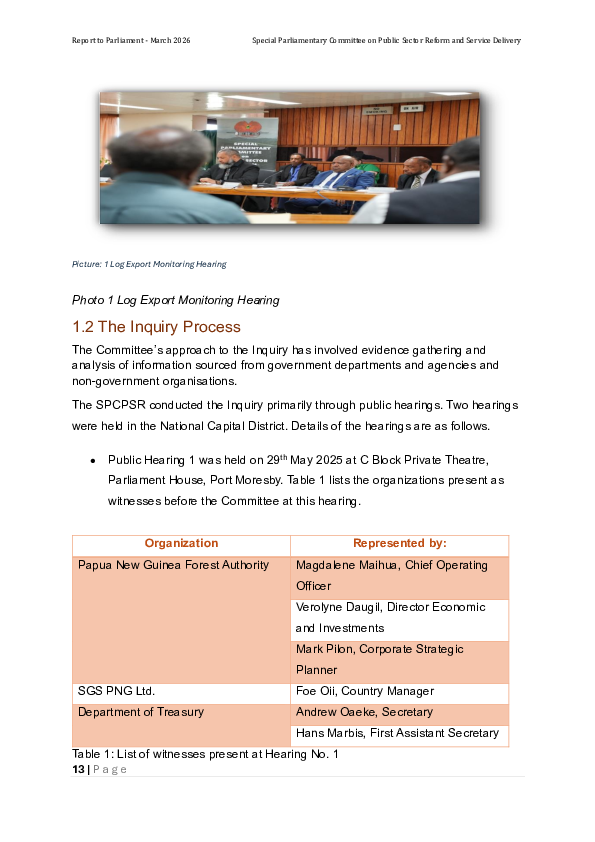
                       Photo 2 Swearing-In of Witness for Log Export Monitoring Second Hearing


Further details in relation to this information follow.

The Committee’s investigation focused on the precise mechanics of the SGS
contract cessation, the resultant unmonitored period, the institutional capability of the
PNGFA to fill the void, and the enforcement history (or lack thereof) regarding
violations of the Forestry Act. The inquiry focused primarily on two interconnected
areas:

    1. The Termination of Independent Monitoring: Investigating the
        administrative, financial, and institutional failures that led to the cessation of
        the monitoring contract with SGS PNG Ltd., and assessing the risks and
        actual losses incurred during the subsequent unmonitored period.
14 | P a g e
Report to Parliament - March 2026    Special Parliamentary Committee on Public Sector Reform and Service Delivery


    2. The Policy on Downstream Processing: Examining the government’s
       stated intent to ban round log exports by 2025 and the current challenges in
       transitioning the sector towards a sustainable, value-added downstream
       processing industry.
The methodology included:

    •    Review of official correspondence, including the SGS contract, notices of
         intent to arbitrate, and inter-agency payment requests.
    •    Detailed cross-examination of witnesses regarding financial liabilities,
         enforcement actions, and internal audit procedures.
    •    Review of previous inquiry reports (e.g., the Tos Barnett Report) to identify
         persistent systemic issues.

The findings rely heavily on evidence-based testimony and documentary proof of
financial negligence and institutional inaction.

1.2.1 Submissions and Invitations to this Inquiry
In July 2025, the Committee summoned the key organizations, including:

    1.   Papua New Guinea Forest Authority (PNGFA)
    2.   SGS PNG Ltd.
    3.   Department of Treasury
    4.   Department of Finance
    5.   PNG Customs Service
In August 2025, the Committee wrote to organizations, including the Commissioner
of Customs, the Managing Director of PNGFA, the Country Manager of SGS, and the
Secretary of Treasury, Secretary of Finance, inviting them to attend the second
hearing and provide responses to specific queries. These queries covered areas
such as log export duty collections, post-audits, pre-shipment inspections, trust
accounts, reporting of discrepancies, post-shipment reconciliation, and the future of
independent inspection services given the log export ban.

The Committee conducted two public hearings, summoning key personnel from the
PNG Forest Authority (PNGFA), the Department of Treasury, and the former service
provider, SGS PNG Ltd.


15 | P a g e
Report to Parliament - March 2026   Special Parliamentary Committee on Public Sector Reform and Service Delivery


1.2.2 Public Hearings
The Committee held two main public hearings in the National Capital District on May
29, 2025, and August 6, 2025, with the following government departments and non-
government organisations:

    •    SGS PNG Ltd.

    •    The Department of Treasury

    •    The Department of Finance
    •    The PNG Forest Authority (PNGFA)

    •    The PNG Customs

The hearings provided the Committee with an opportunity to further explore issues
associated with the Inquiry.

    •    Public Hearing 1: Held on May 29, 2025, at C Block Private Theatre,
         Parliament House, Port Moresby. Witnesses included representatives from the
         Papua New Guinea Forest Authority (Magdalene Maihua, Verolyne Daugil,
         Mark Pilon), SGS PNG Ltd. (Foe Oii), and the Department of Treasury
         (Andrew Oaeke, Hans Marbis).

    •    Public Hearing 2: Held on July 28, 2025, and August 6, 2025, at the B2
         Conference Room, Parliament House, Port Moresby. Witnesses at these
         hearings also included representatives from PNGFA, SGS, and the
         Department of Treasury. The Commissioner of Customs also appeared at the
         August 6, 2025, hearing.

The focus of the first hearing was on the financial non-performance by the State and
the termination notice (which was noted to have been initiated by SGS’s intention to
proceed to arbitration). Committee members, including Hon. Marsh Narewec,
emphasized the need to renew the contract and fix the payment pathway,
acknowledging that PNGFA lacked the necessary independent system.

In the second hearing, the PNGFA Managing Director (MD) was asked to provide a
report on the claimed social benefits (roads, bridges, agriculture projects) delivered
by logging companies, and critically, their strategy for managing the ban on round log
exports and ensuring the transition to downstream processing. The Committee
observed significant evasiveness and a lack of clear strategy on the downstream
ban. Transcripts of the hearings can be found on the website www.spcpsr.gov.pg.
The hearings provided the Committee with an opportunity to further explore issues
associated with the Inquiry. Transcripts of the hearings, together with any
accompanying slide presentations, can be found on the website.


16 | P a g e
Report to Parliament - March 2026   Special Parliamentary Committee on Public Sector Reform and Service Delivery


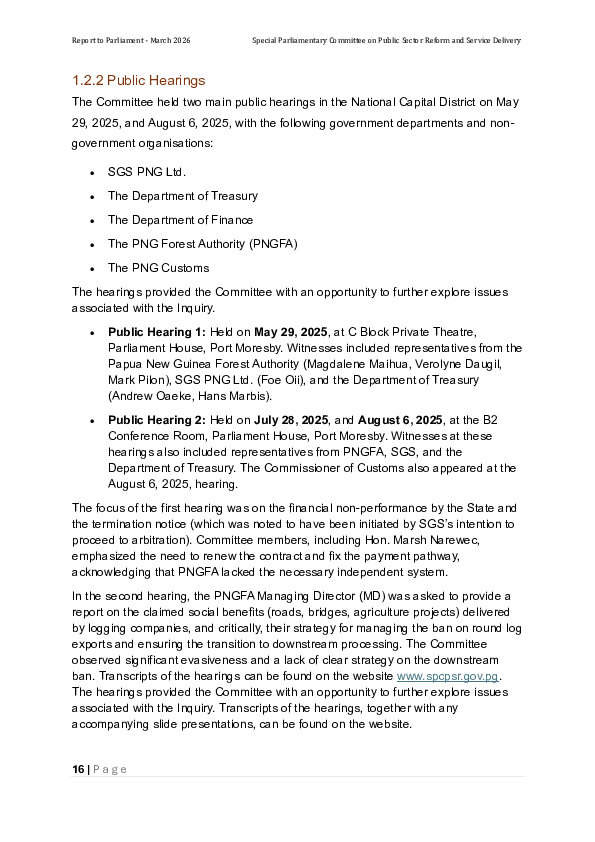
Photo 3 Forestry Hearing

1.2.3 Questions-on-Notice and Further Follow-Up Questions
Following the public hearings, the Committee remitted any questions taken on notice
together with requests for further information to the relevant government
departments and non-government organisations attending the hearings.

The Committee also sent out follow up specific questionnaires to relevant
government departments with questions arising from the Committee’s in-depth
investigation for this Inquiry and matters arising from the public hearings. The
responses to these questions on notice and follow-up questions will be provided in
writing to the committee.

The Chairman indicated that questions held by the Secretariat would be framed and
issued to the attendees for their comprehensive responses. This process was put in
place to ensure all necessary information and clarifications were gathered for the
ongoing inquiry, with further notices for information and clarification expected as the
committee continues its work.

1.3 Directives Following the Hearing for Follow-up:
Here are the specific questions on notice for follow-up and requests for information
from the relevant stakeholders:

    1.   FOR Treasury (John Uware):


17 | P a g e
Report to Parliament - March 2026         Special Parliamentary Committee on Public Sector Reform and Service Delivery


             i.    Provide a detailed response regarding the budgetary support for the
                   financing of SGS's work, specifically addressing allegations of
                   underfunding that led to contract arrears and termination.
            ii.    Clarify the discussions and agreements with various agencies on
                   the retention ratios of their generated revenue, particularly concerning
                   the pushback from revenue-generating agencies regarding how much
                   they should keep versus what Treasury collects.
           iii.    Detail Treasury's stance and planned actions to reintroduce pre-
                   shipment inspections and ensure funding is made available for this
                   vital role, recognizing its importance in keeping PNG off the "gray list".
           iv.     Confirm whether Treasury has conducted an independent analysis of
                   log export discrepancies and the potential for penalties and
                   additional revenues.
            v.     Provide projected export figures for 2025 and 2026 and analyze the
                   potential loss of revenue in the 2026 budget if the government's
                   intention to stop round log exports by 2025 is implemented.
    2.   From PNG Forest Authority (Mr Mosoro):
             i.    Provide further information or clarification on the thorough report
                   previously submitted to the committee.
            ii.    Conduct a verification and review of the SGS discrepancy report,
                   particularly the example concerning Pacific Region Development's
                   shipment, given the significant percentage discrepancy.
           iii.    Submit copies of monthly inspection reports conducted by NFA
                   officers since SGS's contract ceased, to identify any detected
                   discrepancies and allow for comparison with SGS's previous findings.
           iv.     Provide a historical account explaining why ministers are required
                   by law to sign log export permits.
            v.     Furnish a comprehensive list of all companies involved in logging
                   activities across the country, detailing their operating locations and the
                   specific types of agricultural activities they claim to be undertaking.
           vi.     Provide reports on the audit of agro-forestry projects and the
                   board's decisions regarding the cancellation or termination of licenses


18 | P a g e
Report to Parliament - March 2026        Special Parliamentary Committee on Public Sector Reform and Service Delivery


                   for non-compliant companies, especially those that have only cut
                   timber without engaging in claimed farming activities.
          vii.     Submit a report outlining NFA's strategy and action plan to manage
                   the impending ban on round log exports by 2025, including efforts
                   to ensure companies transition to downstream processing.
          viii.    Provide details of NFA's general trust account, including annual
                   amounts, how it's managed, and who is responsible, as well as the flow
                   of royalties to landowners.
           ix.     Submit a copy of the guidelines for spending the Log Export
                   Development (LDL) levy funds and the records kept by the trustees.
            x.     Provide statements detailing all trust monies received and their
                   specific utilization to date.
           xi.     Provide reports on how discrepancies detected by NFA officers
                   during inspections are resolved to clarify that all duties and levies
                   are accounted for and no revenue evasion occurs.
    3.   From Customs (Commissioner David Towe):
             i.    Provide a report detailing the amounts of Log Export Development
                   (LDL) levies collected and remitted to the National Forest Authority's
                   trust account.
    4.   From SGS (Foe Oii):
             i.    Provide an explanation of their discrepancy reports, particularly
                   concerning specific examples like the Pacific Region Development
                   shipment, and the methodology used to obtain such information.
            ii.    Be available to verify their information and the methods used for
                   data collection.
           iii.    Provide clarification on the historical context and reasons for their
                   initial engagement, especially concerning allegations of criminal
                   infiltration in the forestry department and the necessity of independent
                   oversight.


19 | P a g e
Report to Parliament - March 2026            Special Parliamentary Committee on Public Sector Reform and Service Delivery


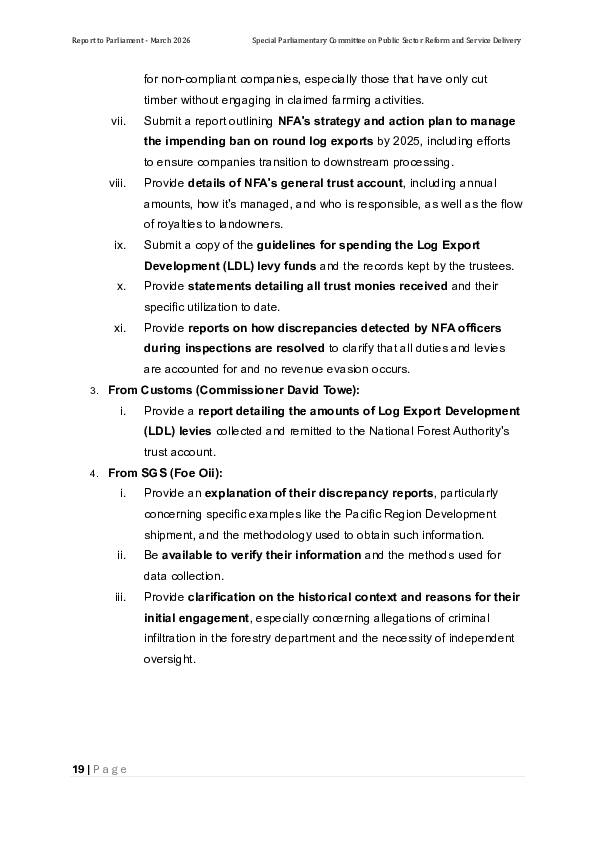
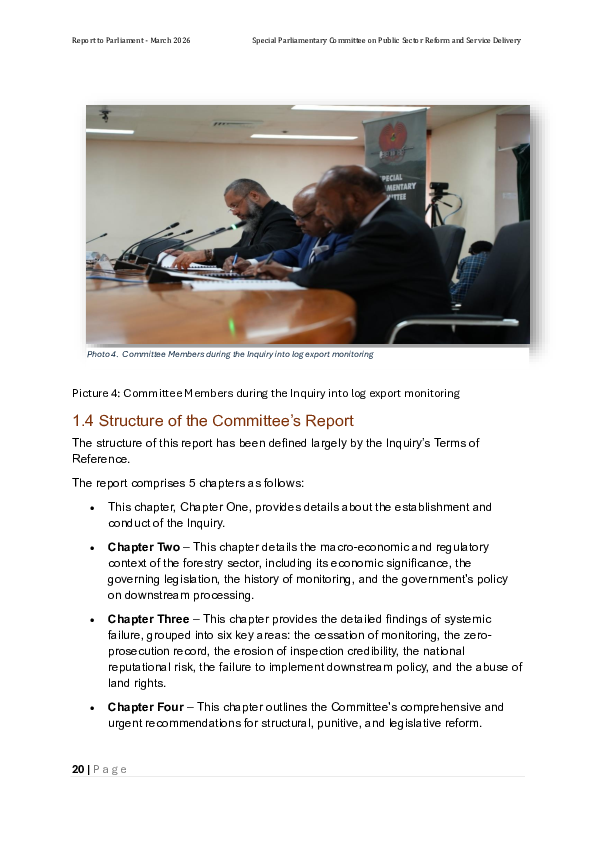
    Photo 4. Committee Members during the Inquiry into log export monitoring


Picture 4: Committee Members during the Inquiry into log export monitoring

1.4 Structure of the Committee’s Report
The structure of this report has been defined largely by the Inquiry’s Terms of
Reference.

The report comprises 5 chapters as follows:

    •    This chapter, Chapter One, provides details about the establishment and
         conduct of the Inquiry.

    •    Chapter Two – This chapter details the macro-economic and regulatory
         context of the forestry sector, including its economic significance, the
         governing legislation, the history of monitoring, and the government's policy
         on downstream processing.

    •    Chapter Three – This chapter provides the detailed findings of systemic
         failure, grouped into six key areas: the cessation of monitoring, the zero-
         prosecution record, the erosion of inspection credibility, the national
         reputational risk, the failure to implement downstream policy, and the abuse of
         land rights.

    •    Chapter Four – This chapter outlines the Committee's comprehensive and
         urgent recommendations for structural, punitive, and legislative reform.


20 | P a g e
Report to Parliament - March 2026            Special Parliamentary Committee on Public Sector Reform and Service Delivery


    •    Chapter Five - This chapter serves as the conclusion, summarising the
         severity of the crisis and issuing a final call to action.


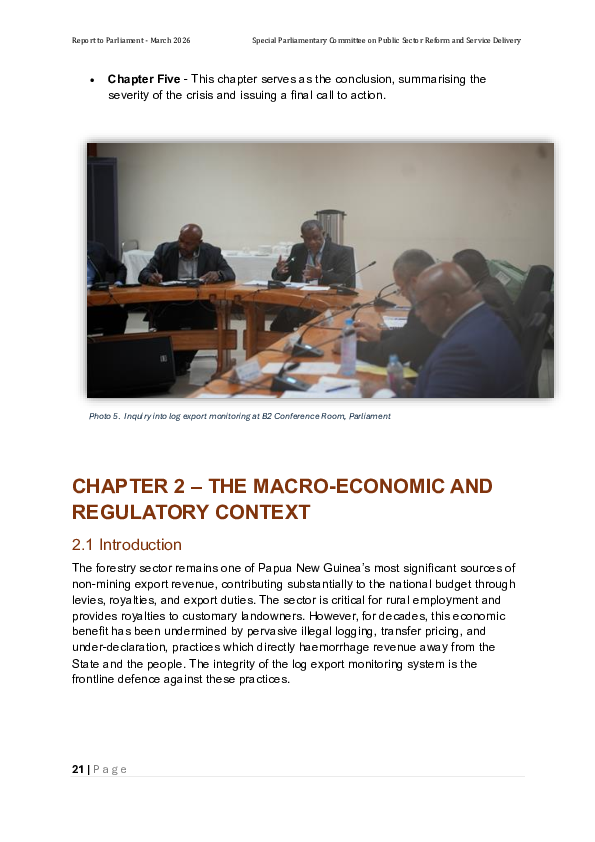
    Photo 5. Inquiry into log export monitoring at B2 Conference Room, Parliament


CHAPTER 2 – THE MACRO-ECONOMIC AND
REGULATORY CONTEXT
2.1 Introduction
The forestry sector remains one of Papua New Guinea’s most significant sources of
non-mining export revenue, contributing substantially to the national budget through
levies, royalties, and export duties. The sector is critical for rural employment and
provides royalties to customary landowners. However, for decades, this economic
benefit has been undermined by pervasive illegal logging, transfer pricing, and
under-declaration, practices which directly haemorrhage revenue away from the
State and the people. The integrity of the log export monitoring system is the
frontline defence against these practices.


21 | P a g e
Report to Parliament - March 2026   Special Parliamentary Committee on Public Sector Reform and Service Delivery


2.2 The Regulatory Framework: PNG Forestry Act 1991 and
Associated Legislation
The sector is primarily governed by the PNG Forestry Act 1991, which established
the PNG Forest Authority (PNGFA) to manage the sustainable use of forest
resources. While the Act provides a robust framework for licensing, management,
and enforcement, the Inquiry found that the application of discretionary powers within
the Act, combined with weak regulatory oversight, has consistently been exploited to
facilitate non-compliant and illegal logging operations. Loopholes related to Forest
Clearing Authorities (FCAs) further weaken the sustainable management mandate.

2.3 Historical Overview of Export Monitoring and Surveillance
(1993–2024)
Since 1993, the PNG Government has engaged independent, world-class inspection
firms, culminating in the contract with SGS, to monitor and verify all round log
exports. This pre-shipment inspection mechanism was put in place specifically
because internal PNGFA and Customs checks were deemed incapable of preventing
massive revenue evasion. The consistent finding of these independent reports over
30 years—that systemic under-declaration is endemic—underscores the failure of
the State to transition from dependency on external monitoring to building credible
internal capacity.

2.4 The Policy Pivot: Government Intent to Ban Round Log
Exports by 2025
The Marape-Rosso Government announced a policy to ban all round log exports by
2025 to compel the industry to transition to downstream processing, thereby
capturing greater value-added revenue and creating more local job. While
commendable, the Inquiry found that this ambitious policy is compromised by a
severe lack of planning, infrastructure development, and failure to enforce a phased-
out approach, making the 2025 deadline increasingly unachievable and creating
regulatory uncertainty.


22 | P a g e
Report to Parliament - March 2026            Special Parliamentary Committee on Public Sector Reform and Service Delivery


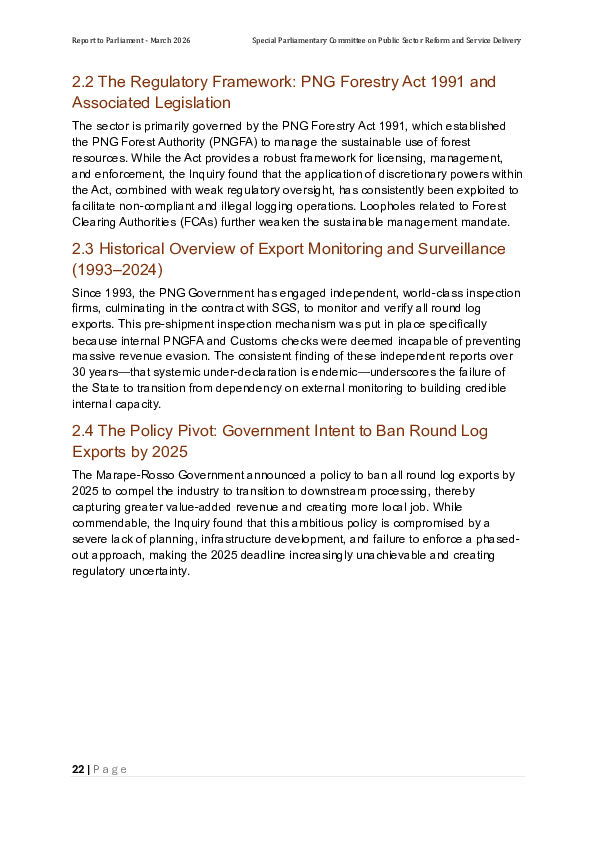
     Photo 6. Inquiry into log export monitoring at B2 Conference Room, Parliament


CHAPTER 3 – DETAILED FINDINGS OF
SYSTEMIC FAILURE

3.1 FINDING 1: CESSATION OF INDEPENDENT
MONITORING (REVENUE VACUUM)
The termination of the SGS contract on March 12, 2024, was not a strategic decision
but a predictable and catastrophic failure of financial governance and basic
administrative incompetence.

    •    3.1.1 Gross Financial Negligence and Quantum of Arrears: The
         Committee confirms that the accumulated debt owed to SGS was
         approximately K15 million. Internal documents also cite a figure of K12.5
         million owed over six years, which confirms the long-term, structural nature of
         the financial negligence and administrative incompetence. This figure
         represents two years' worth of contract fees that the State through PNGFA
         refused to pay, despite the service protecting annual revenues of hundreds of
         millions of Kina. The Committee finds this financial negligence and
         administrative incompetence to be unconscionable.
    •    3.1.2 The Apparent Failure of Treasury

        Testimony indicated that the Treasury, which centralises revenue, contributed
        to the delay in the ability of the PNGFA to secure funding for the monitoring
23 | P a g e
Report to Parliament - March 2026      Special Parliamentary Committee on Public Sector Reform and Service Delivery


         service. The Committee finds that the Department of Treasury failed to
         recognise the monitoring fee as a critical, revenue-protective cost rather than
         a discretionary operational expense. This contributed to delays in the release
         of funds from treasury to enable PNGFA to service its contract with SGS.
    •    3.1.3 The Unmonitored Period and Quantifiable Financial Exposure

         The cessation of SGS’s services created an unmonitored period of over 14
         months (or 18 months, as referenced in internal notes, by the time of the full
         inquiry), during which the State had zero independent assurance regarding
         log exports. This period represents an explicit, quantifiable financial exposure
         that could have resulted in:

              o    Systematic Undervaluation: Misdeclaration of the Free On Board (FOB)
                   price.

              o    Species Switching: Trading high-value species (e.g., Kwila) declared as
                   low-value species to evade duty.
              o    Volume Theft: Manipulating log scaling measurements to reduce
                   declared volume.

The Committee accepts the preliminary findings in the submitted reports that this
service protected an estimated 5% to 15% of annual export value, confirming the
service’s high return on investment.

3.2 FINDING 2: LACK OF PENALTIES AND ZERO
PROSECUTION
The inquiry has revealed that the forestry sector is defined by a culture of absolute
impunity and zero state agency deterrence, where corporate economic fraud is
treated as a minor administrative infraction.

    •    3.2.1 The Zero Prosecution Record (30 Years of Impunity): Despite nearly
         30 years of independent monitoring providing detailed reports of consistent,
         fraudulent discrepancies that constitute economic crime, the Committee
         confirms that not a single prosecution has occurred against logging
         companies or their directors. This failure spans multiple governments and
         administrations. This persistent institutional paralysis guarantees that logging
         companies view non-compliance and tax evasion as a low-risk, high-reward
         business model.
    •    3.2.2 The Nature of the Enforcement Failure: State agencies—including the
         PNGFA, PNG Customs Service, and the Internal Revenue Commission
         (IRC)—have collectively failed to translate irrefutable evidence provided by
         SGS into legally robust criminal or civil proceedings. The response to fraud


24 | P a g e
Report to Parliament - March 2026    Special Parliamentary Committee on Public Sector Reform and Service Delivery


         has consistently been limited to merely collecting the differential duty, thereby
         legalising the attempted fraud post-facto.

    •    3.2.3 Abuse of the Discretionary Powers: The systemic failure is
         compounded by the abuse of discretionary powers within the PNGFA, often
         influenced by political figures, to shield known non-compliant companies from
         penalties and license cancellations. This corruption is enabled by a legislative
         framework that concentrates undue approval authority in political hands. The
         bottom line is that a handful of City Slikers from Waigani and foreign logging
         companies continue to win. While the land owners and the nation of PNG at
         large continue to lose.


3.3 FINDING 3: UNACCEPTABLE EROSION OF INSPECTION
CREDIBILITY
The Committee dismisses the PNGFA’s assertion that its internal mechanisms can
compensate for the loss of independent monitoring as untenable and structurally
unsound. It is evident that PNGFA has neither the technology, work processes or
competent and uncompromised staff to implement the function of monitoring and
reporting of the export of round logs to the international standard established by
SGS.

    •    3.3.1 Loss of Technical System and International Standards: As noted in
         the hearing transcripts, PNGFA lacks the sophisticated technical system and
         international credibility that SGS provided. This includes access to global
         market price databases necessary to verify FOB values (transfer pricing risk),
         advanced log scaling technology, and adherence to internationally verifiable
         chain-of-custody standards.
    •    3.3.2 The Fundamental Flaw of Self-Policing: The current reliance on
         internal PNGFA officers constitutes self-policing. This mechanism is inherently
         vulnerable to corruption, lacks the necessary political independence, and
         cannot provide the necessary assurance to international trade partners or to
         the national government. This is a direct reversion to the highly corrupt
         practices that necessitated the Barnett Inquiry reforms.

    •    3.3.3 Abrogation of Inter-Agency Reporting: The cessation of the SGS
         contract immediately terminated the mandatory, comprehensive, and
         consistent flow of log export and discrepancy data to PNG Customs and the
         IRC. The PNGFA has failed to restore this transparent reporting mechanism,
         leading to critical information silos that make cross-agency fraud detection
         virtually impossible.


25 | P a g e
Report to Parliament - March 2026       Special Parliamentary Committee on Public Sector Reform and Service Delivery


3.4 FINDING 4: NATIONAL REPUTATION AND 'GREY LIST'
RISK
The failure to maintain independent anti-corruption safeguards carries severe, non-
negotiable international consequences that will impact the entire national economy
and contribute to the threat of PNG being grey-listed. It is apparent that PNGFA,
PNG Customs and IRC all appear to be oblivious to the strong positive correlation to
their combined lack of enforcement and prosecution is contributing towards the
country being grey listed.
    •    3.4.1 Dismantling Anti Money Laundering /Counter Terrorist Financing
         Safeguards: Independent pre-shipment inspection is recognized
         internationally as a vital Anti-Money Laundering and Counter-Terrorist
         Financing (AML/CTF) safeguard, certifying the legitimacy of trade flows. The
         removal of this safeguard signals to the international community that Papua
         New Guinea’s trade sector is open to illicit financial flows.

    •    3.4.2 Direct Threat of FATF ‘Grey Listing’: The Committee finds that the
         documented failure to maintain this critical safeguard is contributing to placing
         Papua New Guinea at high risk of being formally designated a 'High-Risk
         Jurisdiction' (Grey List) by the Financial Action Task Force (FATF). Such a
         designation would immediately:

              o    Increase the cost of all international banking transactions.

              o    Deter reputable Foreign Direct Investment (FDI).

              o    Increase the Sovereign Risk Premium, raising the cost of government
                   borrowing.

3.5 FINDING 5: CONTEMPTIBLE FAILURE TO IMPLEMENT
DOWNSTREAM POLICY
The conduct of logging companies and the lack of enforcement by the PNGFA
demonstrate a collective contempt for the government's policy to ban round log
exports by 2025 and encourage domestic value addition.
    •    3.5.1 Lack of Transition and Investment: Despite the clear directive and a
         three-year transition window (2022-2025), logging companies have
         demonstrated a profound and deliberate failure to invest in sawmilling, veneer,
         or furniture manufacturing infrastructure. Their continued operations are
         purely focused on high-volume, low-value extraction of raw material.

    •    3.5.2 Betrayal of Socio-Economic Objectives: The failure to enforce the
         round log ban and implement downstream processing sacrifices national
         employment (where processing creates up to ten times more jobs per cubic
         metre than raw export), forgoes higher corporate and payroll tax revenues,
26 | P a g e
Report to Parliament - March 2026   Special Parliamentary Committee on Public Sector Reform and Service Delivery


         and condemns the nation to perpetual raw resource dependency.
         Furthermore, the countries that are importing our round logs are converting
         the round logs through downstream processing to manufactured products that
         are then exported from their countries to the Americas and Europe. PNG
         misses out of all these potential revenues. The PNGFA MD’s testimony
         regarding the social projects (roads, bridges, etc.) built by companies, while
         noted, does not negate the core policy failure to transition the industry.

3.6 FINDING 6: PERVASIVE ABUSE OF LAND RIGHTS
The Committee finds that the systemic lack of oversight enables the continued,
widespread abuse of customary land rights and wilful breaches of lawful contracts.

    •    3.6.1 Illegitimate Use of Permits Forest Clearing Authorities: Large-scale
         logging is often concealed under the pretext of Forest Clearing Authorities
         (FCAs), which were intended for agriculture. This is a mechanism to bypass
         legitimate forestry permitting and environmental regulations and warrants
         close scrutiny by enforcement agencies. However, this does not appear to be
         the case.

    •    3.6.2 Lack of Free, Prior, and Informed Consent (FPIC): The logging
         operations frequently proceed without the free, prior, and informed consent
         (FPIC) of the customary landowners, violating their constitutional rights and
         depriving them of equitable benefits and control over their traditional
         resources. This practice is perpetuated by opaque permitting and a lack of
         transparency in the consent verification process.

    •    3.6.3 Possible Breach of Lawful Contracts: Where agreements are in
         place. Landowners often complain that the logging companies do not fulfil
         their agreed terms by constructing schools and or health facilities. Once
         again. This practice is perpetuated by opaque permitting and a lack of
         transparency in the consent verification process.


27 | P a g e
Report to Parliament - March 2026   Special Parliamentary Committee on Public Sector Reform and Service Delivery


CHAPTER 4 – COMPREHENSIVE
RECOMMENDATIONS AND LEGISLATIVE
REFORM
4.1 INTRODUCTION
The Committee demands the immediate, non-negotiable implementation of the
following structural, punitive, and legislative reforms.

4.2 RECOMMENDATION 1: RE-ENGAGE INDEPENDENT
MONITORING IMMEDIATELY WITH RING-FENCED
FUNDING
    •    4.2.1 Emergency Contract Restoration and Due Diligence: It is
         recommended that the NEC resolves to instruct the Department of Treasury
         and PNGFA to finalise a contract with SGS or an internationally accredited
         equivalent within 60 days. Prior to signing, the Department of Treasury is
         mandated to conduct an urgent, independent analysis to quantify the total
         financial exposure during the unmonitored period (as referenced in internal
         notes) and confirm the high return on investment of the SGS service.

    •    4.2.2 Legislative Amendment for Payment Pathway Protection (Ring-
         Fencing): It is recommended that the NEC resolve to instruct the Minister for
         Treasury and Minister for Forestry to introduce an immediate amendment to
         their respective relevant legislation to establish a legally binding, non-
         discretionary, ring-fenced payment pathway for SGS’s payments. The
         monitoring fee shall be deemed a mandatory first charge on all forestry
         revenues, deposited into an independently managed Trust Account to ensure
         zero risk of future arrears.

    •    4.2.3 Temporary Legislative Amendment for Payment Pathway via Tax
         Credit for Mining, Oil and Gas Companies. It is recommended that the NEC
         resolve to explore the merits of temporary Legislative amendments to be in
         place while recommendation 4.2.2 is being implemented. This is for Payments
         to SGS for the monitoring and reporting of round log exports to be accepted
         as under the Tax Credit for companies that currently qualify for the Tax Credit
         Scheme projects.


28 | P a g e
Report to Parliament - March 2026    Special Parliamentary Committee on Public Sector Reform and Service Delivery


4.3 RECOMMENDATION 2: CONDUCT A COMPREHENSIVE
FORENSIC AUDIT AND RECOVERY MANDATE
    •    4.3.1 Scope and Mandate of the Forensic Audit: The NEC must
         commission a Detailed Forensic Audit by an international firm managed
         through an interagency Task Force, spanning the period from January 1,
         2015, to the present. The audit's terms of reference shall spell out the sole
         purpose to precisely quantify and provide legally admissible evidence for the
         criminal and civil recovery of all lost revenue and evaded duty from
         misdeclaration and transfer pricing.

    •    4.3.2 Establishment of the Forestry Revenue Recovery Task Force: A
         Forestry Revenue Recovery Task Force must be established through NEC,
         comprising experts from the Department of Justice, the Office of the Attorney-
         General, PNG Customs, and the IRC. This Task Force shall be granted the
         necessary powers and resources to immediately pursue criminal prosecution,
         asset freezing, and forfeiture against companies and individuals identified in
         the audit.

4.4 RECOMMENDATION 3: IMPOSE PUNITIVE PENALTIES
AND CANCEL LICENSES
    •    4.4.1 Introduction of Mandatory Criminal and Administrative Penalties: It
         is recommended that the PNGFA Act be amended to redefine any significant
         misdeclaration (volume or species) as Prima Facie Evidence of Attempted
         Fraud, triggering automatic investigation. It is recommended that the NEC
         resolve to direct the PNGFA to immediately impose punitive financial
         sanctions (three times the evaded revenue) and mandatory license
         cancellation/asset forfeiture for habitual non-compliance. This must go beyond
         mere payment of the differential duty.
    •    4.4.2 Implementation of Penalties and Deterrents: It is recommended that
         the National Executive Council resolve to direct the PNGFA, PNG Customs,
         and IRC to immediately conduct investigations and impose a robust system of
         punitive financial penalties and sanctions, including license suspensions, for
         habitual discrepancies and non-compliance in log declaration, thereby
         establishing a genuine legal deterrent that goes beyond mere payment of
         duty.

4.5 RECOMMENDATION 4: MANDATORY SYSTEMIC
REDESIGN TO ELIMINATE POLITICAL INTERFERENCE
    •    4.5.1 Removal of Ministerial Discretion: It is recommended that the NEC
         amend the PNGFA Act to remove the Minister for Forests as the approving
         authority for log export permits, licenses, or exemptions. This authority must
29 | P a g e
Report to Parliament - March 2026   Special Parliamentary Committee on Public Sector Reform and Service Delivery


         be formally transferred to the PNGFA Board, operating under strict, publicly
         verifiable, and objective legislative criteria, eliminating potential for
         discretionary political abuse.

    •    4.5.2 Digital Register and Transparency Protocol: It is recommended that
         the NEC resolve that a publicly accessible digital real time register of log
         exporters and their volumes shipped to date, against budget and the revenue
         generated from these exports. This register is to show actual discrepancies of
         logs exported.

    •    4.5.3 Timely Sharing of Information It is recommended that the PNGFA
         must immediately restore the provision of comprehensive, monthly log
         inspection and discrepancy reports to the Customs Service, the IRC, and the
         Department of Treasury to ensure transparent accountability and data integrity
         across government agencies.

4.6 RECOMMENDATION 5: ENFORCE DOWNSTREAM
PROCESSING POLICY AND LAND RIGHTS
    •    4.6.1 Review and Rectification of FCA Abuse: It is recommended that the
         NEC resolve to direct the Minister for Lands and the Minister for Forestry and
         PNGFA to launch an immediate joint review of all logging operations currently
         being conducted under FCAs. This review must specifically verify the
         legitimacy of the underlying land title and the existence of free, prior, and
         informed consent from the customary landowners. Where logging is found to
         have occurred without legitimate consent, the corresponding logging permit
         must be immediately revoked, and the company involved must be subject to
         the punitive measures outlined in Recommendation 3.

    •    4.6.2 Policy Enforcement and License Cancellation: It is recommended
         that the NEC amend relevant legislation as required that enable the PNGFA
         Board to immediately cancel the licenses of companies that have been proven
         to have defrauded the state or have breached their lawful agreements with
         landowners or have to establish an agriculture business or have failed to
         demonstrate substantial and verifiable investment in downstream processing
         infrastructure by the final deadline of December 31, 2025. No exceptions or
         extensions should be granted.

    •    4.6.3 Review of Past Inquiry Recommendations: It is recommended that, to
         address the systemic issues plaguing the forestry sector, the PNGFA is
         directed to present a comprehensive status report to Parliament on the
         implementation of all outstanding recommendations from the Tos Barnett
         Report and the SABL Report, with specific attention to actions taken against
         identified bad actors


30 | P a g e
Report to Parliament - March 2026            Special Parliamentary Committee on Public Sector Reform and Service Delivery


CHAPTER 5 – CONCLUSION
The findings presented in this report constitute a national crisis, born from
institutional timidity and financial recklessness. The cessation of independent log
export monitoring is a symptom of a deeper malaise: a systemic failure to protect the
national interest against calculated exploitation by foreign entities that operate with
absolute impunity.

The Committee's recommendations are a prescription for emergency reform. They
require not merely administrative change, but a fundamental shift in political and
bureaucratic will and judicial courage to dismantle the structures that facilitate this
endemic corruption.
This Parliament is now presented with a clear choice: to endorse these punitive and
structural reforms to protect the national wealth, or to condemn the State to
perpetual revenue haemorrhage and international disgrace.

The time for further inquiries is over; the time for resolute action is now.


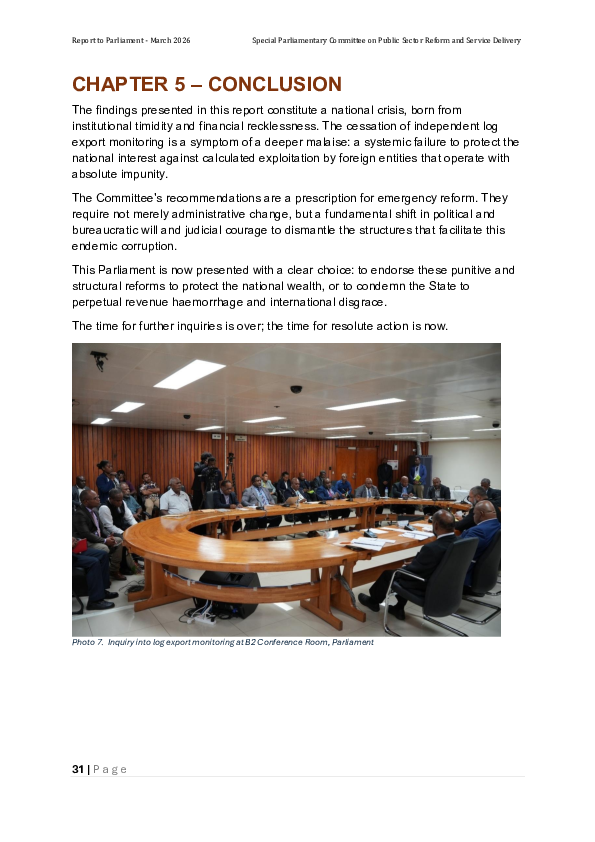
Photo 7. Inquiry into log export monitoring at B2 Conference Room, Parliament


31 | P a g e
Report to Parliament - March 2026    Special Parliamentary Committee on Public Sector Reform and Service Delivery


ANNEXES
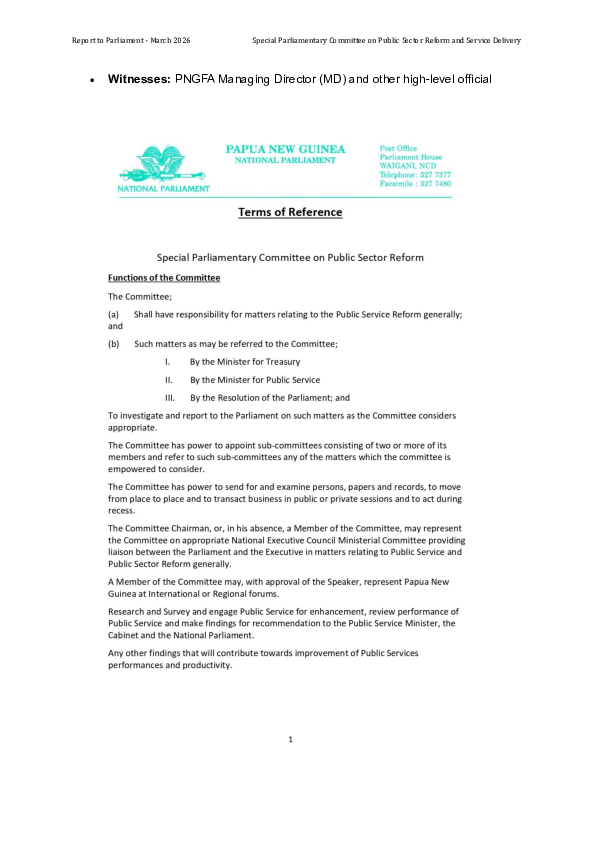
A.1 COMMITTEE TERMS OF REFERENCE
The Committee's mandate and scope serve as the Terms of Reference for this
Inquiry.

Committee Mandate and Legislative Authority

The Special Parliamentary Committee on Public Sector Reform and Service Delivery
(SPCPSR) is established under the authority of the Papua New Guinea National
Parliament to investigate systemic failures within the public sector that impede
national development, erode public trust, and compromise national revenue.

The current inquiry was initiated in response to the abrupt cessation of the
independent pre-shipment inspection and monitoring service for all round log
exports, a service critical to the protection of state revenue and the integrity of PNG’s
forest resources. The Committee's legislative authority empowers it to summon
witnesses, demand the production of documents, and formulate binding
recommendations to the Parliament and the National Executive Council (NEC).

Scope of the Inquiry: Log Export Monitoring and Downstream Processing

The inquiry focused primarily on two interconnected areas:

    1. The Termination of Independent Monitoring: Investigating the
       administrative, financial, and institutional failures that led to the cessation of
       the monitoring contract with SGS PNG Ltd., and assessing the risks and
       actual losses incurred during the subsequent unmonitored period.

    2. The Policy on Downstream Processing: Examining the government’s
       stated intent to ban round log exports by 2025 and the current challenges in
       transitioning the sector towards a sustainable, value-added downstream
       processing industry.

A.2 COMMITTEE PUBLIC HEARING SCHEDULE
Hearing No. 1: May 29, 2025

    •    Hearing Transcript

    •    Witnesses: Representatives from SGS PNG Ltd., the Department of
         Treasury, and the PNG Forest Authority (PNGFA).

Hearing No. 2: August 6, 2025

    •    Hearing Transcript


32 | P a g e
Report to Parliament - March 2026   Special Parliamentary Committee on Public Sector Reform and Service Delivery


    •    Witnesses: PNGFA Managing Director (MD) and other high-level official


33 | P a g e
Report to Parliament - March 2026   Special Parliamentary Committee on Public Sector Reform and Service Delivery


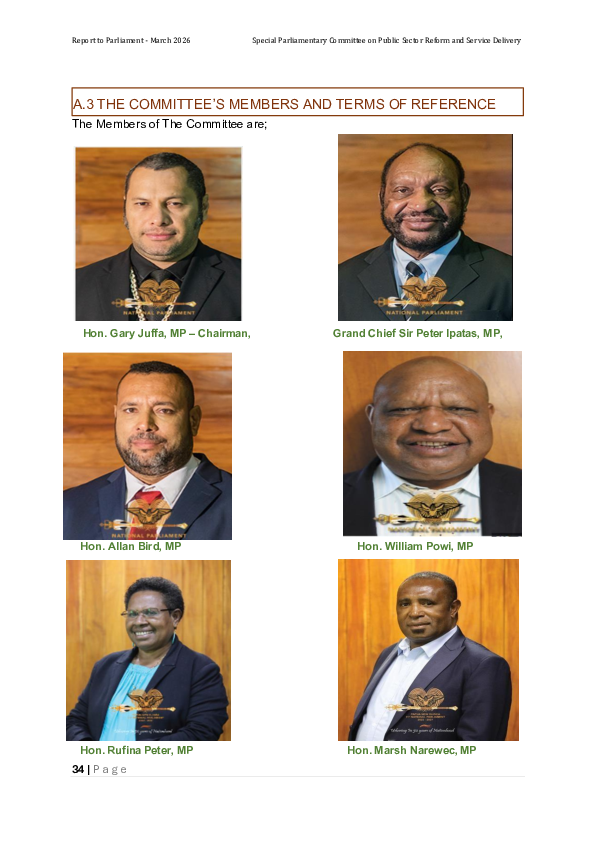
A.3 THE COMMITTEE’S MEMBERS AND TERMS OF REFERENCE
The Members of The Committee are;


  Hon. Gary Juffa, MP – Chairman,                         Grand Chief Sir Peter Ipatas, MP,


  Hon. Allan Bird, MP                                            Hon. William Powi, MP


  Hon. Rufina Peter, MP                                       Hon. Marsh Narewec, MP
34 | P a g e
Report to Parliament - March 2026   Special Parliamentary Committee on Public Sector Reform and Service Delivery


A. 4 LOG EXPORT INQUIRY - HEARING 1 TRANSCRIPT
Date: 6 th August, 2025
Time:
Venue: Parliament House, B2 Conference Room

00;00;40 – 00;01;30
Gary Juffa
Please be seated
[inaudible]


00;01;30 – 00;02;08
Gary Juffa
Right. Thank you all for coming to the this particular inquiry. It is the inquiry carried
out by the Special Parliamentary Committee on Public Sector Reforms. And just to
introduce members of the committee, I have on my left Governor Rufina Peter of the
Central Province and on my right the member for Wau-Waria, the Honorable Marsh
Narewec, who himself is also a chairman of a parliamentary committee on ICT. Am I
correct?


Marsh Narewec
Yep


00;02;08 – 00;03;06
Gary Juffa
Yep. So, this particular inquiry, the format will be quite simple in that we have asked
three departments to come today, the Treasury Department, the PNG Forest
Services or PNG Forest Authority, my apologies, and SGS. And it’s in regards to a
specific area that we are probing into, wanting to seek answers about, and this is to
do with the inspection of round logs or inspection of all log exports from Papua New
Guinea. And we've come to the notice of the committee that the inspection services
that used to be carried out by SGS has come to an end or has been terminated or
has ceased for some time. So we would like to know why that has happened and
what's happening in this regards.


00;03;06 – 00;04;28

35 | P a g e
Report to Parliament - March 2026   Special Parliamentary Committee on Public Sector Reform and Service Delivery


Gary Juffa
We would also like to hear from the Forestry Department as to any plans they have
in regards to a statement made by the Government whereby it was determined or it
was proposed that round log exports would end in 2025. So we want to hear from
the forest services how they prepared for this or what they're doing in this regards to
comply with this particular directive and we would also like to hear from the Treasury
as well as SGS, their views, some thoughts on that. So thank you all for coming.
Thank you Media. Again, this is a you know, this is an inquiry to find some answers
and look at ways where we can work together to improve systems of government
that we feel need attention in regards to this particular subject matter. So without
further ado, I will commence, perhaps, team. Okay. If we could have everyone turn
off their phones or put them on silent, I mean, you can’t turn them off, but put them
on silent.


00;04;28 – 00;05;20
Gary Juffa
I also want to point out that we've received a note from the managing director for
forestry, Mr. Mosoro who is unable to attend today because for medical reasons and
he has asked for deferral of appearance and we take note of that. And in the future
we will inform the PNG Forest Authority as to exactly when we can have the when he
when he has recovered. He is also attached his medical certificate and it's here. I will
hand that over to the Secretariat and it's noted and accepted and in his stead he has
sent his Director for legal services, I believe, and the rest of his team. So who is the
Director for Legal Services? That's yourself?


00;05;20 – 00;05;26
Magdalene Maihua
No, I’m the Chief Operating Officer


Gary Juffa
Oh, you’re the Chief Operating Officer, my apologies. Is the director for Legal
services here?


00;05;26 – 00;05;32
Magdalene Maihua
He's supposed to be here, but he is, he had the Supreme Court case


36 | P a g e
Report to Parliament - March 2026   Special Parliamentary Committee on Public Sector Reform and Service Delivery


Gary Juffa
Oh, he’s got a court matter?


Magdalene Maihua
Yes, yeah


00;05;32 – 00;05;47
Gary Juffa
Okay, Well, that's a very important matter, too. So we'll also accept his apologies for
this. We also have here, Andrew Oaeke, like the secretary for Treasury, am I
correct?


Andrew Oaeke
Yes


Gary Juffa
Secretary, did you come with anybody else?


00;05;47 – 00;05;53
Andrew Oaeke
I'm here with the First Assistant Secretary, Budget Division, Mr. Hans Magis,


00;05;53 – 00;06;11
Gary Juffa
Okay. Thanks. Welcome, Hans. And we have from SGS. Mr. Sir, I


Foe Oii
Foe. Foe


Gary Juffa
Foe Oii. It's a very easy name to remember. I’m guessing you’re from Gulf.


37 | P a g e
Report to Parliament - March 2026   Special Parliamentary Committee on Public Sector Reform and Service Delivery


Foe Oii
Yes


00;06;11 – 00;07;05
Gary Juffa
All right. So Mr. Foe Oii from SGS is also here. And the way the format works is
there's a series of questions that we have based on this particular inquiry. We will get
straight to it and I will ask some of the questions and then I will have my two co-
members here if they have any questions that they wish to ask, they may at any time
intervene and do so. Okay. So the basic story here is SGS used to inspect our logs
or all log exports, leaving our country for the last 30 years, quite a long time, but their
services were terminated recently. Mr. Foe, can you advice us when your services
were, came to an end, when you stopped inspecting all ships leaving our shores?


00;07;05 – 00;07;44
Foe Oii
Chairman, the services, we provided notice as required under the contract. The log
export monitoring surveillance contract between the state and SGS, and forest
authority are the regulatory agency. It was brought to an end when we exercise our
right on the 12th on the 12th of March 2024 and took it to arbritration.


00;07;44 – 00;07;57
Gary Juffa
Please repeat those dates again. 12th of March, did you say?


00;07;57 – 00;08;19
Foe Oii
12th of March


Rufina Peter
2024


Foe Oii
We gave notice of our intention

38 | P a g e
Report to Parliament - March 2026   Special Parliamentary Committee on Public Sector Reform and Service Delivery


Gary Juffa
To cease?


Foe Oii
Yes, to stop due to a financial distress of a large amount of money that the Forest
Authority and the state owed SGS for services already rendered.


00;08;19 – 00;08;26
Gary Juffa
So it came to an end because you were not being paid your bills essentially?


00;08;26 – 00;08;30
Foe Oii
Absolutely.


00;08;30 – 00;08;33
Gary Juffa
How long were these bills not paid for


00;08;33 – 00;09;06
Foe Oii
This goes back to about six years. It accumulated over six years, but got to a point
where it reached almost 12 and a half million Kina. So we chose to stop providing
the service and ask the authority to seek funds to pay us for the services that were
already rendered.


00;09;06 – 00;09;14
Gary Juffa
Mr Oii, the services that SGS provided, could you explain them? What were the
specific services?


00;09;14 – 00;09;29
39 | P a g e
Report to Parliament - March 2026   Special Parliamentary Committee on Public Sector Reform and Service Delivery


Foe Oii
The specific services are monitoring of round log exports by volume and species and
the equivalent of it in foreign exchange earnings on behalf of the state.


00;09;29 – 00;09;34
Gary Juffa
So monitoring of round log exports by volume and species?


Foe Oii
Yes.


00;09;34 – 00;09;42
Gary Juffa
And you carried out the services for how long?


00;09;42 – 00;09;58
Foe Oii
We started back in July of 1994, so we'd almost been 30 years providing the service.


00;09;58 – 00;10;10
Gary Juffa
Okay. And Mr. Foe, can you explain how SGS came about getting engage or being
engaged by the state for these services?


00;10;10 – 00;10;42
Foe Oii
The services of SGS was engaged as an outcome of the Barnett inquiry in 1994,
where the state sought an independent, notable, global organization to provide a
monitoring service for all its round log exports due to the abuse of systems and
services in the forest authorities.


00;10;42 – 00;11;01
Rufina Peter
40 | P a g e
Report to Parliament - March 2026   Special Parliamentary Committee on Public Sector Reform and Service Delivery


So did you say it was 12th of March 2024 that you gave notice to


Foe Oii
Yes


Rufina Peter
Okay. And that you have because you had 12 million, approximately 12 million
outstanding


Foe Oii
12 and a half million


Rufina Peter
in outstanding bills


00;11;01 – 00;11;12
Foe Oii
For services rendered.


Rufina Peter
Okay. So how much a year was the average cost, average contract cost


00;11;12 – 00;11;26
Foe Oii
The average contract cost is in the vicinity of about 6 and a half to 8 million,
depending on the cost of CPI increases in that largely due to that


00;11;26 – 00;11;38
Rufina Peter
Is that an annual cost? Annual average cost?


Foe Oii
41 | P a g e
Report to Parliament - March 2026   Special Parliamentary Committee on Public Sector Reform and Service Delivery


Basically annual


Rufina Peter
Okay, about 6 million.


Foe Oii
And over time it had grown


00;11;38 – 00;11;48
Rufina Peter
About 6 million average cost. So if you are 12.5 million in outstanding, that would be
like approximately two years cost?


00;11;48 – 00;11;50
Foe Oii
Yeah, basically yeah.


00;11;50 – 00;12;18
Rufina Peter
Out of the out of the 29 years you've been in operation?


Foe Oii
Yeah. But this cost accumulated because of underfunding over time


Gary Juffa
Underfunding or you mean payment of your services?


Foe Oii
Payment of our services, the costs of providing the service increases because the
government funds were not made readily available for us to be paid for our services,
over time.


42 | P a g e
Report to Parliament - March 2026   Special Parliamentary Committee on Public Sector Reform and Service Delivery


00;12;18 – 00;12;40
Gary Juffa
Mr. Foe, so your services were provided and then you would be paid after like you
wouldn't perform your services before being paid, after being paid, you’d perform
them as the shipments were going out? That was the contract arrangement?


00;12;40 – 00;13;12
Foe Oii
The ongoing arrangement under the contract was that we would be required to
provide on a fortnightly basis a replenishment record of what we'd spend to carry out
the services.


Rufina Peter
Okay


Foe Oii
Replenishments were provided every fortnight, fortnightly basis. So in a month you
get two replenishment and that we provide to the Forest Authority so they can
replenish the account, so we can go on for the purpose of relationships.


00;13;12 – 00;13;25
Rufina Peter
So when you say the average cost was 6 million, that's including all of the activities
you had to do, plus your payment for the service you provided?


00;13;25 – 00;13;34
Foe Oii
Yes.


Rufina Peter
Okay. So of that 6 million, how much was, what proportion of that was your payment
for the services?


00;13;34 – 00;14;07
43 | P a g e
Report to Parliament - March 2026   Special Parliamentary Committee on Public Sector Reform and Service Delivery


Foe Oii
The actual margins that we applied under the contract would be payable at the end
of each year. The margins would be applied, but the cost, the contract was set up in
a way, it was a cost plus contract, for example, if we paid K100 for something we did,
we'd charge the government or the Forest Authority another 20% for providing the
service. It’s a cost plus contract, okay.


00;14;07 – 00;14;25
Gary Juffa
Cost plus contract. Mr. Foe, could you get a copy of the contract for us and hand it in
to the team so that we can go through that contract some later date?


00;14;25 – 00;14;36
Rufina Peter
So in your experience, how much do you think you were saving the country by
providing those monitoring, surveillance services?


00;14;36 – 00;14;59
Foe Oii
It's best if we go back to and have a look at our annual reports and compare what
the state would outlay to a formal budgetary allocation and our returns on the basis
of inspection services and the value of it by way of returns from round log export


00;14;59 – 00;15;07
Gary Juffa
You would have copies of this, no doubt?


Foe Oii
We would have all the copies. The last report we did, chairman, was the end of
2023.


00;15;07 – 00;15;23
Gary Juffa
Thank you. Could we have copies of all the reports, the annual reports that you
44 | P a g e
Report to Parliament - March 2026   Special Parliamentary Committee on Public Sector Reform and Service Delivery


produced?


Foe Oii
Yes.


Gary Juffa
Okay. That also accompanying that contract to help us understand more.


00;15;29 – 00;15;47
Marsh Narewec
So SGS is a international company?


Foe Oii
SGS Papua New Guinea is a wholly owned subsidiary of SGS in Australia, which is
an affiliate of the Global group SGS Group, Society General de Surveillance, which
is a Swedish company.


00;15;47 – 00;15;55


Marsh Narewec
Okay. Society General Surveillance. Okay


Gary Juffa
Swiss company?


Foe Oii
Swiss company.


00;15;55 – 00;16;02
Marsh Narewec
So you operated across the world?


45 | P a g e
Report to Parliament - March 2026   Special Parliamentary Committee on Public Sector Reform and Service Delivery


Foe Oii
We are a global company.


00;16;02 – 00;16;13
Marsh Narewec
So when PNG Forest contracted you, how many operations or bases in PNG you
operate in?


00;16;13 – 00;16;35
Foe Oii
Our largest here is in the Forest Authority building. We’ve got little eoffices in West
New Britain because the volume of logs exported from West New Britain is high. We
also have another similar little office in Vanimo, given consideration volume of logs
that are exported from there. Everywhere else, it’s fly in, fly out.


00;16;35 – 00;16;47
Marsh Narewec
Oh okay. So when a ship is about to send log overseas, you go and monitor? Please
elaborate on what you do. I’m new to the industry so.


00;16;48 – 00;17;20
Foe Oii
There is a government procedure called the Procedures for Export of Round Logs.
The procedure was set up with three people in mind. The groups of people are the
state, the Papua New Guinea Forest Authority and the logging companies. And we
are the watchdog. The eyes and ears of the state. We’re engaged for that reason, to
check to see that everybody is doing the right thing, simply.


00;17;20 – 00;17;29
Marsh Narewec
Like exporting.


Foe Oii
Yes, the declaration is right, the scale measurements are right, the volumes of logs
46 | P a g e
Report to Parliament - March 2026   Special Parliamentary Committee on Public Sector Reform and Service Delivery


are right, the species of logs are right.


00;17;29 – 00;17;51
Marsh Narewec
Okay. So during your whatever service that you provide, you found some
irregularities.


Foe Oii
Yeah, everything we find, we report as a discrepancy and in each of those monthly
reports and annual reports, we detail all the discrepancies we discover in the course
of our inspection services.


00;17;51 – 00;18;50
Marsh Narewec
Okay, In the course of your service, have you been not being paid for, I mean, how
long has that issue of nonpayment of bills been going on?


00;18;50 – 00;18;22
Foe Oii
That's part of the service. Our cost is paid on the basis of the money we spend on
providing the state the service like we fly people everywhere, basically everyday.


Gary Juffa
Inspectors?


Foe Oii
Yes. If you want them in the Oro province, we put them on an airplane and send
them there.


00;18;22 – 00;18;29
Marsh Narewec
So who request the service? The Forest Authority request the service or it’s
something that you have to go in? Somebody invites you or

47 | P a g e
Report to Parliament - March 2026   Special Parliamentary Committee on Public Sector Reform and Service Delivery


00;18;29 – 00;18;56
Foe Oii
The procedures outline as to how it all starts.


Marsh Narewec
The contract.


Foe Oii
Yes. The procedures, the round log export procedures. If the forest authorities go
over, they provide the guidelines on how to do it. The exporter comes and notifies us
that they have a pending shipment. So we arranged for someone to go and inspect
the logs


00;18;56 – 00;19;06
Marsh Narewec
So the experts have to come to you?


Foe Oii
Yes


Marsh Narewec
You don't just go?


Foe Oii
No.


Marsh Narewec
What if the exporter doesn't come to you?


00;19;06 – 00;19;19
Foe Oii

48 | P a g e
Report to Parliament - March 2026   Special Parliamentary Committee on Public Sector Reform and Service Delivery


Well, that's yet another issue. But it's mandatory that all exporters, the industry
participants are required by the procedure to come and report to us of a pending log
shipment.


00;19;19 – 00;19;25
Marsh Narewec
But what if they don't? Who monitors the exporters if they don't come to you?


00;19;25 – 00;19;42
Foe Oii
Well, we have no other way of doing except that as industry participants, they are
required by the Forest Authority to report any pending shipment.


00;19;42 – 00;19;50
Does PNG Forest also come in and get you guys to go and do the inspection?


00;19;50 – 00;20;08
Foe Oii
When we go to the different inspection sites, there's already Forest Authority people
there, projects people


Marsh Narewec
Do they initiate you


Foe Oii
They don't initiate, the industry participants initiate. We take over on behalf of the
government.


00;20;08 – 00;20;57
Gary Juffa
I believe what happens is that for every shipment to be authorized for export, it
requires a SGS report. Am I correct?


49 | P a g e
Report to Parliament - March 2026   Special Parliamentary Committee on Public Sector Reform and Service Delivery


Foe Oii
Yes. Let me just go back and explain this. When an exporter wants to export round
logs, they first go to the Papua New Guinea Forest Authority and ask for a
endorsement. Ask for a price approval to sell logs at a prevailing market price. Once
that process starts, they also are required to notify us of when that ship is due and
where it's due so we can arrange to go and do that inspection on behalf of the State
and the Forest Authority.


00;20;57 – 00;21;25
Marsh Narewec
Okay. During an inspection, when you find those discrepancies, when you report
them, you don't bother following up whether they get penalized or fined or something


Foe Oii
That responsibility falls back on the Forest Authority.


Marsh Narewec
Not the government? You represent the state so, you say that you represent the
state, there is a forest authority, and there is the industry, I mean, loggers.


00;21;25 – 00;21;47
Foe Oii
I understand where you're coming from, but the law belongs to this state. Whatever
action they want to do to deal with, it’s actually upon them. We are a neutral party.
We're a neutral party, but we are reporting to the relevant regulatory authority that
there’s something that's wrong, something that's out of work.


00;21;47 – 00;21;52
Gary Juffa
Do they get back to you if they take action or they're not required to?


00;21;52 – 00;22;19
Foe Oii
They're not required to

50 | P a g e
Report to Parliament - March 2026   Special Parliamentary Committee on Public Sector Reform and Service Delivery


Gary Juffa
Okay, so your services end there?


Foe Oii
Yeah.


Gary Juffa
You conduct an inspection of a shipment of logs about to be made. You identify the
discrepancies, and then you inform the authority, and then your responsibility stops
there until the next inspection, etc


Foe Oii
Yeah. Taking of corrective action for any discrepancies found is the responsibility of
regulatory


Marsh Narewec
Which is the PNG Forest Authority


Foe Oii
Yes.


00;22;19 – 00;23;16
Rufina Peter
So maybe if we can ask PNGFA to clarify for us the process so we can understand,
get a better picture of the total process from start to finish.


Gary Juffa
I think we can do that, Governor, now that SGS has outlined where their
responsibilities starts and ends, then we could probably move into where forestry
starts and ends as well. I mean, theirs is continuous because they are the state.
SGS has a specific service that they provide. And if I may, the Mr. Oii, Mr. Oii is the
country manager. If you can please provide those reports of the, the annual reports
and you also have data, I would assume, on all shipments that you have inspected?
51 | P a g e
Report to Parliament - March 2026   Special Parliamentary Committee on Public Sector Reform and Service Delivery


00;23;16 – 00;23;20
Foe Oii
All shipments.


Gary Juffa
Would you have electronic copies of this data?


Foe Oii
Yes.


00;23;20 – 00;23;40
Gary Juffa
You would have electronic copies of this data. It would be very useful for us to have
a look at those electronic copies as well. So if you can gather all that data together
and then liaise with my secretariat, our secretariat here, so that we can transfer that
data and then we can have a look at it, that would be very, very good for us.


00;23;40 –
Foe Oii
Chair, can I ask you to give me a couple of minutes to especially explain the
inspection process for the sake of the


Gary Juffa
Yes, please, so we have an appreciation of what you do.


00;23;54 – 00;26;48
Foe Oii
The inspection process is undertaken in two phases. One, the exporter provides a
list of logs to be exported. The first stage of our inspection process requires what we
call a pre shipment inspection. This is before the ship arrives. We go and inspect
one, the species of each of those logs of the log list that’s provided by the industry
participant, the exporting company. And we also do a sample check of 10% of the
volume of logs that's declared for shipment. If it's 6000 cubes, we have a scale
52 | P a g e
Report to Parliament - March 2026   Special Parliamentary Committee on Public Sector Reform and Service Delivery


check of the equivalent of 600 cubic meters of logs, and that that check must be
within plus or minus 3% of the total volume of those logs that we've scaled. That's
the forestry requirement. The second stage of the inspection process is when the
ship is ready to load, there are no log identification tags fixed onto the face of the log
and as the logs are moved out of the stack to go on to the ship, we draw tags to
make sure that those logs are included in the log list and at the end of the process,
after loading is completed we go back and we sit down and calculate the final report
of the logs that have been put onto the ship. In the field, in the field we have
generated a field audit database because some of those volumes are large. One
person could end up having to account for 9,000 – 10,000 pieces of log depending
on the average diameter size of the logs so we do it with using a field computer, a
database that would capture everything. And we use a scanner to make sure that the
logs, when we draw the tags, the inspector scans the log to make sure if the laptop
realizes that that log is not part of the shipment. Before we finalized the report, we go
back to the exporter to say we've discovered there are ten logs that have not been
part of the declaration. We want you to declare it or otherwise ifyou want to take
them off, we can take them off the log list and then prepare a final report.


00;26;48 – 00;26;54
Gary Juffa
What happens in instances where you find restricted or banned species of timber?


00;26;54 – 00;27;12
Foe Oii
That typically, chairman, takes place at initial stages. When we go to check the
species, we check to see the banned species. The Ebonies, the Pines.


00;27;12 – 00;27;32
Gary Juffa
And are they required, say you find them and detect them then and there, what
happens to those logs then and there?


Foe Oii
We issue a notice of discrepancy and they are told that the log is a banned species,
and because it’s banned, the expectation is for them to remove the log.


00;27;32 – 00;27;39
53 | P a g e
Report to Parliament - March 2026   Special Parliamentary Committee on Public Sector Reform and Service Delivery


Gary Juffa
Do you check to see if they've actually done that?


Foe Oii
Yes.


Gary Juffa
And in most instances, do they comply?


00;27;39 – 00;27;44
Foe Oii
Oh yeah, of course.


Rufina Peter
And where does it go?


Gary Juffa
Then what do they do with those logs when they remove them?


00;27;45 – 00;27;49
Foe Oii
They take it and they manage it away from the process of exporting round logs.


00;27;49 – 00;28;08
Gary Juffa
So they manage it. And how do they manage it? How do they manage it? Do you
know?


Foe Oii
They take it away, the log is physically moved from the site.


Gary Juffa
54 | P a g e
Report to Parliament - March 2026   Special Parliamentary Committee on Public Sector Reform and Service Delivery


Okay. It's not on the ship?


Foe Oii
No, it doesn’t go on the ship


Marsh Narewec
But unfortunately it cannot be grown again because it’s already cut down


00;28;08 – 00;28;11
Gary Juffa
That's, that's quite interesting.


00;28;11 – 00;28;43
Marsh Narewec
So what's the most common discrepancies that you


Foe Oii
The largest discrepancies is exceeding the volumes that are authorized by the
authorities. That's the biggest one. They take more than the logs that they're
supposed to.


Marsh Narewec
So they declare that certain amount and they take more than that


Foe Oii
Yeah. It's beyond the plus or minus 10% naturally, because all our logs are from
natural forests they're not the same. The dimensions of all logs are different.


00;28;43 – 00;29;19
Marsh Narewec
So they take more than they declared?


55 | P a g e
Report to Parliament - March 2026   Special Parliamentary Committee on Public Sector Reform and Service Delivery


Foe Oii
Yeah, sometimes. Yeah. The biggest discrepancies is that they load more than the
normal volume of logs that are or the allowances provided by the authority. Species
misidentification is another one. And in this case the Forest Authority, the regulation
says that our species will be the final species if they disagree that they just take the
log away so we just take it out the log list, it’s not part of the shipment until they want
to manage the way they want to manage it.


00;29;19 – 00;30;04
Marsh Narewec
Okay. When you travel to site, do you go with the forest officers?


Foe Oii
There's already a forest guy there.


Marsh Narewec
Do you accommodate them in your invoices?


Foe Oii
They are the people that accommodate us. We're basically the eyes and ears of the
state.


Marsh Narewec
So you meet their expenses or they meet your expenses?


Foe Oii
They meet their own expense. Ours is passed on through the process of
replenishment and say this was what's spent in the last fortnight, 200,000, 250,000.
And then they go and find funds.


00;30;04 – 00;30;33
Marsh Narewec
During the course of your contract, how often you come to close to where you want
to cease operation because of nonpayment?
56 | P a g e
Report to Parliament - March 2026   Special Parliamentary Committee on Public Sector Reform and Service Delivery


Foe Oii
You mark my words, we’ve kept it going in good faith. But at this time we said, no, it's
too large. We cannot continue in good faith. They must pay us the money.


00;30;33 – 00;30;45
Gary Juffa
Have you been paid and has the bill been settled?


Foe Oii
The bill has been settled.


Gary Juffa
So that 12 million you were owed has been paid?


Foe Oii
It has been settled. Clean slate.


Gary Juffa
But you have not been reengaged?


Foe Oii
No, we have not been reengaged.


00;30;45 – 00;30;57
Gary Juffa
How long since your last inspection till now?


Foe Oii
14 to 15 months now


00;30;57 – 00;31;10
57 | P a g e
Report to Parliament - March 2026   Special Parliamentary Committee on Public Sector Reform and Service Delivery


Gary Juffa
So in these 14 to 15 months, if any logs were exported, they would have been
exported without any inspections by you?


Foe Oii
No inspection by us.


33;30;10 – 00;31;55
Gary Juffa
Okay. So in this last 14 to 15 months, all log shipments, is it fair to say that all log
shipments leaving Papua New Guinea in these last 14 to 15 months had no
inspection whatsoever by SGS?


Foe Oii
No, not audited by SGS.


Gary Juffa
So the discrepancies that you mentioned, species, prohibited species, restricted
species and volumes, they obviously couldn't be detected because you weren't
conducting these inspections?


Foe Oii
No, we weren’t. We have a fairly comprehensive system where it actually goes to
calculate the volume of the logs on the basis of the information of the data provided
by the exporter. So before we start, we know where the problem logs are.


00;31;55 – 00;32;17
Gary Juffa
Has PNGFA contacted SGS to try to re-engage or have they given any indication
that there will be a re-engagement or that they've got another system from your
knowledge, that has replaced what SGS was doing?


00;32;17 – 00;32;31
Foe Oii
58 | P a g e
Report to Parliament - March 2026   Special Parliamentary Committee on Public Sector Reform and Service Delivery


We've consultations with the hope of getting the contract back on track, but at this
stage nothing, no positive outcome.


00;32;31 – 00;34;36
Gary Juffa
I have one question of a series of questions, but going back to the history of the
engagement of SGS, if you can elaborate, your engagement took place after the Tos
Barnett Inquiry. Now, from my knowledge, and PNGFA and Treasury and Mr. Oii,
you can clarify or you know, correct me, from my knowledge, Tos Barnett Inquiry
was an inquiry carried out to investigate the presence or the activities of organized
crime within the forestry sector. That's from my understanding of having read the
report. In fact, it's quite an interesting inquiry because during the inquiry the Forestry
Office was burgled, am I correct? The forestry office was burgled, the Fraud Squad
office where the documents were being held and the investigations were being
conducted was burnt and Tos Barnett himself was stabbed in his accommodation
facility at Korobosea and had to be medevacked to Australia. Do you recall this? Is
that is that a correct description of some of the highlights of that inquiry?


Foe Oii
I have no knowledge of that, what you are talking about, but I've all I've heard about
it is the positive outcome of it in our engagement.


Gary Juffa
Okay. So because of that engagement, because one of the recommendations of that
report was that a inspection entity or facility had to be established to inspect and
ensure that PNG interests were protected in the export of all logs shipments leaving
Papua New Guinea nd that's how you came to be engaged. Am I correct in saying
this?


00;34;36 – 00;36;05
Foe Oii
Yes, correct.


Gary Juffa
But I do assure you that what I described did happen, the burning down of the
forestry office. And I know that the forestry officers will agree to that because that
was their building that was burnt down. Am I correct? The building was burnt out, not
59 | P a g e
Report to Parliament - March 2026     Special Parliamentary Committee on Public Sector Reform and Service Delivery


burnt down. Sorry. It was burgled. A burglary had taken place. That was one of the
inquiry occurred around 1990, thereabouts. Do you have a copy of the Tos Barnett
inquiry? Forestry, you should have a copy. So I would ask you to check on that. We
have copies that we can get hold of and then we can hand over to all of you because
this inquiry will continue for some time as we get to the bottom of where we are in
terms of protecting PNG interests with the export of this resource of ours. That's
what's supposed to happen. You know, that's the whole reason why PNG Forest
authority is in existence, and that's the whole reason why SGS has been engaged,
all for the purposes of ensuring that PNG interests are protected.
But you do know that your engagement occurred because of that inquiry?


that you are aware of?


00;35;53 – 00;36;58
Yes, I am aware of the fact that there was widespread malpractices in the industry.


Gary Juffa
Thank you, Mr. Oii. My committee members might want to ask


Marsh Narewec
That dispute you have in terms of your payments, how do you resolve it? Do you
have disputes all the time?


Foe Oii
I agree that it's been ongoing, but it had not reached this stage. The goodwill that's
generated by the success of the project enables us to be able to talk to Treasury and
say, listen, fellows, we haven't got any money to continue to operate. Are you able to
do something?


00;36;58 – 00;37;33
Marsh Narewec
When you send your invoice or your bill, do they dispute it or they accept it?


Foe Oii
I’ll be fairly honest, I don't think they pay attention to it.
60 | P a g e
Report to Parliament - March 2026   Special Parliamentary Committee on Public Sector Reform and Service Delivery


Marsh Narewec
So they don't check the records whether you were there or?


Foe Oii
We've done what is required by the contract and provided them fortnightly
replenishment and many a times we said we're waiting the payment of these
replenishments, they say oh who did you give it to?


00;37;33 – 00;37;58
Marsh Narewec
They will come and say that no, this charge is too high or you didn’t go there


Foe Oii
Previously there were people that came and disputed some of these things. We were
able to sit down and resolve them. But in the more recent past, nobody's paid any
attention to them and we are constantly chasing money.


00;37;58 – 00;38;21
Marsh Narewec
They never disputed your claim, but it's just that they did not pay?


Foe Oii
Yeah, exactly, what you're saying is right. They never disputed it. But it just does it
just doesn't get paid on time. Paid on time.


00;38;21 – 00;39;30
Rufina Peter
For the logging companies that I guess continued to, to break existing laws in terms
of maybe harvesting species that they were not supposed to harvest or loading more
than they declared and which you then picked up by those tagging of the logs etc..
Was there any prosecution at all for repeated offenders?


Foe Oii
61 | P a g e
Report to Parliament - March 2026   Special Parliamentary Committee on Public Sector Reform and Service Delivery


Not that I know of, but I know of an instance where we said, look, someone in the
authority should do something and we were asked to provide a proposal of what may
form a way to address these ongoing practices that were not right. It went to the
forest board and got knocked on the head


00;39;30 – 00;39;51
Rufina Peter
Okay, so the responsibility lay with PNGFA to do the prosecutions based on your
reports and recommendations?


Foe Oii
Yes, we were providing them with the objective evidence and it's up to them to
prosecute If they had reason to believe that that is the corrective action that ought to
be taken.


00;39;51 – 00;40;22
Rufina Peter
But on the surveillance on the ground when the shipment was being done, you would
have forestry officers plus SGS, is that correct?


Foe Oii
Yes, there are people there, projects people who are there, monitoring people who
are there. They have their own monitoring people. We only become exposed to
those logs as soon as they're declared for export, as soon as they're declared for
export, it becomes our resposibility.


00;40;22 – 00;41;02
Rufina Peter
Okay. Which means that the information you have at the time of export is the same
information that PNGFA officers have?


Foe Oii
No, because they outsourced that responsibility to SGS.


62 | P a g e
Report to Parliament - March 2026   Special Parliamentary Committee on Public Sector Reform and Service Delivery


Rufina Peter
But in terms of being on sites, you are there together at the time of export?


Foe Oii
Yes. There are other people around. People who, by way of the procedure are
responsible to look after other core requirements of the timber permits, the licenses,
whatever else is the important requirement that remains the responsibility of the
authority.


00:41;02 – 00;42;16
Rufina Peter
So my line of questioning is I'm assuming that because you are there at the same
time, and PNGFA officers I understand would be there longer than when you come
in because you come at the time of export or preparation for export, so I'm of the
view that, or, I'm understanding that the information that's collected on site, when the
vessel is going in, would be known to both yourself and the PNGFA officers on the
ground at that point in time.


Foe Oii
They don't necessarily have to get involved with the inspection. That's the sole
responsibility of the contractor, us the contractor. We only become aware of these
things on the basis of the information that's provided to us. When we do our own
checks, then we become aware and we look at the logs, the species is not right, the
volumes, we put it through a computer and it shows us that this log may be slightly
out of measurement because of scaling discrepancies that were introduce at some
stage of the process.


00;42;16 – 00;42;58
Rufina Peter
Okay. So what does the PNGFA officers do on the ground while they are there?


Gary Juffa
Well, that could probably be an answer that the PNGFA could, because they are all
here. So maybe Magdalena could probably elaborate on. But, but sorry before we go
there. Marsh?


63 | P a g e
Report to Parliament - March 2026   Special Parliamentary Committee on Public Sector Reform and Service Delivery


00;42;58 – 00;43;35
Marsh Narewec
At any point did PNGFA suggest to take over the role of SGS? You were contracted
to do this inspection, at any point did PNGFA want to do that role by itself not
contracting you like this. When you have disputes with payments and all this, uh not
disputes but when they don't pay you and they want to take over, did they in any way
show some interest in taking over your role?


00;43;35 – 00;45;02
Foe Oii
It would not be wrong to say that I don't think they have the capacity to do that as
comprehensively as we would do.


Marsh Narewec
But did they suggest or give you some idea that they want to take over that role?
Because I can recall sometimes back they put an advert on the newspaper to do
some database on logs and do a system on logs or, is that part of


Gary Juffa
That would be different because what they do is inspect the shipments going out and
it would be a function that in time and if I may cut here, sorry Foe, to my
understanding when SGS was contracted, one of its responsibilities was to develop
the capacity of PNG Forest Authority to carry out this responsibility. Was that ever
the case? Did the did that ever feature? Was that something that was supposed to
happen or was that suggestion ever brought to you?


Marsh Narewec
Maybe, Governor, was it included in your contract for you to build the capacity of
PNGFA to take over that role?


00;45;02 – 00;46;13
Foe Oii
Okay, i’ll answer this question indirectly because we have to go back to the original
stages of the contract. The original idea of the state was that it was going to be
developed as a turnkey project. Turnkey meaning we start it up, get it fully
functioning, then we hand over to the Forest Authority.
64 | P a g e
Report to Parliament - March 2026   Special Parliamentary Committee on Public Sector Reform and Service Delivery


Gary Juffa
So but this never happened?


Foe Oii
After some time, government came back and said, no, we don't want to do that. We
must have this independent monitoring service because it will improve our image
and our reputation with our development partners. That’s a decision of the State. We
stayed on because they moved away from this turnkey idea into State funding it and
independent monitoring


00;46;13 – 00;47;01
Marsh Narewec
When they made the decision, is that decision official? Can you submit evidence that
that decision has been made?


Foe Oii
I think we have to go back and find out exactly how that decision was made. Initially,
when I got involved, it was a turnkey operation, get it going and we'd recruited
enough people and train them for that reason. And then after that decision was
made, we kept the people, included as part of the contract arrangement was that
every log that we inspected out in the field, we'd bring it back to our head office and it
all is captured into our database.


00;47;01 – 00;47;21
Marsh Narewec
Okay, so the state changed the idea?


Foe Oii
Yes, they changed the idea of it being a turnkey project into a outsourced service
provided by a third party, independent with reputation.


00;47;21 – 00;48;59
Gary Juffa

65 | P a g e
Report to Parliament - March 2026   Special Parliamentary Committee on Public Sector Reform and Service Delivery


Thank you, Mr. Oii. We're here to have a conversation to find out, you know, where
we are, what's been happening, and how we can improve. It makes sense at that
time, I think it makes sense that a third party should, for the purposes of
transparency and good governance, it's always good to have an independent party
carry out their inspection activities. So SGS is a fairly reputable organization,
international organization. They carry out these types of services in many parts of
the world, you know, so it does give a tick. What we will then do is come to the PNG
Forest Authority and then find out what they did so that this tick that was given was a
valid tick, you know, so to speak. So we'll be coming to PNG Forest Authority.
Magdalene, if I may start. Magdalene, how many years have you worked for the
PNG Forest Authority, if I may ask?


Magdalene Maihua
Almost 30 years.


Gary Juffa
So about as long as SGS has been engaged. During your time in, I would assume, in
various capacities, but would it be fair to say that during your time you are fairly
aware of what SGS does? Is that correct?


Magdalene Maihua
Definitely, chairman.


00;48;59 – 00;49;55
Gary Juffa
Okay, and you’re fairly aware of the services they provide and the reports they
produce, am I correct?


Magdalene Maihua
That's right.


Gary Juffa
Okay. So in the reports, according to what we just heard, there is discrepancies that
are highlighted. I think the question we want to get to is what happens with these
discrepancies? What does PNG forest authority do with these discrepancies?
Because I'm assuming and then I'll come back to you again, the discrepancies detail
66 | P a g e
Report to Parliament - March 2026   Special Parliamentary Committee on Public Sector Reform and Service Delivery


the value, am I correct? So for instance, if you've got volume of timber, say this
particular company is supposed to export 2000 cubic meters, they end up putting
3000 cubic meters, that 1000 extra cubic meters. That is the discrepancy. What
happens with that information? What does PNG forest authority do with that
information?


00;49;55 – 00;52;45
Magdalene Maihua
Thank you, chairman. Before I answer, I have two of my officers who actually deal
with SGS matters and export matters too, with me here. The director for economic
and trade and Investment, as well as our corporate strategy planner. And if there's
anything that they will explain on this SGS engagement Ms Daugil will come in. But
on the operational aspects of it, on the discrepancies, I will take that. Per the log
export procedures, yes SGS does the export monitoring and surveillance, but whilst
on the ground, that's one thing that is not written out in the report, all the
discrepancies are always being remedied before the logs get loaded onto the ships
because apart from the PNGFA officers, the SGS officers, and other stakeholders,
the landowners’ eyes are on us all the time because of the fact that if there's any
discrepancies and they are not receiving the right benefits, they will come back to us
maybe through the courthouse here at Waigani or elsewhere in the district. So
because of that, our officers on the ground, a lot of them have been, when we
started, they were on secondment to SGS, but over time they've migrated back to
PNGFA. So we have officers there and we have project monitoring officers and
boarding offices in all the provinces in which SGS provides the service monitoring
and surveillance services.
So in terms of discrepancy, that is all been sorted out in the field prior to the logs
being loaded. Without that, even the customs would not allow the logs to be loaded
onto that ship. That's the other party that's in the field as well to. And in terms of
SGS, how they came through and where we are today, may I ask Ms Daugil to go
through and expound on that


00;52;45 – 00;53;35
We will continue with you first and then just get to the. So all these issues are
resolved before the shipment goes out?


Magdalene Maihua
That’s right.


67 | P a g e
Report to Parliament - March 2026   Special Parliamentary Committee on Public Sector Reform and Service Delivery


Gary Juffa
So there are no penalties applied to companies who have discrepancies?


Magdalene Maihua
If those discrepancies are all being sorted out, from our end, we realize that that's
been sorted out so we can’t bepenalizing the company again.


Gary Juffa
So when you say they've sorted it out, that means obviously another inspection is
carried out to make sure it's sorted out?


Magdalene Maihua
It's normally been discussed between SGS and our projects supervisors on the
ground. And it's sorted out before the logs are loaded onto the ship.


00;53;35 – 00;54;12
Marsh Narewec
When you say sorted out, what do you mean? Give an example. Like the volume, if
they declare the volume as say 3,000, but they are trying to ship 6,000. So that's the
discrepancy of 3,000. So when you say sorted out, what does that actually look like?


Magdalene Maihua
The logs are actually removed from the pile of logs that are destined for export
before the ship leaves


Gary Juffa
And then what happens to that pile of logs that are removed?


00;54;12 – 00;55;25
Magdalene Maihua
They are sent to the sawmills. Most of the companies have got sawmills, so the
reject logs, even in line with project agreements and the timber conditions, all the
reject logs must not be wasted. They must be all sent back to the sawmill for
sawmilling.
68 | P a g e
Report to Parliament - March 2026   Special Parliamentary Committee on Public Sector Reform and Service Delivery


Gary Juffa
So what if companies don't have sawmills in those locations? What happens to the
logs then, do they ship them coastal shipping to another facility, to a processing
facility somewhere else, or


Magdalene Maihua
We have provisions in the project agreement that allows for local or in-country local
log sales. So when that happens, if there's an excess of reject logs they have it sold
to other destinations or other provinces that have sawmills.


00;55;25 – 00;56;00
Gary Juffa
So none of these discrepancies are ever exported. Is it fair to say that?


Magdalene Maihua
No.


Gary Juffa
Okay. So once discrepancies are discovered, they are consumed in country. And,
forgive me if I'm not familiar with the how PNGFA works or the laws or policies. But
can PNGFA take those logs and then sell them? From the back of my head, I
thought that there was a provision that allowed for that where PNGFA can actually
take those discrepancies and sell them. Is that the case or not?


00;56;00 – 00;56;46
Magdalene Maihua
No, chairman. The fact that the timber permit is held by the company or the logger,
the log belongs to them. That's why the permit also always emphasizes that there
should be a processing mill in most of the provinces so that if one company does not
have a processing mill, they sell it to the other counterparts within the province
where there is a sawmill.


Gary Juffa
Okay. And you do confirm that? Do you have a means by which you can confirm that
69 | P a g e
Report to Parliament - March 2026    Special Parliamentary Committee on Public Sector Reform and Service Delivery


that actually happened and it wasn't loaded on the barge and shipped out, for
instance?


00;56;46 – 00;58;12
Magdalene Maihua
Yes, we have reports from the project supervisors that work with SGS to provide
that. And without that, the ship will not set sail. And without that, as I’ve said earlier
on, customs will not allow the ship to leave.


Marsh Narewec
Okay. What if they have discrepancies, can they at that point then modify the
declaration again? Instead of, like they declare 3000, but they're shipping 6000. Can
they, instead of removing those 3000 additional, can they modify the declaration so
that it can go through?


Magdalene Maihua
That can be done depending on SGS and our projects supervisors on the ground, if
they can be able to allow and make sure that those logs are actually being identified
and if there's a species misidentification, that must be identified because royalties
are paid based on the different species. Without that, PNGFA as well as customs will
not allow the ship to leave
00;58;12 – 00;59;00
Marsh Narewec
But they can modify the declaration?


Magdalene Maihua
It can be modified. So long as it's remedied in the field before the logs have been
loaded and they must be recorded for monetary benefit payment purposes.


Rufina Peter
So if it's a case where it was intentional, has there been any prosecutions done,
especially for repeated offenders, like whether it's species or whether it's numbers,
the volume. has there been a case where there is strong evidence for PNGFA to
prosecute?


70 | P a g e
Report to Parliament - March 2026   Special Parliamentary Committee on Public Sector Reform and Service Delivery


00;59;00 – 01;00;20
Magdalene Maihua
Honourable member, there's no case that I'm aware of at the moment because of the
fact that many of those issues are sorted out in the field before the ship sets sail with
the logs unless maybe it's happening in the middle of the sea that's outside of our
interests. It’s beyond PNGFA’s control, but if it is at the log pond, that's been sorted
out. Recently we have not had any of those because the misidentification of species
as well as maybe the volume that's been sorted out before the ship is cleared by
customs for it to set sail.


Rufina Peter
So in terms of the reports that SGS does to PNGFA, have you been satisfied with
their reports or are there aspects of what they do that you may have issues with and
how did you address those, if any?


01;00;20 –
Magdalene Maihua
Member of the discrepancies? In terms of discrepancies, we all sort it out before they
leave because we have to come to some agreement, meaning that those problems
must be sorted out. That has been done. So at the moment there's issue, I mean, in
the recent past I should say.


Rufina Peter
So the reporting that SGS does to you, you don't have any issues with it?


01;00;55 – 01;01;35
Foe Oii
Can I say something supplementary? What the committee has to understand is what
she’s said is basically that procedure says if in the event the exporter declares more
than what has been authorized, endorsed by the Papua New Guinea Forest
Authority, in a case like that the procedures got very clear criteria on how that is
managed, one of them is that if the project supervisor says that's okay they can take
those logs, with our system, it captures all that so the state is not losing any money.


01;01;35 – 01;02;14
Marsh Narewec
71 | P a g e
Report to Parliament - March 2026   Special Parliamentary Committee on Public Sector Reform and Service Delivery


Okay, very good. So you don't go into dispute with them for not paying your bills? I
mean they don't dispute your bills, but they have not paid you. So my question to the
chief operating officer is you don't dispute their bills, but you're not paying them. Is
there some issues why you're not paying them? Have they not performed according
to their contract?


Magdalene Maihua
Thank you, Member. I'll get Ms Daugil to answer that question.


01;02;14 – 01;06;48
Verolyne Daugil
If I may go back to 2022, SGS Country Director mentioned that there was an
outstanding of 12 million. During that time we were given funding from the
government. Allocation for SGS was about 8 million, there was a supplementary
budget that cut that funding. Former country director was Mr. Bruce Telfer, from PNG
Forest Authority, we communicated that to SGS that the government gives us the
funding to fund the contract. The contract basically is a 5 million contract
engagement that's been there since 1994, and the funding allocation comes through
under a budget appropriation for PNG Forest Authority to fund. As our country
directer for SGS has mentioned, during the years the price of providing those
services has gone up. Their budget has roughly gone up to 8 million to 10 million.
Despite the cost going up, the contract stands at 5 million. So PNG Forest Authority
has more or less as been trying to pay off that shortfall. We have had a lot of good
discussions with Department of Treasury to do funding assistance to provide to SGS.
There has been communications which we have copies of given to the country
director, including Department of Treasury Secretary as well stating that we can only
fund whatever the government allocates us in the annual budget.
And despite those communications, SGS has not been willing to continue their
services with PNG Forest Authority. We have made full payment of the outstanding
as of December of last year, noting that of the appropriations that’s given to PNG
Forest Authority for SGS is catered. When we get delays in our warrants being
released, delaying our funding being given, that delays our ability to pay our
contractual obligations.
And so PNGFA is strategically having those discussions with our service providers,
including SGS as well, talking with them to continue providing reasons. But this is a
result of those discussions coming to an end. PNGFA has in place certain actions to
take, under the contract, we were not able to engage any other independent log
export monitoring company because we're still under contract with SGS.
You will note that there is a supplementary information on the ending of the SGS

72 | P a g e
Report to Parliament - March 2026   Special Parliamentary Committee on Public Sector Reform and Service Delivery


contract in April and that then allows us to get a new contract. But there is an NEC
decision that’s appointed for SGS to be contracted to PNGFA to undertake this log
export monitoring services. It's initially a function of the PNGFA. As a result of the
Barnett inquiry, that's been outsourced now to an independent company, as part of,
like the country director said, part our good governance and reporting, etc.
So we did pay the full amount of 12 million. In actual fact, when we actually did our
balance reconciliations, we paid the total of 15,000,000 to SGS. There are several
correspondences that’s been written from the managing director to the SGS Country
director to re-engage their services to continue, however the response coming back
has not been positive, and I believe that is why we are here today.
PNGFA knows the importance of the work that SGS does in terms of providing those
important services, not just for the government, but there are other stakeholders as
well like our chief operating officer mentioned, there are resource owners who
depend on those reports as well.


01;06;48 – 01;07;46
Gary Juffa
Okay. From what SGS have mentioned, the few things I've gained that this service is
for purposes of good governance and transparency so that we are deemed by our
partners, development partners or international organizations to be doing the right
thing. So for 14 to 15 months, it's just has not been operating, have we had log
exports during this period of time? I'm assuming that logging companies are
exporting logs in these 14 to 15 months. Am I correct, Madeleine?


Magdalene Maihua
There has been.


Gary Juffa
And how are they being accounted for if SGS is not doing the inspections? Who's
doing the inspections?


01;07;46 – 01;08;56
Magdalene Maihua
Chairman, our officers, some of them were ex SGS officers that were part of the
secondment batch in 1994 and 1995


73 | P a g e
Report to Parliament - March 2026   Special Parliamentary Committee on Public Sector Reform and Service Delivery


Gary Juffa
So we've just heard that SGS themselves have said that they feel that being GFA
does not have the capacity to do this. So now we're moving away from a good
governance mechanism that was in place and we're now doing this ourselves. So
how does that affect the good governance mechanism? You know, from what I
understand, we have an independent entity conducting these inspections. The whole
reason why we have an independent entity conducting these inspections is because
there was corruption, fraud and organized crime activities exposed by the Barnett
report. So have these issues been rectified, so now we are okay to be able to do
these inspections ourselves? I'm just trying to understand this.


01;08;56 – 01;09;36
Magdalene Maihua
We use our own officers to do the work. But the question of whether it's credible or
not credible, it's subject to another party or this committee to determine.


Gary Juffa
Okay, so your officers are now carrying out the work of SGS. They are deployed and
doing the work of SGS. And they are trained do this. They have the knowledge of
how to do this?


Magdalene Maihua
Yes, over time, they've been working with SGS in the field. Those are the same
officers now taking up the export surveillance and monitoring on the ground at the
log export sites.


01;09;36 – 01;10;11
Gary Juffa
We can say, for instance, we would feel comfortable that we've got an independent
party picking up the discrepancies, are your officers picking up the discrepancies
now? Have there been any discrepancies detected by PNGFA since they've been
doing this inspections?


Magdalene Maihua
No, it's just since March last year that they took up that responsibility.


74 | P a g e
Report to Parliament - March 2026   Special Parliamentary Committee on Public Sector Reform and Service Delivery


Gary Juffa
March, last year or March, this year?


Magdalene Maihua
Last year up to today.


01;10;11 – 01;10;48
Gary Juffa
Okay. So from March last year to now did PNGFA pick up any discrepancies in log
shipments?


Magdalene Maihua
That's subject to verification and reporting again.


Gary Juffa
I'm assuming you have the reports and verification. Are you able to produce the
same sort of reports that SGS has been producing? They produce a monthly report.
And in the monthly report, they detail all the species of logs and the volumes per
shipment that leaves PNG. So I would assume that PNGFA would have similar
reports of their inspection of every shipment leaving Papua New Guinea.


Magdalene Maihua
That’s right.


Gary Juffa
Okay. Can we have copies of those reports? We'd like to have a look at it.


01;10;48 – 01;11;58
Magdalene Maihua
We can be able to provide that.


Gary Juffa
And then we want to see if they've picked up any discrepancies as well. To your
75 | P a g e
Report to Parliament - March 2026   Special Parliamentary Committee on Public Sector Reform and Service Delivery


knowledge, have they picked up any discrepancies?


Magdalene Maihua
Not that I know.


Gary Juffa
Okay. So when SGS was conducting the inspections, from my recollection, almost
every shipment there was a discrepancy. Am I correct, SGS?
Foe Oii
Yes


Gary Juffa
But now, since PNGFA is doing the inspections, there are no discrepancies. You
know how interesting that sounds that for 30 years SGS does inspections and every
shipment that goes out, there's a discrepancy. And now when PNGFA takes over the
inspection responsibilities, there are no discrepancies. This is very interesting and
unusual. The other question I wanted to ask, Magdalene, just going back to the first
discussions in regard to royalties and customs involvement, royalties are paid per
cubic meter, am I correct?


Magdalene Maihua
That’s right.


Gary Juffa
And they differ according to the species to the landowners?


Magdalene Maihua
Yes


01;11;58 - 01;13;31
Gary Juffa
Okay. Now, if logs are not exported, are the royalties still paid?


76 | P a g e
Report to Parliament - March 2026   Special Parliamentary Committee on Public Sector Reform and Service Delivery


Magdalene Maihua
Thank you, chairman. Royalties paid and it's based at the stump level, where the
logs are cut. And the measurements that are being taken at the stump is the volume
that is used to pay. Pay is based on log harvest. Different species have different
rates. With more prime species like Kwila ranging around K42 per cubic meter.


Gary Juffa
So if they're not exported and the discrepancies are sent to some other, the same
royalties applied. It doesn't matter. Right?


Magdalene Maihua
That's right.


Gary Juffa
Thank you. Sorry, I'm not familiar with how this works. I'm trying to understand how it
works. It's quite useful information, but yeah, it's interesting what we have just
revealed here, because I would imagine that Pengfei would still be detecting
discrepancies, you know, so I'm assuming and forgive me for being overly
suspicious, but they’re not discovering discrepancies, that mean no logs are being
taken off the ships. They're all loaded and just sent off because there are no
discrepancies. Is that a fair comment?


01;13;31 – 01;15;41
Magdalene Maihua
Chairman, it's fair. But again, it's subject to us going back and verifying it with the
officers on the ground.


Gary Juffa
Okay. Maybe when we get those reports, they will probably elaborate. I think they
might have them in the report. We don't have the benefit of having those reports so
maybe we can have a look at those reports. Going back to the image of good
governance, we are now at a stage where PNG, you know, is in danger of being put
on the grey list. And Secretary for Treasury, you'll be the one to pay attention to this.
One of those concerns would be because of the fact that we don't have a third party
conducting these inspections. So I'm curious to know if that's the case, what are we
doing about preventing, I mean, we must be doing everything correct so that we
don't get on the grey list. Am I correct, Secretary? We are very worried about that.
77 | P a g e
Report to Parliament - March 2026   Special Parliamentary Committee on Public Sector Reform and Service Delivery


We don't want to be on the grey list. Once we're on the grey list, there's going to be
some problems for all of us.
So one of the things that would get us on that grey list is not having a transparent,
good governance mechanism for the inspection of our logs, because now the world
is very worried about what's happening with the environment, with the forestry
sector, and they want to make sure that we're doing everything right. In fact, I believe
in Europe and you may correct me, Magdalene, in certain parts of the world, they're
not going to accept our timber, you know, because they're very concerned that it
didn't come about through proper processes and means, etc.
And from my own knowledge and I might be speaking out of turn and if so, you can
correct me, but I would imagine that we have to be doing everything possible to
maintain an entity that's a third party, that's an international organization that's
trusted to carry out these inspections. So any one of you can answer this, but what
are your thoughts on that?


01;15;41 - 01;17;27
Andrew Oaeke
Thank you, chair. I think what you have mentioned is very critical. And I think that it
boils down to the reputation of the sovereign nation, it's because, you know, Papua
New Guinea is recognized as one of those biggest if not second or third to the
Amazon forest in terms of the climate change agenda.
And I think more recently, as you are aware, that, you know, the government has
been engaging a lot of our development partners in terms of the support that we
receive, not only on the monetary basis, but also from the technical basis that we
have had with the IMF. There is a couple of things that we have in place, what we
call a structural benchmark in terms of how we go through these IMF reviews. Now
we are into review number four. And one of those involves structural benchmarking,
which has some reference to what we call the Resilience Sustainable Fund, which is
very much climate climate related in terms of our infrastructure development and any
reforms development that is undertaken, they should have that aspect of climate
component in that. So it does and we have brought in to look at it very closely as
well.


01;17;27 – 01;18;31
Gary Juffa
Thank you. Secretary. From your perspective, we have SGS engaged for the last 30
years. Funding has always been made available. Is there a reason why that's no
longer happening from your perspective? Or maybe PNGFA. Why we no longer have
SGS engaged because in my opinion, and I'm sure my colleagues here share the
78 | P a g e
Report to Parliament - March 2026   Special Parliamentary Committee on Public Sector Reform and Service Delivery


sentiment, that third party entity carrying out those inspections is very important. And
from what I've just understood here and again, we have to look at the reports from
PNGFA. But if PNGFA, in the last efforts of it conducting its inspections cannot pick
up discrepancies, that in itself is an alarm bell that I would say warrants
reconsideration of engagement of SGS or a reputable third party , you know, that
does similar work. So are you aware of any efforts to re-engage SGS or ensure that
this funding is available so that that mechanism for good governance purposes is in
place?


01;18;31 – 01;21;48
Andrew Oaeke
Thank you, chair. I think it’s uh, we were concerned when this contract was
terminated or is not in place anymore because from where Treasury sits, there are a
couple of things we see the value in terms of this report being provided, one in terms
of our revenue projection, two in terms of the contribution it does to the general
economy, in terms of our GDP. It was out in the non-resource sector, which is our
revenue base and, of course, one aspect of it is we are trying to make sure that there
is always budget available for it. Because of the value, the importance that attracts to
this engagement, annually we make provisions for that, about 5 million in a budget.
There was some references made to a supplementary budget where this funding
was cut. I will go back and look into that very closely because when we come to a
budget process in terms of supplementary budget, there's a number of things when
we consider supplementary budget. And as you know, in November every year the
government passes the budget and that's based on revenue projections. But very
much in terms of our expenditure, it’s fixed. It's the projection that’s estimated, we try
to see throughout the year whether we are able to meet our bottom line in terms of
our deficit and throughout the year, what we call a mid-year economic review,
MYEFO, which happens in the sixth month and based on that we see a projection
based on the performance of the economy or the revenue for the first six months, we
will recast again to see whether our budget, the bottom lines in terms of our deficit,
whether it’s on a whole. So again, to protect the integrity of our budget. So in the
process when we realize that there is going to be a revenue shortfall and what we do
is that we then adjust the budget. So then we have a supplementary budget that can
be done only with our expenditure.
Certainly, when we go into that, we look at categories that we try to and some of this
is mainly we look at our development budget in terms of the projects, their
performance, where they are at the moment or we can make some adjustment. But
what we have in terms of some of our contractual expenditures, for example, such as
the SGS contract, we will definitely protect that and not to be touched.
So I think that was one of the reasons I tried to get my officers to look at that in a

79 | P a g e
Report to Parliament - March 2026   Special Parliamentary Committee on Public Sector Reform and Service Delivery


short period of time to make sure that we had that available. But going forward for
this year, we have an appropriation of 10 million set aside and we will await because
as you know, Treasury relies on entities who are out there working closely with those
industries. They have the knowledge and expertise in that regard. So we rely on their
expertise to come forward and then we try to assist in meeting those special
contractual obligations.


01;21;48 – 01;22;37
Gary Juffa
Thank you, Secretary.


Rufina Peter
Just in terms of the importance of the services that are provided by SGS, just
seeking clarity from you, Magdalene, whether at the board level or at the
management level, discussions were held around the outstanding and the vacuum
here for the 14 to 15 months of them not being operating.


01;22;37 - 01;23;48
Magdalene Maihua
Thank you. Member. I would like to say that my managing director, before he fell
sick, for the last one or two weeks, he has been in communication with the general
manager, Australia SGS and hopefully by next month he should be down in Australia
to renegotiate this agreement again. So there is some communication with SGS
Australia, with my managing director and we are looking at reengaging them again.
We have realized that the vacuum that they have left is, you know, it's not a good
image for the nation itself, as chairman has said. So that's why my managing director
has gone ahead to liaise with SGS Australia. So hopefully within the next two weeks
they should be able to meet together to pave the way forward for reengagement of
SGS, which means that we have to relook at the agreement


01;23;48 – 01;24;31
Rufina Peter
So during the gap that has been prevailing, the 14 to 15 months gap, in terms of the
volumes of exports and other key indicators, is there much difference from what SGS
doing and what PNGFA is doing trying to fill the gap?


80 | P a g e
Report to Parliament - March 2026   Special Parliamentary Committee on Public Sector Reform and Service Delivery


Magdalene Maihua
Member, as I said earlier on, at this point in time I can’t be able to answer your
questions directly, but we will come back. We have do our homework on the ground
first.


01;24;31 –
Rufina Peter
Okay. So one of the key things that I think I'm understanding here is the cost of the
contracts I understand that in 1994 it was 5 million per month, I assume contract and
now is at the value of almost 10 million per year. Is that correct? And how has that
been captured in terms of the resource allocation through the annual budgets?


Magdalene Maihua
The funding is actually coming from Treasury. I believe secretary would be in a
better position to address that.


Andrew Oaeke
Yes, we have for 2025 an appropriation of 10 million that's in the budget for this year.
And I think that's the information that we gathered from the Forest Authority in terms
of the contract. So that's based on that, we have made that. So we do have a
funding provided for in this year's appropriation.


Rufina Peter
Okay. And it's reflective of the increasing costs.


Andrew Oaeke
I think so. That's why we have provided. It was in the past, what, 5 million and of
course, honourable governor, any time a price increases, we like to know about it,
were they able to justify that increase in their cost, because also what we do realize
is that across globally, I think the demand in terms of the export logs have kind of
subsided a little bit. So we're trying to see these and try to understand some of the
cost that’s associated. And I think this is a timely inquiry into these and we'd like to
have a good appreciation of that cost.


01;26;39 – 01;27;51

81 | P a g e
Report to Parliament - March 2026   Special Parliamentary Committee on Public Sector Reform and Service Delivery


Marsh Narewec
So, you actually ceased the contract? SGS, you stopped working and that’s how the
contract gets ceased?


Foe Oii
Yeah, because of the nonpayment of funds. We exercise our right.


Marsh Narewec
Am I right to say that previously you have the ability to pay the bills, but then all your
fees are now being transferred to Waigani accounts?


Gary Juffa
Treasury has always paid them?


Magdalene Maihua
As per the NEC Decision. The NEC came and then the contract, followed by the
NEC Decision in 1994.


Marsh Narewec
So that's the responsibility for the Treasury to pay?


01;27;51 - 01;28;41
Magdalene Maihua
Through PNGFA


Marsh Narewec
So you have not been receiving funds from Treasury, so that's where you have not
paid them? My question to you. Because Treasury has to pay you, release funds to
PNGFA to pay SGS. So, my question is, have you not been receiving these funds
from Treasury?


Magdalene Maihua
Thank you. I'll let Ms Daugil answer that question.

82 | P a g e
Report to Parliament - March 2026   Special Parliamentary Committee on Public Sector Reform and Service Delivery


Marsh Narewec
Can you make it short? Have you been receiving this? We know you have those
budget items, did those funds for SGS come to you and you release to them or they
have not been coming to you so you have not been releasing them?


01;28;41 – 01;29;23
Verolyne Daugil
As I stated, in 2022 supplementary, there was a cut, which they provide the service
and then we kind of reimburse. They provided the service but because there was a
supplementary budget cut we were not able to pay that amount, that’s how there’s a
accrual of all those bills. In 2023, funding was provided, it was delayed until
December. We’ve cleared all the outstanding and actually paid 3 million exceeding
the actual bill.


Marsh Narewec
What about 2024?


Verolyne Daugil
2024 as well.


01;29;23 – 01;30;38
Marsh Narewec
That was after they ceased the contract, you paid them all the bills


Gary Juffa
The bills were still outstanding. The contract hasn’t ceased, am I correct? It’s just on
hold at the moment.


Magdalene Maihua
Yeah the contract was never ceased. But their services was terminated by
themselves. They ceased to provide that even though we have sent numerous
letters for them to provide the service, it fell on deaf ears so we never bothered. Until
April because of their non provision of services, we terminated that agreement in
view of engaging another party. But then, as I said earlier on, we realized that we still
83 | P a g e
Report to Parliament - March 2026   Special Parliamentary Committee on Public Sector Reform and Service Delivery


need their services because they're the ones that have all the facilities,
infrastructure, everything already in the country. And the other thing is that the facility
that they're occupying in PNGFA has no rental fees, you know, against the company,
it's free.


01;30;38 – 01;30;58
Marsh Narewec
I think it’s just a matter for you guys to negotiate a new contract.


Gary Juffa
I think that's what's going to happen eventually, there’s discussions for that.


Marsh Narewec
You don’t want the problem from previous contract to move on to new contract.


Gary Juffa
Well, I think PNGFA has already cleared the all fees am I correct?


Foe Oii
That’s right


01;30;58 – 01;32;02
Marsh Narewec
But still the issue of paying is not coming directly from PNGFA. It’s from Treasury to
PNGFA to them.


Gary Juffa
We have the Treasury office here and they've just advised how important they feel
this is so which should be good. Thank you very much, all. We'll be wrapping up
shortly unless we have any more questions here. But just a curiosity, I wanted to ask
SGS. SGS, with your reports, you normally point out the customs duties that have
been saved as a result of your work that you've performed. So I'm just curious about
that if you can elaborate, because if the discrepancies are not exported, but are
consumed internally, that means there's no customs duty payable on that. So I'm just

84 | P a g e
Report to Parliament - March 2026   Special Parliamentary Committee on Public Sector Reform and Service Delivery


curious, how have customs duties been saved?


01;32;02 – 01;32;58
Foe Oii
The process is set up in a way that we calculate and compare what duty


Gary Juffa
Would have been evaded if they had?


Foe Oii
Yes.


Gary Juffa
Okay, I see. If those discrepancies had not been detected and they had been
shipped out. Okay. So say for instance, the certificate I remember would say 3000
cubic meters, but 4000 cubic meters was shipped and that 1000 was not detected,
then what you're saying is that the customs duty applicable on that 1000 would have
been evaded had that detection not have occurred. Okay. So I just wanted to clarify
that. None of us are experts in your field. So we have to ask these questions. So
thank you for your patience and for bearing with us on this.


01;32;58 - 01;33;31
Rufina Peter
Just about going from logs into downstream products in forestry, because that's
really the government's push now, how has PNGFA taken that on board in light of
what we are doing now, it will obviously affect the contract going forward, but I just
wanted to know how exactly are you moving into that direction of moving away from
logs and moving into downstream?


01;33;31 – 01;35;23
Magdalene Maihua
Thank you, member. It's the responsibility of Ms Daugil, Director for Economic and
Trade and Investment so she will answer that.


85 | P a g e
Report to Parliament - March 2026   Special Parliamentary Committee on Public Sector Reform and Service Delivery


Verolyne Daugil
Member, we have in place a downstream processing strategy that was approved by
the Prime Minister for 2019 to 2024. We’re currently reviewing that. Just to make
note, the last 6 forest management agreements have all been under 100%
downstream processing. And currently we have the state marketing agency that's
known as PNG Diwai Holdings Limited, that will be responsible for driving the four
industrial paths that will be established throughout the four different regions. That's
been approved by NEC Decision 114 of 2023. Currently, we have in place strategic
plans to implement the downstream processing plans that the Government has for
the forestry sector. We know that currently we export about 300 million cubic
volumes of logs. So if we are going to the downstream processing, that means we
have to absorb that kind of capacity we are currently exporting. So the processing
facilities that we'll be building has to strategically cater for that kind of volume. So
currently we’re processing, if I’m correct, 5% to 10% of our current volumes. So that
is a challenge for PNGFA, but we have strategic plans in place on how to address
that in the medium term.


01;35;23 - 01;38;12
Gary Juffa
Thank you. We’d like to see those plans and that would be the next step. Thank you.
Governor. Do you have any further questions? Okay. So, in our next meeting, we
would like the reports that we've asked for and also those plans. We want to see
what your plans are to be able to ensure that we have the downstream processing
facilities being built. I mean, the strange thing is we actually did have downstream
processing facilities until for some reason we decided to scale them down and allow
round log exports to take over. I think the next question would be how do we
determine that these logs are coming through a process, a legal process, so that
when we downstream process because certain markets are going to be very keen to
understand where these logs came from, you know, how they came, you know, and I
can't speak about other provinces, but I can tell you about my province. There are
two illegal logging operations. I insist they're illegal. You guys have issued permits
and licenses. To me, they're still illegal because they are delving into traditional land.
And I have got report from my landowners, we've taken the matter to court. One of
these matters is stuck in court still. And as far as I'm concerned, the companies that
are operating there are not operating according to how they ought to operate. For
instance, they're logging in incline areas. They're logging along waterways, they're
going past their permit areas into traditional land. And, you know, those, in my
opinion, become tainted logs. If you get logs from, these areas it's tainted logs that
we are now going to be processing and exporting. It doesn't do well for good
governance.
Reforestation. Again, we just recently won another court case in Oro. The Ifane
86 | P a g e
Report to Parliament - March 2026   Special Parliamentary Committee on Public Sector Reform and Service Delivery


project. These characters that were there were supposedly embarking on tree
planting programs. There is not a single tree that has been planted by these
companies. Your organization is not making an effort to get on the ground and
inspect and stop these habitual offenders from carrying out their activities. It's still
happening, you know, and there are many somewhat similar incidents, not just in
Oro province, but throughout the country where you have very bad actors that are
running around completely blatantly disregarding our laws and just basically
plundering our forests, you know? And I'm sad to say that PNGFA is not anywhere to
be seen, you know, the one Collingwood Bay, we found that the Provincial Forest
Management Committee had not endorsed that particular project.


01;38;12 - 01;40;02
Gary Juffa
So these are some of the discrepancies. I've written to MD several times about this.
So I would like from this moment I want reports coming to me as well, and I will
declare that I have a conflict of interest because it's in my province. But I want to
know all the documentation in regards to these two logging operations that are taking
place in my province and how they came about.
So if we're going to be doing similar things going into downstream processing, how
are we going to assure the rest of the world that our timbers are coming from
properly mandated logging operations or forestry development operations. Yeah, so
that'll be our discussion for the next session onwards. In the meantime, if you can all
the information you have and forward them to our secretariat, we would really
appreciate that.
And thank you so much guys for turning up and giving us this time. It's been a
pleasure to understand how you work and also, please don't hesitate to highlight, this
is also your opportunity to highlight the challenges you face as an organization.
You're supposed to be protecting our interests, but if you don't have the tools or the
means to do that, then you have to come and say so. You have to say, well, we
could do a better job if we have this or that, you know, so this is also an opportunity
for the organizations to come and say these are some of the challenges we face. So
collectively we find solutions to the problems that are confronting us. Other than that,
thank you very much, ladies and gentlemen, for coming to our inquiry.
Thank you very much, Governor. Thank you very much to the chairman, my
colleague, Chairman, for another parliamentary committee that he is chairing. Very
important one, ICT. Sorry, communications. If there's any further comments,
Governor.


01;40;02 – 01;40;56

87 | P a g e
Report to Parliament - March 2026   Special Parliamentary Committee on Public Sector Reform and Service Delivery


Marsh Narewec
 think I just hope you guys work together to renew the contract, and all the problems
of previous conduct can be addressed in the new contract, especially the payment
pathway, so they can do their work. Youu're doing good work. You should continue.
They have the system, I don’t think you guys have it so you need their system.


Gary Juffa
Thanks, team and thank you to the media who stayed and reported or who are going
to report. We will be reconvening at some future date and then hopefully your MD
will be able to attend. I'm sure he will be better by then. We can have more robust
discussions on how we can go forward.
~ End ~


A.5 WITNESSES BEFORE THE COMMITTEE HEARING 1
Table 1 lists the organizations present as witnesses before the Committee at this
hearing

                    Organization                                Represented by:
 Papua New Guinea Forest Authority              Magdalene Maihua, Chief Operating
                                                Officer
                                                Verolyne Daugil, Director Economic
                                                and Investments
                                                Mark Pilon, Corporate Strategic
                                                Planner
 SGS PNG Ltd.                                   Foe Oii, Country Manager
 Department of Treasury                         Andrew Oaeke, Secretary
                                                Hans Marbis, First Assistant Secretary


88 | P a g e
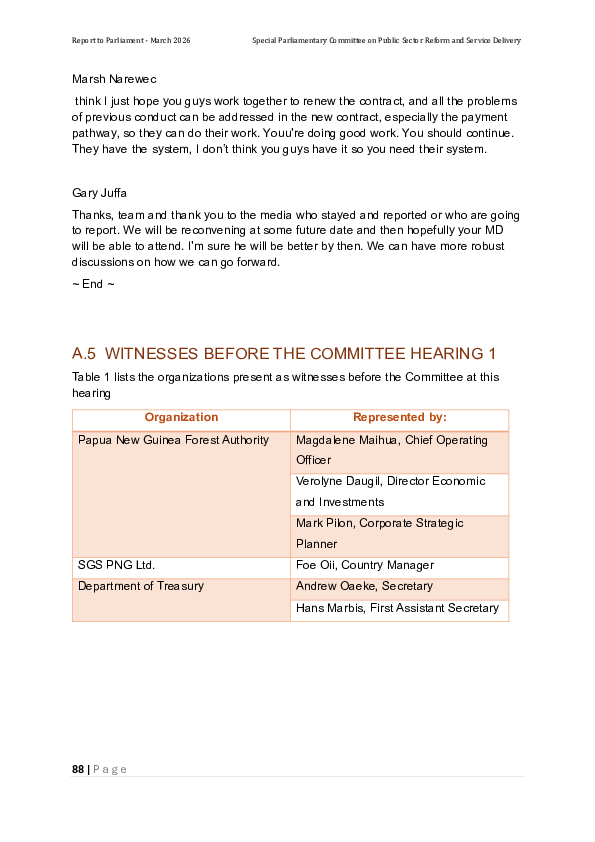
Report to Parliament - March 2026   Special Parliamentary Committee on Public Sector Reform and Service Delivery


A.6 LOG EXPORT INQUIRY - HEARING 2 TRANSCRIPT
Date: 6 th August, 2025
Time:
Venue: Parliament House, B2 Conference Room

00;10;48 - 00;11;37

Gary Juffa

First and foremost, I will introduce my colleagues, Governor William Powi, governor
for Southern Highlands, and Governor Sir Peter Ipatas, Governor for Enga province
and we formed the Quorum. The other members, unfortunately, Governor Rufino
Peter is ill and she could not make it so she has passed her apologies. Honorable
Member for Wau Waria the Honorable Marsh Narewec is attending to another matter
at the moment, but he is on his way here once he has attended to that matter, he will
be here. So just to set the pace, I'll make a few comments and then we can continue
from there on. I am the chairman of the Special Parliamentary Committee on Public
Sector Reforms. My name is Gary Juffa and I am the governor for Northern Province.


00;11;37 - 00;12;21

Gary Juffa

First and foremost, I want to welcome you all here and basically assure you that this
effort is an effort to try to find solutions to problems that plague our nation, and
specifically, what are the issues confronting your organizations in, you know, in
relation to this particular subject matter that we are inquiring into. And this is into the
PNG Forest Authority and the engagement of SGS on round log exports. This is
cognizant of the fact that it is the Marape-Rosso government's intention to put a stop
to round log exports in 2025 and look at encouraging downstream processing.


00;12;21 - 00;12;44

Gary Juffa

This is also cognizant of the fact that we have had two inquiries into the forestry
sector and the activities in the forestry sector that have brought concern to decision
makers and concern to the people of Papua New Guinea in regards to how the
sector is managed and how the sector is managed in such a way that benefits the
stakeholders, especially the people of Papua New Guinea.


00;12;44 – 00;13;33
89 | P a g e
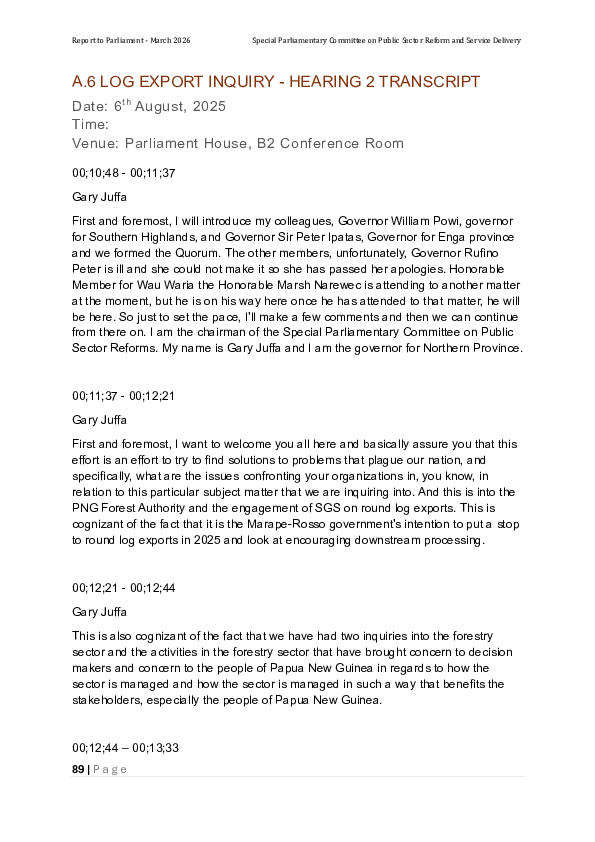
Report to Parliament - March 2026   Special Parliamentary Committee on Public Sector Reform and Service Delivery


Gary Juffa

We've had many reforms proposed. The inquiry's themselves have made
recommendations and we want to know what has happened to the recommendations
since those inquiries. A lot of taxpayer money was spent and there are always
allegations, as we know, allegations of improper dealings by various organizations in
that grouping. So this will be a protracted hearing. It's not going to be a hearing that's
going to be over after this. And then we go back to work and everything's fine. This is
going to continue for some time until we bring about necessary reforms that will
ensure that the people of Papua New Guinea are benefiting as much as they
possibly can from this very important sector, the forestry sector.


00;13;33 – 00;13;45

Gary Juffa

One of the major reforms in the forestry sector imposed in 1994 was the introduction
an independent pre shipment inspections of all round log exports.


00;13;45 - 00;14;25

Gary Juffa

This vital service ceased since December 2023 and appears to be publicly
unavailable evidence on the urgency to fill this vital gap. There is risk to revenue, risk
to national forest stock and risk to potential fraudulent export of extra logs and
misdeclaration of logs species. So we are applying here to sorry, we're meeting here
to basically go through this and determine accountability so that we can renew pre
shipment inspection after 18 months of the absence of the independent monitoring of
shipments.


00;14;25 - 00;15;01

Gary Juffa

And we aim to discuss this afternoon is pre shipment inspections going to be
restored at all, status of export permits signed by the Minister, Audit Trails, and PNG
Forest Authority trust account funding, roles and responsibilities of organizations
such as Customs, Treasury, Finance. Eventually, down the line we will also be
having discussions with organizations such as the Environment and Conservation
Ministry and the Internal Revenue Commission as well, and perhaps even the central
bank.


90 | P a g e
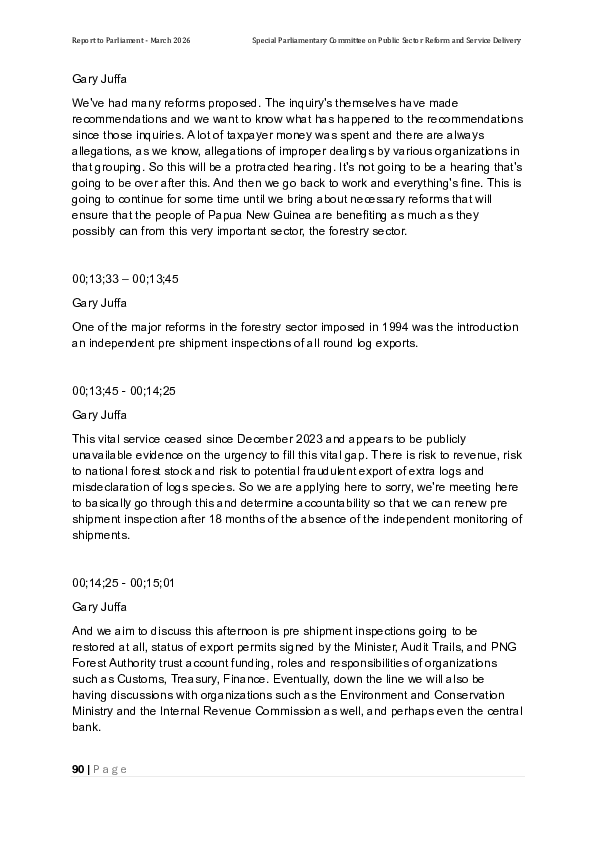
Report to Parliament - March 2026   Special Parliamentary Committee on Public Sector Reform and Service Delivery


00;15;01 - 00;15;26

Gary Juffa

We will also be considering bringing in few of the key players in the industry, many of
whom claim to be involved in agro forestry projects. But from my information, they
are hardly doing anything agro. There are a lot of forestry but very little agro. For
instance, I can say this from my own experience in my own province where two
logging operations claim to be involved in agro activities.


00;15;26 - 00;16;03

Gary Juffa

I could tell you on the ground there's no evidence of any activities that indicate that
there's some agricultural activity taking place in those areas that are being logged.
So that's basically setting the pace for our discussions. The government
organizations, established authorities, ministries, departments, etc. are designed
specifically to protect the interests of Papua New Guineans. Is that adequately being
done? While we invite investors into our country, we invite them to come and behave
in accordance with our laws.


00;16;03 - 00;16;25

Gary Juffa

We ask them to come and carry out their activities in such a way that they abide by
these laws. They pay their taxes, they acquire their licenses and permits in a
transparent manner, and they respect this country. Are they doing that? And are the
government organizations and entities responsible ensuring that they are doing that,
for instance?


00;16;25 - 00;16;49

Gary Juffa

That's what we hope to achieve with this inquiry, and we represent the people of
Papua New Guinea. This committee. We do not report to executive government. We
report to the people of Papua New Guinea, the summons that we issue carry
significant weight. They carry the weight of the expectations of the people of Papua
New Guinea who have elected us here to serve them without fear or favor.


00;16;49 - 00;17;19
91 | P a g e
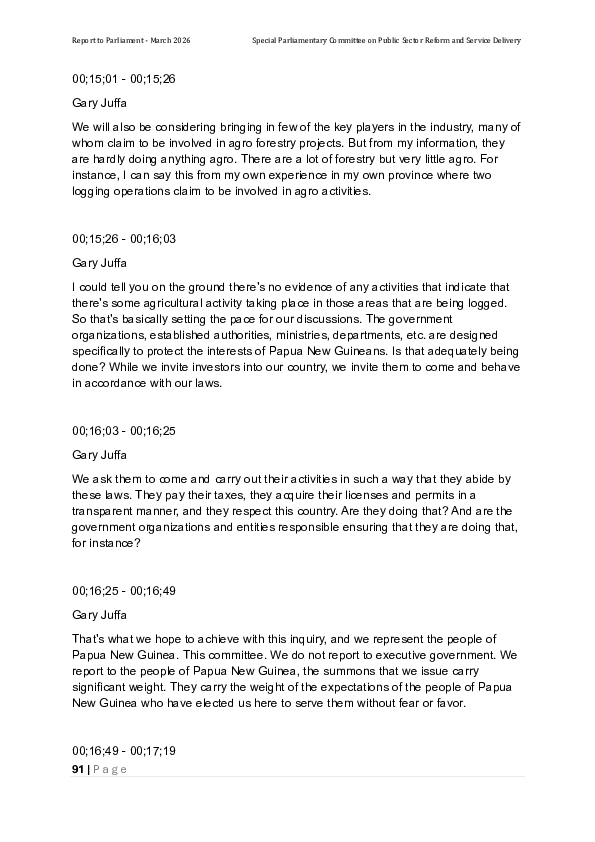
Report to Parliament - March 2026   Special Parliamentary Committee on Public Sector Reform and Service Delivery


Gary Juffa

Just as many of you who are public servants have signed an oath to serve your
country without fear or favor. So thank you very much for coming. There is going to
be no finger pointing. There's not going to be any accusations of wrongdoing here.
There's basically going to be a discussion of what can be done so that we can
improve in how we serve our country and our people, especially on the eve of the 50
years that's about to come by.


00;17;19 - 00;17;50
Gary Juffa

What's going to happen in the next 50 years? Consideration of such questions as the
natural environment. What are we doing to protect the third largest rainforest? 7% of
the world's biodiversity. What are we doing to ensure that our activities in harvesting
our timber resources are done in a sustainable manner? That those stakeholders
operating in this space of being responsible are being genuine and considerate of
the interests of the people of Papua New Guinea.


00;17;50 - 00;18;22

Gary Juffa

Thank you. Now, from time to time, the - my colleagues here will interject whenever
they feel like it. They will be going through all the documents they have and they may
ask questions at any time they feel it's necessary. And when when they have a
question that they feel needs to be answered to any of you out here. Our inquiry will
commence with Treasury.


00;18;22 - 00;18;57
Gary Juffa

Is Treasury here? John? John, you’re with Treasury? Sorry, I keep forgetting. I
always confuse you with finance. Yeah, My apologies, John. My apologies. John, I
think we've sent documentations to Treasury in regards to the information we wanted
or we've asked for, and we will be making reference to some of that information,
including reports that were presented by SGS and also by forestry.


00;18;57 - 00;19;24
Gary Juffa
92 | P a g e
Report to Parliament - March 2026   Special Parliamentary Committee on Public Sector Reform and Service Delivery


Mr. Mosoro, I want to thank you and your team at Forestry for putting together a very
thorough report and sending it to us. We've gone through the report and we will be
requesting further information or clarification. And at the end of this inquiry, which will
probably be, you know, some months from now, we hope to put together our
contributions as to how things can be done in such a way that we are comfortable,
our people's interests are protected.


00;19;30 - 00;20;10

Gary Juffa
I'll start the questions. And gentlemen, you may jump in at any time. We are talking
to the Treasury Office, so we wish to ask the address or to address the allegations
regarding Treasury's role in the underfunding and termination of SGS contract and
their assessment of PNGFA's current capacity. Question number one John, the
committee would like to hear from you on inferences that your department is the
main reason for not providing adequate budgetary support, culminating in years of
contract arrears resulting in contract termination.


00;20;10 - 00;20;17

Gary Juffa

Could you clarify or give us some thoughts in regards to that question?


00;20;17 - 00;20;32

Gary Juffa

Thank you, Mr. Narewec. Do we need to swear him in? Oh you already swore him in.
Sorry, sorry. Thanks. John, please commence.


00;20;32 - 00;20;52

John Uware

Well, thank you. Thank you, Chairman and members of the committee. Firstly, I want
to take this time to convey Secretary's apologies that he's unable to be present. Yes,
some important matters relating to the MYEFO report. So he had to stay back and so
he asked me to come on his behalf.


00;20;54 - 00;21;22
93 | P a g e
Report to Parliament - March 2026   Special Parliamentary Committee on Public Sector Reform and Service Delivery


Gary Juffa

Uh just very sorry for interrupting, Governor Ipatas has a very urgent matter to attend
to. So, Governor Ipatas, we will excuse you. We have quorum because Mr. Narewec
has just arrived. So, Governor Ipatas, thank you for joining us. And we’ll appraise
you on how the inquiry went after at some future date. You may continue, John.


00;21;22 - 00;22;49

John Uware

Sorry, uh, I think your question, you ask about the budgetary support that Treasury is
supposed to ensure is provided for financing of the work that SGS does. I suspect
because of the the revenue the revenue situation that we we have I know we tried to
address revenue here, shortfalls in here, but the reality is that our revenue that we
collect to to finance the budget for the government, we've been we've been
struggling especially on non-tax revenue collections, dividend collections that have
been over the last few years. There have been struggles in making sure government
collects these adequate revenue. And so making sure adequate budgeting is
provided to not only forest but the different department that the government is
responsible for and the people of this country. Year in, year out, we've had to
struggle through making sure that adequate budget is allocated to our different
departments to make sure that they they finance their expenditure that's necessary
going forward.


00;22;49 - 00;23;25

John Uware

And so I'll probably get our department, our team responsible to provide a detailed
response. But at a high level, the Government currently is struggling to finance the
expenditure that is expected by our people. And so over the years, maybe reductions
have been have been made in making sure there's adequate money to finance the
team that's here. And so I totally agree with the mandate of the committee to making
sure that the all the necessary questions that need to be raised are raised.


00;23;25 - 00;23;52

John Uware

And we collectively as government entities take steps to making sure that adequate
budget is made available. That's on the one side, that's the expenditure side. But
we're also making sure revenue on the other side is coming in regularly from people

94 | P a g e
Report to Parliament - March 2026   Special Parliamentary Committee on Public Sector Reform and Service Delivery


who are supposed to bring in the revenue that would help Treasury ensure that
funding is made available to finance this critical expenditure that our people deserve.


00;23;52 - 00;24;03

John Uware

Maybe, Governor, I'll probably stop here and probably expect a few other questions.
If you have.


00;24;03 - 00;24;23
William Powi

Gov, let me emphasize, the question here is, is Treasury appropriating budget to
SGS as it is now, that's what we or you have stopped in the appropriation and
funding. I think the question is specific. We need to know on this one.


00;24;23 - 00;25;10

John Uware

Yes. I was say, you know, we need to have adequate revenue coming in in order to
make money available. That's the gist of what I was. I know it's specific to SGS here,
but we in Treasury, we wait for people to submit the budgets. And based on different
submissions, have come from various agencies, various provinces, allocations are
made based on what is available. At the end of the day, if I had all the money
available, I could easily fund everybody. That's the question I'm trying to answer
here. But if I am not getting the adequate revenue coming in, although Customs and
IRC have been really good, they've been doing their bit, but it’s the other revenue
that are not coming in. So we have gaps.


00;25;10 - 00;25;46

John Uware

And so when we have gaps, we have to go and borrow. And so sorry Governor, that
was where I was coming from. Sorry, if I'm not really addressing directly the
question, but at the end of the day, it's a funding issue. We have to make sure there's
money available to finance the different expenditure priorities that government has.
And so when Treasury doesn't have the money, because we take care of everybody.
It's not it's not just one department we are worried about. We're worried about the
whole country making sure adequate money is going down to all the provinces, all
95 | P a g e
Report to Parliament - March 2026   Special Parliamentary Committee on Public Sector Reform and Service Delivery


the departments and everybody that's in the budget in line with the annual budget.
Thank you.


00;25;46 - 00;26;30

Gary Juffa

I'll ask a few more questions. It's interesting you mentioned this because this is the
first time this has happened since SGS was initially engaged some 30 years ago.
John, are you aware that it's very important that we have this function in place for
purposes of ensuring that we maintain a great record? It's one of the key indicators
to keeping us off the grey list. You're aware of that? Not having this function actually
moves us towards putting us on that grey list. Am I correct in saying that?


00;26;30 - 00;26;45
John Uware

Yes, chairman, I think you're absolutely right that this is a critical function and the role
the SGS or whichever company that comes in plays a critical role in ensuring that we
get value for money. Yes, I agree.


00;26;45 - 00;27;16

Gary Juffa

So having said that, I believe that in the past forestry did have funds to be able to
fund this engagement but after the new laws came in whereby all funds were swept
to Treasury, I believe there was this, I forget the particular term, the NTRA, but the
when that happened then forestry do not have the funds to be able to engage SGS.
Is that a correct assertion? Could I say that?


00;27;16 - 00;27;43

John Uware

I'm not sure about it because NTRA just came in a few, I think it was ‘23 March of
‘23, and so it started around there. So that could be correct. But I think the
department of Finance and Treasury, between them have been engaging regularly
with all the revenue raising agencies lately. And so, however, we've been having
some push back.


96 | P a g e
Report to Parliament - March 2026   Special Parliamentary Committee on Public Sector Reform and Service Delivery


00;27;43 - 00;27;59

John Uware

We ideally, we want all the money to come in. Yes, we want to fund everybody, just
that we've had push back from various agencies on the different ratio determinations
on how much they should keep, how much Treasury should collect to finance the
budget. And so there's been challenges in managing that process.


00;27;59 - 00;28;25

Gary Juffa

So, John, if, just a simple question here, if forestry retain some of its funds that it was
managing to raise as an authority, which is what many authorities are doing and say
it kept components for taking care of very important engagements like this, it then
would be able to do that. Am I correct, rather than having to wait for Treasury to find
funding to fund this engagement?


00;28;25 - 00;28;34

John Uware

Yes. Under the NTRA arrangement, Yes. Are they're supposed to there's the
engagement I'm talking about. They're supposed to be talking and then determine
how much.


00;28;34 - 00;28;36

Gary Juffa

So that hasn't happened yet.


00;28;37 - 00;28;49
John Uware

No, that has happened lately. For the last two, two years we've had that discussion.
But that's where determinations need to be made and treasurer signs off on ratio
arrangements. What they can keep and what they give to government yet.


00;28;49 - 00;29;15

97 | P a g e
Report to Parliament - March 2026   Special Parliamentary Committee on Public Sector Reform and Service Delivery


Gary Juffa

Thank you, Joe. I think two years is a long time for having discussions. This matter
needs to be resolved as soon as possible so that this engagement can continue. Is
there a future whereby the engagement of a log pre shipment inspection service is
going to take place or is Treasury satisfied that this is a function that PNGFA can
continue in its absence?


00;29;15 - 00;29;46

Gary Juffa

Because note here, John, that one of the reasons why SGS was engage is purposes
of good governance and transparency that came out as a result of the Tos Barnett
inquiry. And the whole reason why SGS was engaged was because there were
allegations that forestry one did not have the capacity or two had been corrupted by
criminal elements and as a result the inquiry was carried out.


00;29;46 - 00;30;04
Gary Juffa

And then the inquiry made a recommendation that an independent organization for
the purposes of good governance had to be engaged so that it can carry out its
duties without any allegations of corruption or, you know, illegal influence of any sort.


00;30;04 - 00;19;50;07

Gary Juffa

So now knowing that I mean, for instance, we at the first inquiry we had, we heard
from SGS that every shipment, every shipment, there was a discrepancy. They found
it. If you go through any of the SGS reports, you will find that there’s discrepancies in
every shipment. Fast forward to now when forestry have been doing the inspections.
Zero discrepancies.


00;30;31 - 00;30;52

Gary Juffa
This is exactly what was happening before the Tos Barnett inquiry. So there's two
things here. Either forestry do not have the capacity, so they are unable to get out


98 | P a g e
Report to Parliament - March 2026   Special Parliamentary Committee on Public Sector Reform and Service Delivery


there and carry out all these inspections in a very thorough manner. And so we can't
blame them for that or that system has been corrupted. It's one of the other or both.


00;30;52 - 00;31;18

Gary Juffa

So taking that into consideration, what is Treasury's stance in ensuring that, one, this
very vital element of keeping PMG off the gray list is maintained or reintroduced?
And the big question will a new contract for pre shipment inspections worth it when
PNG is supposed to be banning the export of run logs by end of 2025? Thank you.


00;31;18 - 00;32;03

John Uware

Chairman, I think in relation to the first question, I think the role that SGS plays or
that particular mandate is an important role if we are to continue to collect good
revenue and we need somebody independently doing all those checks. So I
understand that's what they do. So it's an important role that we need to still maintain
until the ban. I don't know what the impact of the ban will be, but as long as it's
necessary, I think that the role should continue. Yes. Sorry, governor, and on top of
that, funding be made available to finance that particular role, yes. Sorry.


00;32;03 - 00;32;32
William Powi

Pre-shipment, Mr. Chairman, and the arrangements and the importance of pre-
shipment scrutiny, now, we are looking at it in terms of forestry, but for other sectors
as well. This is a fundamental function of government. We can't just sit back coming
here in 50 years and allowing things to happen at will and whim. This is important,
SGS plays a fundamental role.


00;32;32 - 00;32;55

William Powi

When I was in the Prime Minister's department, we had this inter-agency meeting
dealing with this SGS before I went up to Mendi. It plays a very important role
safeguarding our resources for this country. We cannot allow Treasury and Finance
to, you know, say that there is no money in the appropriation and all that is. This one
brings money.
99 | P a g e
Report to Parliament - March 2026   Special Parliamentary Committee on Public Sector Reform and Service Delivery


00;32;55 - 00;32;36

William Powi

It safeguards the interest of the country. If it is not happening, who does this? Is it
forestry or finance or Treasury? What we want to know, because this is a mini
parliament, we are parliament sitting here looking at this very important national
issue that we need to be guided properly. If it is not happening, speak out and say
that this is lacking. It's an important function of government and we need to be
guided. I don't say we look at revenue coming or not coming. You know, it's an
important function of government. If it is not happening, tell us we are not doing this.


00;33;36 - 00;33;54
John Uware
I note the concerns you've raised. Yes, I'll convey that to the department and we will
ensure that that is made known to others. And when submissions are coming in, that
is considered on that basis.


00;33;54 - 00;34;38

Marsh Narewec

Chairman, just one clarification. So this NTRA Act is there to bring in all the revenues
from the, those guys who, or those agencies who generate revenues, back to
Treasury. So PNGFA generates revenue but all gets into Treasury and now because
that's the revenue that PNGFA generates, so why can’t it send back, keep it, PNGFA
so they can pay SGS?


00;34;38 - 00;34;55
John Uware

As I was saying earlier, the agencies, when they make the submissions, they come
and they talk to the Treasury and determine how much they should keep. So it's an
agreement that needs to happen. So if it's 50% they want to keep, they have come
and justify that and then they get it.


00;34;55 - 00;34;56

Marsh Narewec
100 | P a g e
Report to Parliament - March 2026   Special Parliamentary Committee on Public Sector Reform and Service Delivery


Did they make that agreement?


00;34;56 - 00;34;05

John Uware
Well, they've had some meetings. I'm aware that the different agencies have been
have come in and met with Treasury and Finance.


00;35;05 - 00;35;09

Marsh Narewec

So did you guys meet with the finance or treasury department and have the
meeting?


00;35;09 - 00;35;22

John Mosoro

Thank you, Chairman and the committee members, I believe the decision was taken
by Treasury and Prime Minister’s Department without consulting Forestry. They have
taken, uh, they gave us zero. I can say, zero.


00;35;22 - 00;35;25

Marsh Narewec

So, you’re saying that they consulted with


00;35;25 - 00;35;42

John Mosoro

I have the letter written from the Treasurer advising me that you will not retain any
money and it's zero and we are now appealing to that, to the Treasury and to the
Prime Minister’s Department.


00;35;42 - 00;35;44

Marsh Narewec

When did that start?
101 | P a g e
Report to Parliament - March 2026   Special Parliamentary Committee on Public Sector Reform and Service Delivery


00;35;44 - 00;25;20;02

John Mosoro

It started back in 2023, the NTRA Act came into force. First it was anti-money
laundering act, they removed almost about 80 million from forestry.


Gary Juffa
80 million?


John Mosoro

80


Marsh Narewec

80, eight-zero or one-eight?


00;36;02 - 00;36;24

John Mosoro

From Forestry


Marsh Narewec

Eight zero?


John Mosoro

And we had no nothing to operate, so they forestry, chairman, they put forestry in a
very awkward position at the time when we had all the money and all the money was
taken out and we have suffered all throughout. We try to cannibalize all our accounts
from the Bulolo plantation, from our levies and all that to survive.


00;36;24 - 00;36;30
Marsh Narewec

102 | P a g e
Report to Parliament - March 2026    Special Parliamentary Committee on Public Sector Reform and Service Delivery


Is that the reason why we, the districts, are not receiving our levies?


00;36;30 - 00;36;32

John Mosoro
That may be, but that's different.


00;36;32 - 00;36;37

Marsh Narewec

We are not receiving the forestry levies for two years now.


00;36;37 - 00;36;40

John Mosoro
That’s different matter, member, committee, that’s a different matter


00;36;40 - 00;36;42

Marsh Narewec

But you’re saying that NTRA is collecting all these


00;36;42 - 00;36;59
John Mosoro

I just wanted to say that we have not received any or we have not return any money
that we've collected. As you know, Chairman, we have contributed in the last how
many years, 400 million, 500 million every year from the log export. And we get
nothing from the budget.


00;36;59 - 00;37;05
Gary Juffa

From that 400 million, it could easily, um SGS, their fees


00;37;05 - 00;37;23
103 | P a g e
Report to Parliament - March 2026   Special Parliamentary Committee on Public Sector Reform and Service Delivery


John Mosoro

Oh, yes, chairman, definitely chairman, with that money we've retained, we can take
over SGS. We have an agreement with SGS to fund their operations. Now that all
the funds had been taken out, we are now going back to the Treasury to ask for
funding. It has been a real problem for us.


00;37;23 - 00;37;38

Marsh Narewec

Okay, back to Treasury. Who makes the decision on what percentage of money
collected should be paid back? Who makes the decision? The minister or the
secretary or who makes the decision for how much money can be paid back and
how much can be kept?


00;37;38 - 00;38;00

John Uware

Minister Treasury signs off on after consultation. That's the process that NTRA states
in the NTRA law. After they consulted, an agreement is made on which ratio that the
agency gets, which one comes into government and then the minister signs off on
that decision.


00;38;00 - 00;38;12

Marsh Narewec

Okay, good. So the consultation process, how does the consultation process starts?
During budget session or during planning session? How often do you have
consultation session with the PNGFA?


00;38;12 - 00;38;30

John Uware

Before the budget is finalized for an annual like for instance, for 2026, the
consultation would have taken place in the early part of the year until a decision is
made and then the ratio is factored into the budget for next year.


00;38;30 - 00;38;34

104 | P a g e
Report to Parliament - March 2026   Special Parliamentary Committee on Public Sector Reform and Service Delivery


Marsh Narewec

Okay, good. Did you have any consultation with the Department of Treasury with
regards to that for 2026 budget?


00;38;34 - 00;38;43

John Mosoro

Chairman, we have written a number of letters, we requested and we have not
received any formal response.


00;38;43 - 00;38;52

Marsh Narewec

So which officer in Treasury is responsible for PNGFA for such? Secretary or the
deputy secretary or?


00;38;49 - 00;39;10

John Mosoro

As an MD I talk straight to the Secretary and from my colleagues, they talk to the
deputy secretary and we decide on the funding. So it has been, chairman it has been
a real challenge for forestry to get funding to support our programs.


00;39;10 - 00;39;19

Marsh Narewec

Okay forget about the funding, let's talk about the consultation. Have you, any
consultation happening for that 2026 budget?


00;39;19 - 00;39;20
John Mosoro

Yes, we have.


00;39;20 - 00;39;21

Marsh Narewec
105 | P a g e
Report to Parliament - March 2026   Special Parliamentary Committee on Public Sector Reform and Service Delivery


With with Treasury?


00;39;21 - 00;39;23

John Mosoro
With Treasury.


00;39;23 - 00;39;32

Marsh Narewec

Okay. So did you come up with a final figure? Well, now you want to reach out to split
your revenue.


00;39;32 – 00;39;44

John Mosoro

We have the budget submission with my director for our budget. So we have.


00;39;44 - 00;39;48

Marsh Narewec

Did that same thing happen last year in 2024.


00;39;48 - 00;39;49

John Mosoro
Yes.


00;39;49 - 00;39;53

Marsh Narewec

And how much was the percentage split in the consultation?


00;39;53 - 00;40;13

John Mosoro

106 | P a g e
Report to Parliament - March 2026   Special Parliamentary Committee on Public Sector Reform and Service Delivery


What would be the percentage of...if I can recall the percentage was around 35...oh,
you mean the...yes, sorry, currently 0%


00;40;13 - 00;40;20

Marsh Narewec

That was in 2024, 25 zero. But for 26 you did you come up with.


00;40;20 - 00;30;01;26

John Mosoro

Not yet. We requested but they have not given us the percentage yet and there's a
discussion still going on with Treasury and PM’s Department that they will respond
formally to my letter. I'm asking for percentage sharing to retain certain component
percentage and they have not responded to me.


00;40;39 - 00;40;47

Marsh Narewec

Okay, chairman, I think you might, your committee might, you know, call whoever is
supposed to respond to the letter.


Gary Juffa

Thank you


00;40;47 - 00;41;20

William Powi
Chairman, can I just state from gathering since SGS has not been engaged, we are
now hearing appropriate state agencies telling us that pre-shipment has been going
on without being monitoring. Is that the general conclusion we are getting that pre-
shipment and the functions of SGS has not been carried out in two years or how
many years because of this funding thing.


00;41;20 - 00;42;07

William Powi
107 | P a g e
Report to Parliament - March 2026   Special Parliamentary Committee on Public Sector Reform and Service Delivery


So meaning that, I'm trying to get to the point that we as a country have not been
monitoring our log export because of this funding thing that we are raising. Is that
right? Who does this now? Who does this on behalf of the independent state of
PNG? We’re just allowing companies to come in and cut trees and just go like that.
Oh, who's doing it for us? For the people of PNG. I think that's the fundamental thing.
Yumi lose control or sampla man mekim blo mipla?


00;42;07 - 00;43;36

John Mosoro
Chairman, thank you. Let me answer this question in a more holistic way. actually,
before SGS came into the country after the Barnett inquiry, all the monitoring was
done by PNG Forest Authority. Our officers were trained for monitoring and
surveillance, export at FOB value at the log ponds. So, my officers were already
trained. When SGS came in, they play the same role as my forestry officers out in
the field. But they did the independent. They did independent just to verify that what
my officers are doing on the ground is correct. So they did only the independent
verification so due to the funding system, the funding was not on time. SGS was
spending their own money and we, Forestry, we to support them a little bit. However,
they couldn't because they have other commitments they have to wind up
themselves. We did not, Chairman, we did not terminate the contract. They
themselves could not sustain their operation so they left and we’re struggling to,
backpedaling, trying to get them back in slowly, which we will explain later on. Now,
in terms of illegal export and all that, I can say that my officers are expert, they’ve
worked in that, they know and they've given me all the tallies.


00;43;36 - 00;44;26

John Mosoro

I think it's only one and a half years, almost two years I think of non-monitoring done
by SGS. But as soon as they left, my officers stepped in and you know, I have
officers throughout the country and they did all the monitoring and surveillance work
at the log pond. And you'll see that in our report, we have stated that although SGS
have claimed discrepancies and miscalculation and all that, but my officers have
gone in and identified some issues also from SGS which we will provide and we will
also explain a bit more on that. So in other words, sorry, chairman, we did the
surveillance and monitoring ourselves as we have trained.


00;44;26 – 00;45;39

108 | P a g e
Report to Parliament - March 2026   Special Parliamentary Committee on Public Sector Reform and Service Delivery


Gary Juffa

Thank you. We will come back to you. Uh, when we finish our line of questioning with
Treasury. Just for clarification, MD, from my knowledge of the history of SGS and
how it came about and the reasons why it was engaged was and we will have to
revisit the Tos Barnett inquiry, you know. Why was this inquiry carried out? The
inquiry was carried out because of allegations of criminal infiltration of the forestry
Department. I think at that time forestry probably came under agriculture, or was it
already a standalone organization? I can't recall. Was it still part of agriculture or
lands or? It was a department before it became an authority? So from my
understanding of the Tos Barnett inquiry, SGS was engaged as a recommendation
so that it could be stated confidently that the inspections were done at Arm's length
by an independent organization without the influence of the department or without
the influence of the the stakeholders at that time.


00;45;39 - 00;46;08

Gary Juffa
So that's my knowledge of how SGS came to be engaged. And we will come to that
line of questioning later because we're very curious about the discrepancies that
SGS has identified. Whenever they do a inspection of a shipment and they are
discrepancies, there's significant discrepancies like you're supposed to export, say,
for instance, a thousand cubic meters, they find 2000 cubic meters instead, example.


00;46;08 - 00;46;30

Gary Juffa

What happens to that other additional 1000 that where we're going to come to
eventually. And this is why Customs is here, because they play a very key role in
this. You know what happens to those discrepancies? We're talking about a
commodity of very high value that's leaving our country. These high value commodity
attracts customs duties. Okay.


00;46;30 - 00;46;06

Gary Juffa

And the customs duties are charge per cubic meter. And also according to the
species of the high value commodity that's leaving, the discrepancies picked up by
SGS are additional cubic meters or misclassification of the species of timber, you
know. So we're going to narrow down to that because we want to understand what's

109 | P a g e
Report to Parliament - March 2026   Special Parliamentary Committee on Public Sector Reform and Service Delivery


happening here. Part of our role going forward as a committee is to identify revenue
gaps or areas where we can tighten the belt so that we can make savings for the
country, etc. This is one of those exercises.


00;46;06 - 00;47;27

Gary Juffa

So Managing Director, thank you for your answers. We will come back to that. We'll
just wrap up with Treasury again. Now we are going into the subject area of trust
accounts here, but we understand that PNGFA has a trust account. Am I correct?
John, are you aware of that or


00;47;27 - 00;47;30

John Uware

I think probably Forestry will be the best people to answer that


00;47;30 - 00;47;36
Gary Juffa

Okay, so managing director, you've got knowledge of a trust account that PNGFA
has?


00;47;36 – 00;47;52

John Mosoro

Chairman, We do not have a specific trust account for uh on log export or SGS


00;47;52 - 00;47;58

Gary Juffa
But do you have a trust account? Does your department or does your authority have
a trust account? Trust account?


00;47;58 - 00;48;00

John Mosoro

110 | P a g e
Report to Parliament - March 2026   Special Parliamentary Committee on Public Sector Reform and Service Delivery


We have a normal trust account.


00;48;00 - 00;48;01

Gary Juffa
A normal trust.


00;48;01 - 00;48;02

John Mosoro

Not specific for


00;48;02 - 00;48;06

Gary Juffa
Okay, what is that normal trust account for?


00;48;06 - 00;48;12

John Mosoro

The trust account is mainly for royalty.


Gary Juffa
For royalty


John Mosoro

For royalties.


00;48;12 – 00;48;18

Gary Juffa
Okay, so all royalties collected on every shipment is paid into the trust account, am I
correct?


111 | P a g e

Report to Parliament - March 2026   Special Parliamentary Committee on Public Sector Reform and Service Delivery


John Mosoro

Correct.


00;48;18 - 00;48;20
Gary Juffa

And then those royalties are paid to?


00;48;20 – 00;48;30

John Mosoro

The landowners.


Gary Juffa
Okay, so the trust account is merely a processing facility to pass on to landowners
the royalties that are due to them?


John Mosoro

Yes.


00;48;30 - 00;48;42

Gary Juffa

Okay. How much annually is paid into that account? Does your department retain
any of those funds, any of those royalties, say, for administration costs or anything
like that?


00;48;42 - 00;48;48

John Mosoro
Chairman, unfortunately, we don't we don't retain or we don't hold any of this royalty
money. It belongs to the people.


00;48;48 - 00;48;52

112 | P a g e
Report to Parliament - March 2026   Special Parliamentary Committee on Public Sector Reform and Service Delivery


Gary Juffa

Okay. So you pay them directly to the


John Mosoro
We pay them directly


Gary Juffa

To the landowners.


John Mosoro

To the landowners.


00;48;53 – 00;48;59

Gary Juffa

Okay.


John Mosoro

And 5% tax. We pay 2% tax.


00;48;59 - 00;48;37

Gary Juffa

Do you have oversight over the trust account? I'm assuming that Treasury or is it
finance is supposed to always have oversight over trust accounts.


John Uware

Finance department.


Gary Juffa


113 | P a g e
Report to Parliament - March 2026   Special Parliamentary Committee on Public Sector Reform and Service Delivery


Okay, so head of Secretariat, take note that we will have to ask Finance to come in
so they can explain at some later date. Okay. Thank you. John, from your
understanding, just going back to this again, has Treasury indicated that they will
look at funding the reengagement of SGS?


00;48;37 - 00;49;42

John Uware

Because of the publicity that this matter has raised uh


00;49;42 - 00;50;27

Gary Juffa

Well, it should not be because of the publicity, but it should be because it's a very
vital element of ensuring that we are not moving towards the grey list. As much as
possible, we as a country want to stay off that grey list. And this is one of the
indicators that keeps us off that grey list. But we've now removed it. We are moving,
you know, faster and closer towards that gray list. So I would assume that Treasury
would do everything possible to stop that, you know, movement by looking at paying
for this engagement again. So is that happening? Is Treasury having conversations
that are going to have a positive outcome in the very near future? Not two years, but
like as soon as possible? Is that happening to your understanding?


00;50;27 - 00;50;53

John Uware

Yes. Sorry. Chair. Look, I said I was going to explain that the publicity has brought
this to the fore again. And so internally there has been various discussion amongst
our key people to do with our budgets, and so we will even after this meeting, I'll go
and reinforce that and making sure that this matter is addressed properly. You know,
we don't want this to be repeated again going forward.


00;50;53 - 00;52;22

Gary Juffa

Thank you, John. As the organization that's basically responsible for policy on
revenue matters, would Treasury have conducted an analysis of, say, log exports,
discrepancies and potential penalties? Because, for instance, the managing director
has advised that about 400 million is collected every year or generated yeah, of
114 | P a g e
Report to Parliament - March 2026    Special Parliamentary Committee on Public Sector Reform and Service Delivery


which you would think that paying SGS, which is about 30 million per year. Am I
correct? Is it? Um 12, 12 million. 10. Sorry, 10, 12 million. 10 million from 400 million
is absolutely nothing, if you think about it, for cost, for rate of return, for instance, for
their services. But they're picking up discrepancies. Now from my understanding,
these discrepancies, if they were processed, would also result in additional
revenues. And then you'll you'll have to guide me in this. I'm not an expert in this
area, and customs will probably be looking at this as well. Say, we're shipping out
1000 cubic meters. SGS picks up and says, hang on, we found 2000. So the
discrepancy is 1000, but permits have already been signed, etc.. Well, what happens
to that additional 1000? We heard from the last inquiry that what Forestry insists is
that that 1000 is then dispersed internally for processing internally. Am I correct in
assuming this?


00;52;22 - 00;52;55

Mark Pilon

Thank you, Chairman. So with the discrepancies. I'm sorry, I'm the corporate strategy
planner. Thank you. Yes. With the with the discrepancies, what happens is when
SGS identifies that there are discrepancies, what is due from those discrepancies is
paid. Yes. Before the ship leaves with the logs.


00;52;55 - 00;52;59

Gary Juffa

So it's paid, the duties are paid then and there?


00;52;59 - 00;53;03

Mark Pilon
Duties are paid, levies are paid before the ship leaves with the logs.


00;53;03 - 00;53;32

Gary Juffa

Okay. And this is why I want the Treasury to take note, because I think they should
do an independent analysis of this. Now, the discrepancies are frequent. You know,
particular companies are habitually having these discrepancies. What is deterring
them from carrying out this discrepancy? So that, you know, we get the right
shipment off all the time. Do we apply penalties of any sorts?
115 | P a g e
Report to Parliament - March 2026   Special Parliamentary Committee on Public Sector Reform and Service Delivery


00;53;32 - 00;54;10

John Mosoro

Chairman, yes. We give them lawful directions. We give them the notice that in the
next shipment you try as much as possible to reduce your variance, the volume, the
amount that we calculate from the source and what amount that goes must almost
similar. So we give notices to the companies and they're starting to comply, try to
reduce as much as possible the discrepancies.


00;54;10 - 00;54;52

Gary Juffa

Now, I'm curious, chairman, when a shipment is about to leave, normally what you
would do is fill up an export entry. Okay, So with the discrepancies, is this corrected
before the export entry is filled, or is there another export entry field for the
correction? and permits as well because I think there's a shipping permit that goes
out with every export. Am I correct?


00;54;42 - 00;54;55

Mark Pilon

So, chairman, if I may just explain. So the discrepancies basically figures that are not
consistent with the export price endorsement and the export permit.


00;54;55 - 00;54;56

Gary Juffa

Okay.


00;54;56 - 00;55;57

Mark Pilon

And you will notice that there are a lot of discrepancies because when buyers come
to buy the logs, there can be instances where they also would like to purchase an
extra amount of logs. So those discrepancies will always be there in terms of
variances between the actual values that were initially applied for and what the buyer
would like to take when they are onshore. So you would have discrepancies.

116 | P a g e
Report to Parliament - March 2026   Special Parliamentary Committee on Public Sector Reform and Service Delivery


Discrepancies don't mean that there is an illegal act happening, those discrepancies
are basically values that are not consistent with the initial application for, it’s like a
packing list. You're saying that basically this is what I want to put on the ship and
then you decide to add something else on, but it's not consistent with your initial
original list.


00;55;57 - 00;56;31
Mark Pilon

So the adjustments are made. You pay for whatever adjustments that you have now
consider to be on that list. And once that duty is paid, once that levy is paid, then it
gets exported. SGS’s role is, it would be irresponsible of it to allow logs that are not
captured by way of duty, by way of levies onto a ship in the first place.


00;56;31 - 00;57;23
Mark Pilon

But what they do, their role is to report that there was an inconsistency between the
original supplied list and what the companies have now taken on by way of new
species, maybe new volume and value, and then those are accounted for by way of
the actual payments for levies and duties before they actually ship. So the
discrepancies don't, yeah, so, so for example, there could be a discrepancy where if
a ship comes in and a company has like by your example, a company has said, you
know, I'll get 2000 or a thousand, and then there is a there's a business sort of
decision made said, you know what, I would probably want to get another thousand
because there’s a thousand available.


00;57;23 - 00;57;58
Mark Pilon

But that thousand available is not consistent with this list that you had submitted
earlier. So that becomes a discrepancy. And so, SGS knows that there’s a
discrepancy to that list. And then it is required now that the company pay the duty,
the levies for that discrepancy and then they're allowed to ship the logs. Those
discrepancies are captured by customs entries as well. So the whole figure that we
get for the total values that PNG gets is inclusive of the discrepancies as well.


00;57;58 - 00;58;52

117 | P a g e
Report to Parliament - March 2026   Special Parliamentary Committee on Public Sector Reform and Service Delivery


Gary Juffa

I see. That's quite interesting. I mean, SGS, you can jump in any time for further
clarification if you wish to give us more insight, to enlighten us more about what goes
on here. It's very curious to me because, for instance, you've got a buyer here, say a
buyer wants 1000 cubic meters, then the company should be supplying 1000 cubic
meters. Why does the company suddenly turn up with 1500 cubic meters and then
the buyer suddenly changes their mind and say, Oh no, we'll buy that as well? You
know, it just doesn't make sense unless the buyer and the seller are actually owned
by the same people. Could that be the case? Transfer pricing, for example, say one
company owns the same company that is doing the logging and also buying on the
other side?


00;58;52 - 00;59;21

Gary Juffa
They could do this easily. You know, I mean, because if you have an agreement to
purchase a certain amount, it's a contract. And then the company says, yes, we can
provide that amount. Then the company goes and from its pool of timber that it has
available from its logging activities. It should have that exact amount, those exact
species that it should be able to provide.


00;59;21 – 01;00;24
Gary Juffa

What's happening here is that consistently, I mean, every shipment we're seeing
these discrepancies, these are high value commodities, very high value
commodities. And whilst we are saying that there's nothing illegal that has happened
here, the information and intelligence out there suggests otherwise, that there is a lot
of things that are happening that shouldn't be happening. You know, so if you've got,
say, for instance, 1000 cubic meters ordered of Kwila, but suddenly there's 1500, you
know, Kwila that's ready to be shipped off and then the company suddenly changes
its mind and then that discrepancy is sorted out before it goes to customs, you agree
that there are, you know, there is cause for suspicion. You know. That's why we are
curious about this. We want to understand what's happening here, you know, And
yeah, so so SGS is could probably give us an explanation of the chart there, the
report.


01;00;24 – 01;01;29

Gary Juffa
118 | P a g e
Report to Parliament - March 2026   Special Parliamentary Committee on Public Sector Reform and Service Delivery


So. Mr. Foe, sorry, John, thank you. We are done with Treasury. You can observe,
but I would suggest that you take notes that Treasury should do an independent
inquiry into what's happening here as the entity responsible for revenue policy. And
perhaps, SGS, you can lead us through this particular example. If you look at that
particular example there, of all the shipments done by all these companies here,
very, you know, logging companies who call them, many of them like to call
themselves agro forestry companies. There's no agro involved in many instances.
They're not planting anything up there. They're just cutting. But we'd like to
understand what they're doing. Yes. So if you look at the if you look at the reports
there, is it clear or is it too small to understand. The discrepancy. Anyway, we go
down. Foe, if you, you probably have your own documents similar to this.


01;01;29 – 01;02;32

Gary Juffa
The last row there, where it says discrepancy, if you look at every line, the on the left
hand side which is company and grouping, those are the companies that are
exporting. Okay. Say for example, is the Pacific region. Okay. And they've exported
Malas. It's a species of timber and they're supposed to ship out 10 cubic meters.
Yes, but they've shipped out 290. There's a big difference between ten and 298 cubic
meters and the discrepancy is 2,887%. So perhaps, Foe, just get us to understand
what that means. And it also says grade is Saw Veneer. Is this a round log or is this,
this is a round log? Right? Okay. So Foe, you could probably get us to understand
that. It’s sawn timber, but that's what the purpose is for.


01;02;32 – 01;02;45

[inaudible]


01;02;45 – 01;02;47

Gary Juffa

What the purpose is for, I guess


01;02;47 – 01;02;56

[inaudible]


119 | P a g e
Report to Parliament - March 2026   Special Parliamentary Committee on Public Sector Reform and Service Delivery


01;02;56 – 01;03;36

Foe Oii

That’s a classic example of overloading.


Gary Juffa

Of overloading


Foe Oii

Of overloading where the exporter was permitted to take 10 cubic meters but they
actually took 298, almost 300 cubic meters and so we've highlighted the fact that
there is there is additional volume that has been taken and that the the authorities
should be aware of the fact that that’s what’s happened.


01;03;36 – 01;04;04

Gary Juffa

Now, I want to understand this. When the permit is signed and I believe an export
permit is signed by the minister, am I correct? So when the permit is signed, is it
signed for the ten cubic meters or is it signed for the 298 cubic meters? It’s signed
for the ten? Okay. So the minister signs believing that ten cubic meters is leaving the
country.


01;04;04 – 01;04;48

Mark Pilon

So technically, yes, the minister would be signing off on that figure. Probably the
word believing would be a little bit too. But yes, he is, he has signed off on the 10.
Yeah, but by practice, in the event that the values differ above ten plus or -10%, then
the companies are required to submit for an amendment of the of the permit.


01;04;48 – 01;04;49
Gary Juffa

And does he sign the amendment as well?


120 | P a g e
Report to Parliament - March 2026   Special Parliamentary Committee on Public Sector Reform and Service Delivery


01;04;49 – 01;04;50

Mark Pilon

Yes.


01;04;50 – 01;04;55

Gary Juffa

So he will sign another permit for the discrepancy?


01;04;55 – 01;05;01

Mark Pilon

It will supersede the former one to take on now the new ones.


01;05;01 – 01;06;34

Gary Juffa

This is where it gets interesting because the minister is signing based on a contract,
an agreement between the buyer and the seller, that ten cubic meters is going to be
cut and exported. Okay. So how do they jump from ten cubic meters to suddenly 200
cubic meters? I'm just really struggling to understand this. They're going to provide,
say company, ABC in Singapore or Malaysia decides to purchase ten cubic meters
from Pacific Region Development, and then all of a sudden they've got 298. That's a
huge jump. And then it comes back to the minister again to sign for the 298. Why
didn't they just say 298 in the first permit? Why did they suddenly say 298 after? This
is where it gets confusing. If you going to have a contract to purchase ten, then why
don't you just buy ten and then you have another contract to buy 298 later or
something. You see where I'm coming from? I'm trying to understand this. It doesn't
make business sense, you know, if if they're shipping, if they have a contract to
provide ten cubic meters, why have they suddenly decided to ship 290 cubic meters
instead? Now, here's where it gets interesting. SGS is now no longer doing this.
Okay? Forestry is doing this.


01;06;34 – 01;06;55
Gary Juffa

So according to forestry, there are no discrepancies because we established that in
the last inquiry we had where according to forestry, you aren't picking up these
121 | P a g e
Report to Parliament - March 2026   Special Parliamentary Committee on Public Sector Reform and Service Delivery


discrepancies. So does that mean that they're just signing for the 298 or are they
signing for the ten and not worried about the 200 extra cubic meters?


01;06;55 – 01;08;02

John Mosoro

Chairman, let me address this issue here. I strongly believe that I have to get this
data from SGS. I think that's a biased data. I have to verify with SGS on this
datasets. I am just aware of this. It was not given to me to verify before I come here,
so I would like the data to be reviewed again. I wouldn't want to come in here to
present to you, chairman, something that has not been verified by the authority. It’s
like you are abusing the process, providing a table like this, saying that. This is 2022
when SGS was not doing the monitoring so how can they have this data up here?


Gary Juffa
23


John Mosoro

So how can SGS have these? They were not doing the monitoring yet they can go in
and do that and say that we have the data sets. To come and say that we are
presenting this. So I need to verify this Chairman in order for us to discuss this. It's a
massive increase and I'm quite concerned about this.


01;08;02 – 01;08;58

Gary Juffa

Yeah, we're very concerned. Yeah. Imagine. We're like you. Yeah. Because, you
know, at the end of the day, let's get this straight. All of us are interested in protecting
our people's interests. Okay? So we all performing different roles. And even SGS,
they are Papua New Guineans there like Foe who are also doing that. So what we
will do is we will make this report available to you and you can have a look at that
report and come back to us. And SGS will be on standby to verify their information,
how they got that information, etc..And we will be curious to know what happens, you
know, for instance, and also if if possible, Chairman sorry, M.D., if you can get copies
of your reports. Okay. So we want to see forestry to give us monthly reports on your
inspections. Okay. So now you're doing the job instead of SGS, we want to see your
reports.

122 | P a g e
Report to Parliament - March 2026   Special Parliamentary Committee on Public Sector Reform and Service Delivery


01;05;58 – 01;09;48

Gary Juffa

We want to see if you're picking up any discrepancies, because if SGS is picking up
discrepancies with every shipment, I can't imagine that this company has suddenly
overnight become angelic, law abiding citizens, honest, never making a mistake. All
of a sudden, they have no discrepancies. So I want to see your reports and then we
want to compare them because we're interested. So and MD, you're absolutely right.
You should have a look at this data so you can verify, because from ten cubic meters
to 290 cubic meters, that's a big jump. And it seems as if these companies can do
that whenever. Why do they keep doing that? It makes no sense. I'm trying to
understand why do they have a contract to supply ten cubic meters? Suddenly they
have 200 cubic meters.


01;09;48 – 01;11;47

William Powi

Okay. Uh, Mr. Chairman, can I just make a question here to the MD of Forestry. I
don't know, but you need to correct me on this one. Why do you people use ministers
to sign off on very important matters like this? Politicians should not be coming to
sign off on important things like this. You are supposed to be the CEO looking after
the organization because you have a preview of all the things that are going on.
Keep the politicians away. If it is empowered by law, then you can correct me. Law
tok osem minister ba sign. You're telling ministers to sign this and that, here and
there. Em wanpla issue me pickim up here lo you. The other one is. Mr. Chairman,
through you, I think we need to we need to go back to the Treasury people and also
to forestry. Do you need this pre-shipment monitoring done by SGS or is the Forest
Authority has the capacity to do it and provide that reliable information to us? I think
that's critical on the part of government. The people of this country need to have a
firmer idea that our forestry is protected. We want to get from you, now forestry is
doing the monitoring, these discrepancies, this data is not right. We are doing it,
we’ll present to you that's what the assurance, we want to get it from you, because
seeing a discrepancy like this is very alarming. Someone is not doing their job. You
don't need rocket science. and so is it Treasury through you, Mr. Chairman, He has
conceded that this is an important functions of government.


01;11;47 - 01;12;14

William Powi

123 | P a g e
Report to Parliament - March 2026   Special Parliamentary Committee on Public Sector Reform and Service Delivery


It has not been budgeted. So we take that point and they are in the, John, correct
me, you are in the process of correcting it. So this thing is done correct. So this idea
but SGS needs to be mapped out clearly here with the MD of Forestry, you are
telling us and giving us the assurance that you have capacity to do it.


01;12;14 - 01;13;19

John Mosoro

Thank you, committee and chairman. I have the capacity. Uh, the officers are well-
trained. However, like I said earlier on, we need independent, independent person to
verify those export, it's good because when you provide an independent
assessment, then you can, you can tell whether there is transfer pricing or is there is
undervaluing and all that. So another checks again by the independent body.

So I would prefer to retain SGS because if the government policies say log export
ban by 2025 it doesn't happen, I need SGS. You know the policy. So I need SGS to
continue to do the surveillance and monitoring for the government and including not
only that, once you go to downstream processing we’ll expand their scope of work
into the processed wood as well, all the plywood, the chipped mill and everything
that goes out of this country. So we’ll extend that and some minor forest products as
well.


01;13;19 - 01;13;26
John Mosoro

So SGS’s function is very important for us and chairman we will retain SGS.


01;13;26 - 01;13;51

Gary Juffa

Thank you managing director. Finally, for Treasury, just a couple of more questions
for John, I thought we are finished with you but we have a few more just before we
continue. Head of Secretariat, it's getting a bit warm in here, is the aircon getting
restored or? We don’t want anyone in here to


01;13;51 - 01;14;04

William Powi


124 | P a g e
Report to Parliament - March 2026   Special Parliamentary Committee on Public Sector Reform and Service Delivery


So the important thing, SGS and Treasury position must be clear seeing what he is
saying...


Marsh Narewec

Tupla wanbel pinis lo olim ol stap so gim money lo ol na...


01;14;04 - 01;14;51
Gary Juffa

With the Treasury, the final questions that I want to ask you, John, is, uh, and you
may provide them now or at a later date, how much is projected for log export in
2025 and 26 and has treasury factored in this potential loss of revenue in the 2026
budget if we decide to impose the round log exports. That’s another issue. Managing
Director stated that there’s about 400 million that's paid as a result of these round log
exports. What will happen if round log exports are stopped and therefore the 400
million is not available anymore from round log exports? So I guess, is Treasury
discussing this or, you know, considering this?


01;14;51 - 01;15;17

John Uware

Yes, like you said, I'll get our team, our revenue team to actually prepare an
appropriate response for this and taking note of all the questions you raised. So can I
request that, chair? We’ll get a team to properly review these and provide a better
response in case I say something that’s not, yeah.


01;15;17 - 01;15;44
Gary Juffa

I totally agree. Now, we've got quite a lot of questions, but we've also got time
constraints. And so what we will do is the questions that we have, Head of
Secretariat, we will be framing them and issuing them to all of you and you can put
your information together. You’ve got your information already. Sorry, Head of
Secretariat just advised me that the questions we’re asking are actually based on
questions we’ve already sent to you.


01;15;44 - 01;17;01

125 | P a g e
Report to Parliament - March 2026   Special Parliamentary Committee on Public Sector Reform and Service Delivery


Gary Juffa

So, so thank you, treasurer. I think for my purpose and my two colleagues may come
in at any time. Uh, Managing Director, you've actually provided a lot of the answers
to some of the questions that we wanted to ask, you know, and your statement that
you would rather engage SGS I think that's something that also appeals to us
because it's an arm's length entity that continues to perform those responsibilities for
purposes of good governance, keeping us off that grey list. Treasury, nod. Now, I
would like to just touch on a few questions that we will ask to our friends from
Customs. And again, my colleagues may ask as well. Welcome, Commissioner Towe
and your team to this inquiry. Just a few questions that I want to ask. The subject
area specifically is Customs log export duty collections and question, Commissioner,
can you inform the committee total export duty on export of round logs for the years
’22, ’23 and ’24, projected also in ’25?


01;17;01 - 01;18;36

David Towe
Thank you. Thank you, governor and chairman and thanks to the members of the
committee. For export in the year 2022, export duty collected by Customs was
455.99 so almost 456 million. That's for the year 2022; 456 million. For the year
2023, the export duty collected by Customs and revenue to Treasury was, there was
a drop, so 347.79 million, almost 347.8. For the year 2024, we collected 300 million.
300.38 million and for the year 2025 to date June, we are now in August, so for the
first half of 2025, we collected 145 million from log export.


01;18;36 - 01;18;48

Gary Juffa

So it can be said that there's a declining revenue flow as per the information giving
us.


01;18;48 - 01;20;23

David Towe

So governor and chairman, in 2023, the export duty on logs the budget amendment
2023 to 2024 budget, there was a decrease from almost, a significant increase there.
I think there’s bit of a mistake here.

[inaudible]

126 | P a g e
Report to Parliament - March 2026   Special Parliamentary Committee on Public Sector Reform and Service Delivery


Sorry, chairman, there’s a bit of uh...2023 to 2024, in the 2024 budget, 2023 budget
for 2024,

[inaudible]

Okay, so, so the tax rate increased from 50% to 70% in 2023


01;20;23 - 01;20;27

Gary Juffa
Okay, so, when the tax rate increase, the revenues decline?


01;20;27 - 01;20;55

David Towe

Correct, correct


Gary Juffa
It'd be interesting to see the volumes and whether the volumes remained stagnant or
not. And this is where, SGS, you could probably give us some insight, and forestry.
For these periods, the volumes of exports decrease or were they the same, or did
they increase. I’m trying to understand if there’s a correlation or not.


01;20;55 - 01;21;22

John Mosoro
Chairman, I just want to inform the committee also that tax increase. From 2022;
45% tax. 2023; 50% tax. 2024; 50-71%, and then 2025, 50% tax. So that has
resulted in the decrease in volumes export.


Gary Juffa
The increase in taxes?


John Mosoro

Increase in taxes.


127 | P a g e
Report to Parliament - March 2026   Special Parliamentary Committee on Public Sector Reform and Service Delivery


Gary Juffa

What about the volumes?


01;21;22 – 01;21;35
John Mosoro

The volume also reduced. The company applied for force majeure that cannot they
cannot operate because it's too high. The tax is too high.


01;21;35 - 01;21;38

Marsh Narewec

So how many companies applied for that?


01;21;38 - 01;11;03;23

John Mosoro
I think more than 50%


Marsh Narewec

So they close up shops?


01;21;43 - 01;22;30

John Mosoro
We've given them, we've given them force majeure for three months to allow them to
recover, recoup. And if they don't come within three months, we’ll give additional
months. And then we hope that the government change the tax and allow the
operation to kick off


1;22;30 - 01;23;14

Gary Juffa
MD, it’s quite interesting because that the companies haven't gone into downstream
processing they could actually earn more from downstream processing than from
round log exports. So, is there a reason why companies, I mean, it was, prior to, I'd
128 | P a g e
Report to Parliament - March 2026   Special Parliamentary Committee on Public Sector Reform and Service Delivery


say, in the early seventies, in the early seventies, up until eighties. And then it was, I
think towards the end of the eighties when suddenly run log exports really took off.
Prior to that, we had companies, am I correct? Correct me if I’m wrong, but we had
companies that were engaged in downstream processing. We had veneer mills,
plywood mills, woodchip mills, and then these companies folded. They couldn't
operate anymore because they were not given licenses and permits. You know,
these were companies from New Zealand, the US, Japan, etc. When we had
Malaysian companies coming in, suddenly these companies exited our Malaysian
companies focused around log exports, primarily, no downstream processing.


01;23;14 - 01;23;38

Gary Juffa

In this instance, you know, it's common knowledge that downstream processing
value adds you make more money from downstream processing rather than just
exporting raw resources. From your understanding, why didn't these companies go
into downstream processing? Why were they only interested in exporting round
logs? Is there any reason?


01;23;38 - 01;24;37
John Mosoro

Chairman, I think from historical evidence we have is that at the time the government
went for a percentage export facility downstream processing. So, back in 2021
upwards, it was, uh government allowed, every year they allowed 10% reduction
from 100%. So after all these years, now it comes up to 30%, 35 to 40%.


Gary Juffa
For downstream processing?


John Mosoro

For downstream processing. 60-40, 40% downstream processing 60% for export,
that's a government policy directive to forestry.


01;24;37 - 01;24;43

Gary Juffa

129 | P a g e
Report to Parliament - March 2026   Special Parliamentary Committee on Public Sector Reform and Service Delivery


To basically encourage a shift away from round log exports and focus on
downstream processing?


John Mosoro

Correct


01;24;23 – 01;25;40
Gary Juffa

If you look at the basic ideology of how companies operate, if these companies
aren’t compliant, if they're not interested in downstream processing, which is a
government directive, then we have really no problem if they shut shop and leave
because they're not complying with us. Our interest as a developing country, as a
progressively developing countries to go into processing processing because that's
the trend towards becoming a developed nation. You go into downstream
processing, eventually you go into industrialization and then you are a developed
nation, We are being prevented to get there by examples like these, where these
companies refuse to go into processing and insist instead on exporting raw
resources, as in this case, timber.


01;25;40 - 01;26;15

Gary Juffa
So for me, I personally have absolutely no sympathy for companies that are not
interested in downstream processing. If you're not interested in downstream
processing and you shut down shop and leave, too good. I have no problem with that
because you are not complying by government directives to go into downstream
processing, which earns more revenue for the country, which generates more
income, sorry, which generates more taxes for the country and greater earnings from
value added products that we are able to export, creating jobs as well.


01;26;15 - 01;27;56

Gary Juffa

If you did an analysis of a company that's say just purely round log exporting and
compare that to a company that's into downstream processing, you will find that the
downstream processing company is actually creating more jobs for Papua New
Guineans. It is paying more in taxes, it's paying customs duties if necessary, and it's

130 | P a g e
Report to Parliament - March 2026   Special Parliamentary Committee on Public Sector Reform and Service Delivery


doing far better for the country than, say, the round log exporting company that's just
purely cutting down logs, putting them on a ship and shipping them to some
company that they also own down there, transfer pricing taking place, etc.. So for me
personally, I have no sympathy for the companies that are shutting down and leaving
because you're not compliant with the government gave you directives, I think it was
in 2022, it was said that we should shut down, so they've had 2022 to now 2025.
They've had three years to go into downstream processing, value add and they
haven't done that. Are we able to get a list of those companies that have shut down
and understand, because I'd like to know they are around. Why did they shut down?
Why didn't they go into, why didn't they establish a veneer plant? Why didn't they
establish a woodchip mill? Why didn't they establish, you know, timber processing
entity, maybe even furniture making, exporting high end furniture from very high
value? Our tropical timber is one of the highest value products in the world, but we're
not getting true value from these products because we allow these characters to
keep exporting our raw resources.


01;27;56 - 01;28;11

Gary Juffa

So thank you, MD. In regards to the, Commissioner Customs, going back to you
again, do you receive any notices from SGS reporting on post shipment logging
discrepancies? Is this information that comes to you?


01;28;11 - 01;28;28

David Towe

Chairman, we receive some reports some time ago, but lately we have not, I think
two or three years ago we did. But after that we have not been receiving the SGS
reports.


01;28;28 - 01;18;20;19

Gary Juffa

So it would be fair to say that after SGS ceased its contractual obligations, you’re no
longer receiving any reports?


01;28;36 – 01;29;01

David Towe

131 | P a g e
Report to Parliament - March 2026   Special Parliamentary Committee on Public Sector Reform and Service Delivery


Maybe. Maybe not.


Gary Juffa

Okay. Do. So. Do you recall getting any reports from forestry? And then, forestry, you
may also, I'm assuming that since you are now carrying on these functions, that you
would be producing inspection reports and sending them to Customs, as SGA may
have done in the past years. SGS, I believe you used to send reports to customs. Is
that correct?


01;29;01 - 01;29;05

[inaudible]


01;29;05 – 01;29;14

Gary Juffa
On a monthly basis and those MD, are you providing those reports on a monthly
basis to Customs and other government agencies?


01;29;14 - 01;29;33

John Mosoro

No, based on our own monitoring, we have not actually provide any reports to the
customs.


Gary Juffa

Okay. So that's a backward step, then. We're not performing that function. And you're
saying that it's consistent with SGS no longer being contracted. You're not receiving
any reports at all?


01;29;33 - 01;29;42

David Towe

We were not aware of the disengagement of SGS, but we have stopped receiving
the SGS reports.


132 | P a g e
Report to Parliament - March 2026   Special Parliamentary Committee on Public Sector Reform and Service Delivery


01;29;42 - 01;29;57

Gary Juffa

Okay. So now can you recall if there are customs post audits that were conducted on
log exports since SGS has been in operation? They’ve been in operation for 30
years. So do you recall any instances?


01;29;57 - 01;30;08

David Towe

We only do our post audit on imported cargo. We have not done post on export
cargo.


01;30;08 - 01;30;24
Gary Juffa

Thank you. Does customs receive or sight SGS pre-shipment discrepancy reports
prior to processing export duty and clearance of logging vessels to sale?


01;30;24 - 01;30;36

David Towe

No, we don't get them reports at the time of the lodgment of declarations. When we
do get the reports, we get them two or three months after the vessel had left.


01;30;36 - 01;30;50

Gary Juffa

And does customs calculate log export duty on the volume prescribed in the PNGFA
log export permit? Or is the SGA discrepancy report sighted and taken into account?


01;30;50 - 01;31;09

David Towe

The log export duty is calculated based on the entry lodged by the exporter. So we
have a system that automatically calculates the export duty based on the export
declaration.

133 | P a g e
Report to Parliament - March 2026   Special Parliamentary Committee on Public Sector Reform and Service Delivery


01;31;09 – 01;33;00

Gary Juffa

Okay. And according to M.D. and Forestry, those discrepancies are sorted before it
gets to customs. Okay.

Finally, we’re um, thank you, Commissioner and your team. Thank you. We are now
back to director, managing director, Forestry. Mr. Mosoro, we're almost there. We're
looking at the log export permit and discrepancy resolutions and, you know, just to
clarify the process of amending permits and contracts when discrepancies are
detected and the effectiveness of administrative resolutions. So, gentlemen, forgive
us not understanding how this works. You help us, enlighten us, and slowly through
the process, we're beginning to understand things, you know, so that we're all in the
clear about this. Uh, are log export permits issued by the PNGFA Minister amended
to reflect the SGS-detected discrepancies. And also I must highlight that there are
instances where discrepancies are not always above and beyond because
sometimes they say 100 cubic meters and then they end up exporting only 50 cubic
meters. So the discrepancies also go in the other direction as well. So I just wanted
to point that out. So when you talk about adjustments, it probably takes into
consideration this situation. So managing director, if you will, please humor me. Are
log export permits issued by the PNGFA Minister, amended to reflect the SGS-
detected discrepancies?


01;33;00 - 01;22;25;21

John Mosoro

Yes


Gary Juffa

They are?


John Mosoro

They are


01;33;03 – 01;33;31

Gary Juffa

134 | P a g e
Report to Parliament - March 2026   Special Parliamentary Committee on Public Sector Reform and Service Delivery


And are these changes, if any, you could probably give us some examples in at a
later inquiry, that would be useful. Are these changes, if any, shared with SGS or
customs like these discrepancy adjustments, are they shared with SGS or customs?


John Mosoro

No, that’s not done.


Gary Juffa

That's not done. So SGS or Customs has no idea that discrepancies have been
attended to.


01;33;31 - 01;33;34
John Mosoro

But it's done at the log ponds. They do it.


01;33;34 - 01;33;40

Gary Juffa

Oh, that’s done at the log ponds before the permit


01;33;40 - 01;34;03

John Mosoro

For instance, when the logs get out from the bush, it lands on the log landing, they
do the calculations for the royalty payments, and then it goes down to the wharf. So
the royalties, levies are already paid and the logs are taken down to the wharf. When
there's a discrepancy at the log pond, that's when they will address it.


Gary Juffa

Then and there?


John Mosoro

Then and there.
135 | P a g e
Report to Parliament - March 2026    Special Parliamentary Committee on Public Sector Reform and Service Delivery


01;34;03 - 01;34;10

Gary Juffa

Okay. Is a log export permit a legal document? I would assume so.


01;34;10 - 01;34;21

John Mosoro

Yes, it is. It's under the Forestry Act. Section 7(1)(g) of the Forestry Act. It's a lawful
instrument.


01;34;21 - 01;35;11

Gary Juffa

So, now this is, uh, and then so the SGS discrepancy, how it's dealt with, I don't see
that reflected in the SGS reports. That's where the confusion comes about. Because
when we don't see that, then we assume that there's a hanging discrepancy that has
not been dealt with. So SGS, maybe that's where you can help us understand or MD,
because I think there is the problem that this information is not getting back to SGS
who are then recording this information in such a way that would say, for instance,
people like ourselves who are doing an inquiry or auditors, they can say, oh yes, this
is what happens to the discrepancy and they can understand what's going on. Are
You ever informed, SGS in instances where discrepancies are corrected or?


01;35;11 - 01;35;15

Foe Oii

It’s not a general practice.


01;35;15 – 01;36;08

Gary Juffa

Okay, It's not a requirement either?


Foe Oii

No
136 | P a g e
Report to Parliament - March 2026   Special Parliamentary Committee on Public Sector Reform and Service Delivery


[inaudible]


01;36;08 - 01;36;40

Gary Juffa
So what I would think is that a report should be formulated every month or if not, it
should be part of your report detailing that these discrepancies have been recorded,
these discrepancies have been treated accordingly, and there was no evasion of
customs duty. I think that's what needs to go in the report. So there's no uncertainty,
there's no confusion. Because of this lack of reporting that's where this confusion is.
And many of us are assuming that this, you this foul play or something wrong that's
happening.


01;36;40 – 01;37;55
Foe Oii

There is, in fact, chair, similar to this shipment report, discrepancies. There's also a
section of the report generated by SGS on customs duty


Gary Juffa

Oh, yes, I’ve seen that. And the potential of what could have been evaded. But
because that's a gray area, it doesn't detail what has happened. That's why it gives
this perception that needs to be clarified. You know, that's why I think going forward,
say if SGS is reengaged, this has to be contained in your reports so that we know
how these discrepancies are dealt with, you know, you know, so customs doesn't feel
uneasy that they're missing out on duty that they should have collected, including
penalties that they should have applied, etc.. Now, here's the curious thing.
Managing director, do you get your monthly reports from your team on the
inspections that they're conducting now that SGS is no longer engaged? Does the
team send you a monthly report like you used to get from SGS or not?


01;37;55 - 01;38;08

John Mosoro

Yes. Yes. Chairman, I get monthly reports from all the shipment from all those log
ships that arrive at the log pond.


137 | P a g e
Report to Parliament - March 2026   Special Parliamentary Committee on Public Sector Reform and Service Delivery


01;38;08 - 01;38;13

Gary Juffa

And is it possible to get copies of those log shipment reports? Because we would like
to see them.


01;38;13 - 01;38;26

John Mosoro
Yes, we have produced a report. We have done some comparative analysis of
monthly reports, and we can provide the report. In fact, the report is complete, which
we will provide you.


01;38;26 - 01;38;40
Gary Juffa

Thank you. And from your best of knowledge, did your report or did your efforts did
the efforts of your officers detect any discrepancies?


01;38;40 - 01;39;17

John Mosoro

Yes, chairman


Gary Juffa
So you did detect discrepancies?


John Mosoro

We detect some minor, minor discrepancies and we on the spot requested to rectify
that issue before the logs get on the ship. So we did on the spot, for instance, the
FOB value that calculated and additional logs or the logs that were taken off because
the log ship is too heavy, cannot get additional logs, and all these things we calculate
and report every day. I get every day report however for SGS I get after three
months.


01;39;17 - 01;39;47
138 | P a g e
Report to Parliament - March 2026    Special Parliamentary Committee on Public Sector Reform and Service Delivery


Gary Juffa

Okay. Thank you, MD. Now, MD, finally for me and again my colleagues may have
their questions to ask. I understand that you met with the SGS team perhaps in
Australia. Was it is to look at re-engagement or to discuss ways forward. Can you
perhaps elaborate on that and what were the outcomes of that meeting?


01;39;47 - 01;41;56

John Mosoro

Chairman and Committee members, it's a government policy, it's a government
decision, um, I had to travel personally to Australia, personally to Australia to meet
the SGS boss in Brisbane, he is from South Africa. He traveled all the way to meet
me in Brisbane in Australia. We discussed the draft contract, renewal of the contract.
And we also discussed looking at widening the scope of work, not only on round log
export but only on wood products, downstream processing as well. So we agreed on
a whole range of works to be undertaken by SGS. Yes, we agreed. So we, we
drafted a draft contract, from our legal team, we send a copy to the, the head office
in, in Geneva and they had their legal team also had a look at it and send their
comments back to us. I also want to inform you, Chairman, that we have increased
the scope as a result of the cost that the fees has gone up a bit. And now the request
that the contract to be to be signed by the Governor-General and our view Chairman,
is this it's a contract that is approved by NEC, by the Cabinet, whether we want to
hold it at the forestry level, at a board level, forest board level, not to take it up to the
Governor-General because um, the it's not a high impact project, more than 300
million and all that. It's only less than that. So we are now discussing with them to,
they put in the contract for the Governor-General to sign, and we realized that and
we said no, we will discuss with the state solicitor tomorrow. We’ll finalize the
contract, we’ll send it back to them and hopefully we can sign the contract this week.


01;41;56 - 01;42;02

Gary Juffa

Okay. Thank you. Thank you, MD. It's good to hear that. Yes.


01;42;02 - 01;42;36

William Powi
Just a small passing question. MD, wonem law em tokim Minister lo signim ol
shipment yu tok long e mya, em wonem National Forest Authority Act or and what

139 | P a g e
Report to Parliament - March 2026   Special Parliamentary Committee on Public Sector Reform and Service Delivery


gives them the power? Because I said this previously before the legislation came on
board, there used to be some ministers ol sa go wokim lo laik blo ol. So you guide
your ministers, every time they signed this.


01;42;36 - 01;42;58

John Mosoro

Yes. Thank you, committee member. I do my best to provide the guidelines to the
minister. However, as the minister, as you know, minister, what they're doing is
required by law under the Forestry Act. So I have not much authority


01;42;58 - 01;43;02

William Powi

What do you mean? Hang on, hang on. Just qualified that. What do you mean what
they are doing is qualified by law.


01;43;02 - 01;43;11
John Mosoro

Signing the permit under section seven.


William Powi

But you are the CEO, you should be in front, yeah?


01;43;11 - 01;43;28

John Mosoro
Yes I, I prepare


William Powi

You don’t expect politicians to go and sign left, right, center and everywhere. We
don’t know. Mipl em raun, raun lo ogeta hap. Have you come across instances, I’m
not saying you are doing that, have you come across instances like this?


140 | P a g e
Report to Parliament - March 2026   Special Parliamentary Committee on Public Sector Reform and Service Delivery


01;43;28 - 01;43;43

John Mosoro

Yeah. Yeah. We have all the checks and balances, however, the minister, under the
act, is required to, we otherwise we make a major amendment to the Forestry Act
and it cause a lot of problems so


01;43;43 - 01;44;05

Marsh Narewec

Good. Can I ask a question? Uh.


Gary Juffa

Thank you. Thank you, MD


Marsh Narewec

For a company, how many export permits does he have to sign every year? I mean


Gary Juffa

Every month


Marsh Narewec

Every month. How many export permits minister has to sign for one company for a
year?


01;44;05 - 01;44;23

John Mosoro

[inaudible]
From 2024, minister signed 618 export permits


01;44;23 - 01;44;32

Marsh Narewec
141 | P a g e
Report to Parliament - March 2026   Special Parliamentary Committee on Public Sector Reform and Service Delivery


Just year 2024 only


Gary Juffa

600


Marsh Narewec

So one company can apply for 2, or maybe 10, 20 permits in a year?


01;44;32 - 01;44;38

John Mosoro

It depends on the cargo, if they are subsidiary or they, depends on the cargo, they
can apply.


01;44;38 - 01;34;10;18
Marsh Narewec

So the minister has to sign off on all 600 permits?


John Mosoro

Correct


01;44;42 – 01;44;48
Marsh Narewec

Does somebody signs on behalf of the minister or just, minister has to sign himself?


01;44;48 - 01;44;56

John Mosoro

Himself, Wherever he is, we have to take the permit to him to sign, or he or she is,
take the permits in the plane


142 | P a g e
Report to Parliament - March 2026   Special Parliamentary Committee on Public Sector Reform and Service Delivery


01;44;56 - 01;45;16

Marsh Narewec

Why did we create this? Who advised us to create this law like this?

[all talking at once]


01;45;16 - 01;45;46

Gary Juffa

Well they will probably maybe perhaps managing director if I may provide us a
historic account of why the situation exists whereby ministers have to sign the
permits. You know, your team wrote a very good report that we have, so I'm sure
they can go and do some more research and find out how this came about so that
the permits are being signed by the ministers. I think that that would give us some
understanding of why it's the case.


01;45;46 - 01;45;48

John Mosoro
We'll do that, governor.


01;45;48 - 01;45;54

Marsh Narewec

Does it affect your work, you know, you have to go and look for ministers to sign your
permits. Does it affect your work?


01;45;54 - 01;46;10

John Mosoro

Um, it's, it's part of our duty. Responsibility. That when the ship comes in, it doesn't
wait out there for too long, demurrage costs. So I have to send my officers
immediately where minister is.


01;46;10 - 01;46;15

Marsh Narewec

143 | P a g e
Report to Parliament - March 2026    Special Parliamentary Committee on Public Sector Reform and Service Delivery


But it will cost you to send your officers


John Mosoro

Sorry?


Marsh Narewec

It will cost you to where the minister is.


01;46;15 - 01;46;20

John Mosoro

I have to send my officer to go down, just sign and get on the plane and come back
the same day.


01;46;20 - 01;46;30
Gary Juffa

And then he has to do it again for the discrepancies.


[laughter]


Gary Juffa

Am I correct? That's quite interesting. No, we want to understand


01;46;30 –

Marsh Narewec

We have to look into this and see


Gary Juffa
I agree. In fact, we want to understand how the sector is tracking. Okay. And where it
is going. Or is it going anywhere, for instance, the government has insisted on a ban
on round log exports. I believe in 2020. The last time was 2020 they mentioned and
144 | P a g e
Report to Parliament - March 2026   Special Parliamentary Committee on Public Sector Reform and Service Delivery


then now is 2025. And has the department or organization, do you have any plans in
place to ensure that these companies are complying with PNG government
directives and that they are moving into downstream processing? How would we be
going with that? Do you guys have a plan to do that? Do have a dedicated team
that's making sure that all these companies operating, you know, throughout the
country cutting all our trees, are they actually moving to downstream processing or is
the department got a plan for this?


01;47;30 - 01;48;01

John Mosoro

Yes, chairman, we have a plan. My director, legal is here. We have a plan of action.
What we are doing now, we are currently going through all the project agreements,
some project agreements is for 50 years and 35 years, the others 50 years. So we
try to get those project agreement in order because these are these are contracts
signed with the companies.


01;48;01 - 01;48;06

Gary Juffa

Okay. But it's also contingent upon the companies doing their part, right? They're
supposed to comply.


01;48;06 - 01;48;38

John Mosoro

They’re supposed to comply


Gary Juffa

We will have this discussion later because a lot of the companies that you've signed
these agreements with claim to be involved in agriculture. This is the interesting part.
If you go and look at the SABL inquiry, you'll find out that large tracts of land were
basically given or gifted to these companies on the assumption or on their proposal
that they would be involved in agricultural activities. So I'm assuming that you're also
reviewing whether that's the case or not. Does your department do that?


01;48;38 - 01;49;00

145 | P a g e
Report to Parliament - March 2026   Special Parliamentary Committee on Public Sector Reform and Service Delivery


John Mosoro

Yes, we are. Currently we have put a moratorium, we’ve got a two-year moratorium
on all, what we call FCA, forest clearance authority. Which, chairman, now you're
saying, they just go and cut the trees down, not even one oil palm standing. So in the
last two years, no more, no more FCA, no more license, I put moratorium, it’s still
effective.


01;49;00 - 01;49;34

Gary Juffa

In fact, managing director, I would like to comment that not just moratorium, but it's
obvious that these companies had no intention of planting oil palm. So if they had no
intention of planting oil palm, but they came and cut the timber anyway, that means
that their applications were, from the very beginning, they were acts of fraud
because their intention was not to plant oil palm or cocoa or tree farming or whatever
else they claim. Their intention was to cut timber. Would that be the case?


John Mosoro

Yes


01;49;34 – 01;49;39

Gary Juffa

And if that's the case, what do you do with these companies that have perpetrated
this fraud upon this country?


01;49;39 - 01;49;46

John Mosoro

Chairman, we have imposed on them a heavy bond fee.


01;49;46 - 01;51;43
Gary Juffa

How much is the heavy bond fee?


146 | P a g e
Report to Parliament - March 2026    Special Parliamentary Committee on Public Sector Reform and Service Delivery


[inaudible]


Gary Juffa

1 million? Which is what they put in place before they go into this business, am I
correct?


John Mosoro
Correct


Gary Juffa

Okay. So, for instance, let's say Ifane, it's close to my province, in fact, it's right in my
province. And I know for a fact that the company that's operating there claimed that
they were engaged in tree farming and cocoa production. Now I drive past Ifane
every day, I'm going to Girua airport or back and I can tell you, MD, there's no tree
farming taking place and they have not planted a single cocoa tree and they've been
operating there. In fact, if you look at those, there's a Ifane agroforestry company
there that's operating, it says there in one of their shipments. The SGS reports there
and they are shipping logs out. So they're claiming to be involved in agricultural
activities. They're not doing agricultural activities. They're simply cutting timber and
then they're procuring permits, licenses to ship out this timber essentially under false
pretense because they procured these licenses and permits on the assumption that
they were going to be involved in these agricultural activities.

So what is your organization doing about this? Like all these companies that are
pretending to be involved in logging, uh, farming activities or agricultural activities,
but instead they're only cutting timber. They're not doing any farming whatsoever, like
you admitted in one instance. And even with the oil palm, I would go as far as saying
with some of the companies that they're not even compliant with RSPO, which we
are required to do so as a RSPO partner.


01;51;43 - 01;51;52

William Powi
Yes.


Gary Juffa

147 | P a g e
Report to Parliament - March 2026   Special Parliamentary Committee on Public Sector Reform and Service Delivery


So in fact, the oil palm they're planting cannot be sold on the international market
because it's not compliant with RSPO laws. Am I correct?


01;51;52 - 01;52;08

John Mosoro

Correct.


Gary Juffa

So what's your organization doing about these bad actors? You would agree with me
that these are bad actors. They are not operating with respect to this country, with
respect to our laws, and definitely they don't seem to respect our people.


01;52;08 - 01;52;51

John Mosoro

Uh, yes, chairman, thank you. For the final one, I have taken this matter to the board
and the board has now taken a decision to cancel their license and number of them.
We have a whole list of FCA projects in the country.


Gary Juffa

That's good to hear.


John Mosoro

We've gone through that and we are, we will be shortly, the board will make a
decision to cancel or terminate the licenses. We have all the audit report. We've
done the audit of all the FCA projects in the country. In the next board meeting, we
will present to the board to recommend for termination and cancellation of, I think
almost 65 to 70% of FCAs in the country.


01;52;51 - 01;53;57

Gary Juffa

That's the way, MD. That's what the people of Papua New Guinea expect. While
you're doing that, may I add that you will also look at the Wanigela Agro forestry

148 | P a g e
Report to Parliament - March 2026   Special Parliamentary Committee on Public Sector Reform and Service Delivery


project carried out over there by Northern Province, I forget what the name of the
company is. Northern Forest, yes. They're using an outdated permit, environment
permit. I can tell you this. I will send you the letter on this. That outdated environment
permit was issued to another company and now the same company is going into
traditional land and using that same permit. So I will be sending you a report on this.
It seems that we have been very accommodating with investors, but, you know, ol
kam inside lo country blo yumi ol no respectim yumi, ol pipol blo yumi, ol law blo
yumi. So I'm quite happy to hear that your organization is taking this action, MD, if
you can provide reports on what you are doing in regards to this, that would definitely
help us as we collectively tighten the belt on what's happening in this sector.


01;53;57 - 01;54;29
Gary Juffa

Now, my two colleagues may add their thoughts and comments, but from me I would
like you to avail yourselves of the Tos Barnett report report and the SABL report,
because what we want to do next is going to those recommendations and find out
what's happened with those recommendations from those reports and how far we
are progressing with with implementing those recommendations so that we can on
the one hand we can work well with the genuine investors and on the other hand we
can identify the bad actors and deal with them.


01;54;29 - 01;55;12

Gary Juffa

Thank you, MD. I think we had the head of Secretariat, if I may.

[inaudible]

Yes, thank you. The final question to Customs was if customs, if you pay any fees
into a trust account owned by forestry, is that something that happens? Are you
aware of that or is that a misinformation that we have? Does customs collect any
fees that it pays into any trust accounts owned by forestry?


01;55;12 - 01;55;43

David Towe

Yes, chairman, we do collect what we call LEDL levies, log export development
levies, per export entry and we remit those to a trust account held by National Forest
Authority on a regular basis.

149 | P a g e
Report to Parliament - March 2026   Special Parliamentary Committee on Public Sector Reform and Service Delivery


01;55;43 - 01;56;04

Gary Juffa

Okay. We'd like to see a copy of a report detailing how much has been paid, etc. and
managing director, these funds are for LEDL, I guess and then they're all are they all
swept by Treasury as well, taken by Treasury, or do you disperse them to the..


01;56;04 - 01;56;19

John Mosoro
Chairman, the trust accounts is operated under the finance, the trust account. The
trustees are secretary for Planning and myself, MD for Forest. We are the trustees to
that trust account


01;56;19 - 01;56;25
Gary Juffa

And the payments made from there are to landowners or to government
organizations?


01;56;25 - 01;56;52

John Mosoro

K8 per cubic meter from the log export is paid into this trust account. There's a bit of
confusion, however, the trust account is managed by uh. Yeah, by that line, yes. So
the Trust account trustee, is owned by the Department of Finance.


01;56;52 - 01;57;04

Gary Juffa

Can you provide us details of this trust account, how the funds that are placed in
there are utilized and who's responsible for them, etc.. This would also help us.


John Mosoro

Yes

150 | P a g e
Report to Parliament - March 2026   Special Parliamentary Committee on Public Sector Reform and Service Delivery


Gary Juffa

Understand what's happening.


01;57;04 – 01;57;50

John Mosoro

Yes. The payments, chairman, is done through a LEDL guideline that was approved
by NEC. So all the payments done through that and it supports those provinces
where there's log exports. There's, recently NEC has approved, made some changes
to that, becomes like a development kind of a levy where the government policy on
‘Painim graun, planim diwai’. So it applies now also. So we plant trees on degraded
forest area for the purpose of later plantation for carbon trading and all that purpose.
So, the guideline is there. We will provide a copy of the LEDL guidelines, how we
spend the money and the records are kept here by the two trustees.


Gary Juffa

Thank you.


01;57;50 - 01;58;14

William Powi

Chairman, we can ask the MD to provide the payments to date of all those trust
monies. Yes, trust that funds are specifically established for a specific purpose.


John Mosoro
Yes.


William Powi

We can’t just pay here and there. So we would want to know as part of the inquiry
how much, how much has been paid by IRC and, you know, we can determine that
and what has been used. That is.


01;58;14 - 01;58;18

151 | P a g e
Report to Parliament - March 2026   Special Parliamentary Committee on Public Sector Reform and Service Delivery


Gary Juffa

Thank you very much. Uh, Commissioner, please.


01;58;18 - 01;58;44
David Towe

Chairman, we understand there's been a change to a trust instrument, so for this
year, from January to current, we have not, um, we have not transferred the LEDL
funds, we still hold on to them until MD Forestry inform us of the amended trust
instrument then we will transfer the funds to the trust account.


01;58;44 - 01;59;31

Gary Juffa
All right. Thank you very much, Commissioner. And thank you all gentlemen, for this
opportunity. And ladies, at the back and everywhere else who came. The team from
SGS. Thank you for your time. Treasury Office, thank you. I think we will be having a
call out for continuation of our inquiry as we try to narrow down on the issues
affecting the industry and how we can best help the organizations that are
responsible, what we can do. We've learned quite a lot. We understand that the,
PNG Forest Authority is in dire need of financial, you know, assistance, I would say,
so that it can perform its roles and responsibilities to the country.


01;59;31 – 02;00;33

Gary Juffa

And is there any other questions? And, uh, I'll leave that to my two colleagues. But
other than that, please accept our apologies for any, uh, confusion here. Chairman,
finally, for me, I want us to have a list of all the companies that are involved in
logging in the country. If we can have a listing of all the companies, where they
operating, and in that list, you want to tell us what type of agricultural activities
they're undertaking. Because I understand from my knowledge that FCA, SABLs,
SABLs are no longer operating or we don't use them anymore. But FCA especially
was specifically for the purposes of agriculture. So I'm curious to know what
agricultural activities these companies are undertaking because we want to ask
some of them to come and tell us what exactly they've been doing out there with
their agricultural activities, uh, you know, whether they've been planting oil palm or
looking after cows or what have they been doing, they're can to explain to us.


152 | P a g e
Report to Parliament - March 2026   Special Parliamentary Committee on Public Sector Reform and Service Delivery


02;00;33 – 02;00;50

John Mosoro

Chairman, may I also add to that, thank you very much for the opportunity to come
and present. I have the report on for, uh, for the entire country, all the provinces,
number of roads built, number of bridges built, agriculture projects.


Gary Juffa

Very good.


02;00;50 – 02;01;18

John Mosoro

All in a, sort of a submission form, that's been written already, which will be provided
to you. Um, so you can appreciate what sort of projects in all throughout the country.
So for Kerema, we have a number of projects, for Morobe, projects, how many roads
they build, how many bridges they build, how much money they spend, how much
money they generated. All this in a report that we presented to you.


02;01;18 – 02;01;57

Gary Juffa
So thank you, Managing Director. I look forward to that report. Uh, also your strategy
or your report on how you're going to manage the ban on round log exports. You
know, how you're working with the companies to ensure that they go into
downstream processing. Okay. Yeah. Thank you very much, Governor Powi.
Chairman Narawec. Okay. Thank you very much all and we look forward to our next
hearing, and we will send notices for further information, for further clarification.
Thank you.
~ End ~


153 | P a g e
Report to Parliament - March 2026           Special Parliamentary Committee on Public Sector Reform and Service Delivery


A.7 HEARING NO. 2 WITNESS LIST
 No.     Name                       Organization                              Position
 1       Gewa Gamoga                PNG Forest Authority                      Director - Reforestation
 2       Jim K. Menge               PNG Forest Authority                      Director - Allocations
 3       Tobias Dalid               PNG Forest Authority                      Director - Legal
 4       Ivo Kusip                  PNG Forest Authority                      Chief Scaler
 5       Foe Oii                    SGS PNG Ltd.                              Country Manager
 6       Dambis Kaip                PNG Forest Authority                      Acting Chief Operating
                                                                              Officer
 7       Mark Pilon                 PNG Forest Authority                      Corporate Strategic
                                                                              Planner
 8       John Mosoro                PNG Forest Authority                      Managing Director
 9       David Towe                 PNG Customs Service                       Chief Commissioner
 10      Benjamin Sine              PNG Customs Service                       Commissioner Border
                                                                              Security and Regional
                                                                              Operations
 11      Nelson Kapo                PNG Customs Service
 12      Rai Shaho                  PNG Forest Authority                      GSMA?
 13      Esther Beni                PNG Forest Authority                      Board Secretary
 14      Verolyn Daugil             PNG Forest Authority                      Director Economic and
                                                                              Investment
 15      Donny                      PNG Customs Service                       Director
         Kowuropa
 16      James Barasuru             PNG Customs Service                       Assistant Commissioner
 17      William Maino              PNG Customs Service                       Director
 18      John Uware                 Department of Treasury                    Deputy Secretary -
                                                                              Economic Policy Wing


Media and Observers
 No. Name                           Organization                              Position
 1   Solomon Gali                   Forest Ministry                           Executive Officer
 2   Mais Konor                     Southern Highlands                        Executive Officer
                                    Provincial Government
 3       Joel Andrew                Media                                     Journalist
 4       Hura Kwarara               NPS Media                                 Broadcast Officer


154 | P a g e