Risk Alert: Kevin Ling, the KK Connections Group and its logging operations in Papua New Guinea
Logging companies mentioned in this document:
- RIMBUNAN HIJAU (PNG) LIMITED
- SUPER GREEN LIMITED
- KK CONNECTIONS LIMITED
- HUGO SAWMILLING LIMITED
- KERAWARA LIMITED
- LOW IMPACT LOGGING LIMITED
- WILLIS-KENT LIMITED
- TIAN SUYN LIMITED
- K L CONNECTIONS LIMITED
- LALOANI NO. 8 LIMITED
- RICHARD GAULT INDUSTRIES LTD.
- WESTENDERS LIMITED
- TARAIWARA PTY. LIMITED
- CHAIN REACTION LIMITED
- G88 LIMITED
Concessions mentioned in this document:
 RISK ALERT


KEVIN LING, THE KK CONNECTIONS
CORPORATE GROUP AND ITS
LOGGING OPERATIONS IN
PAPUA NEW GUINEA
      RISK ALERT AUTHOR AND CONTACT DETAILS
      ACT NOW Limited
      PO Box 5218, Boroko, NCD
      Tel: +675 7715 9197
      Email: info@actnowpng.org

      Date of publication: April 2026

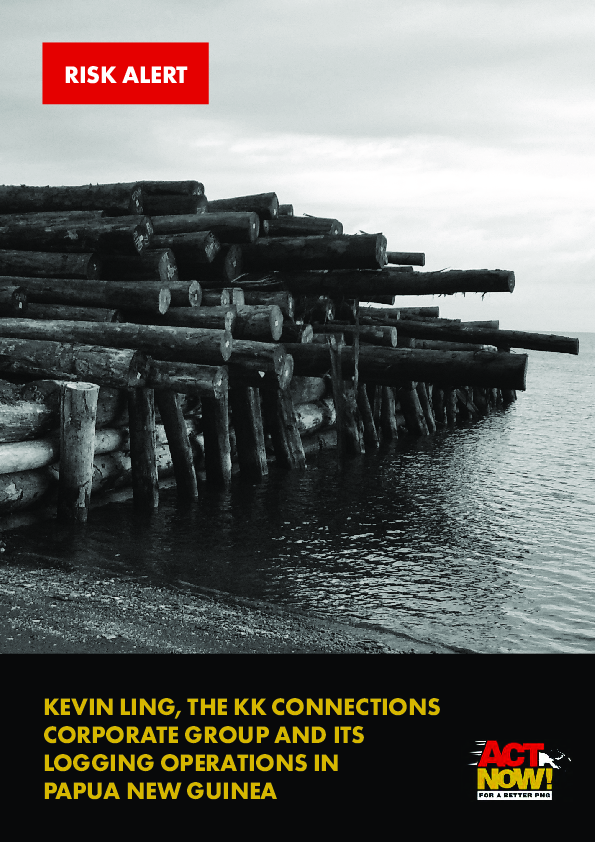
      Cover image: Tropical rainforest logs from the Mengen FCA concession in East New Britain Province ready for export, 2023


KEVIN LING, THE KK CONNECTIONS CORPORATE GROUP AND ITS LOGGING OPERATIONS IN PAPUA NEW GUINEA                                    1

      SUMMARY
      Business: The KK Connections corporate group
      Principal shareholder(s): Kuok Tiang Ling (Kevin Ling), Han Hook See, Jiangfeng Zhang
      Primary geographical areas of operation: East New Britain Province, Papua New Guinea.
      Primary business areas: Forestry, agriculture, construction and manufacturing


      LINKED COMPANIES IN PAPUA NEW GUINEA:
      KK Connections Limited; K L Connections Limited; KKC Sawmill Limited; KKC Veneer Limited; KKC Veneer No.2 Limited;
      KKC Balsa Limited; Laloani No.8 Limited; Westenders Limited; Chain Reaction Limited; G88 Limited; PL Connections Limited;
      KKCV Supermarket Limited.


      RISKS IDENTIFIED
      Credible evidence collated in this report indicates there is an elevated compliance risk associated with certain KK Group
      companies operating in Papua New Guinea due to: (1) historical corporate and personnel linkages with the Kerawara Group,
      an operator subject to adverse judicial findings concerning unlawful logging and governance failures; (2) participation in
      logging operations conducted under Forest Clearing Authority (FCA) permits, a licensing pathway identified in national
      inquiries and sectoral reviews as presenting heightened risks of regulatory non-compliance; (3) documented concerns in
      Commission of Inquiry proceedings regarding landowner consent processes linked to projects associated with KK Group
      entities; (4) judicial findings declaring FCA permit 15-10 (Dengnenge ‘A’) invalid due to deficiencies in mandatory consent
      verification procedures; (5) reported asymmetries in access to independent legal and technical advice affecting landowner
      participation in certain project approval processes; and (6) satellite-image-supported civil society reporting raising questions
      regarding the relationship between authorised agricultural development objectives and observed logging activity in selected
      concession areas.


      RELEVANT STAKEHOLDERS
      Given the risks identified in this report, these findings will be of direct relevance to organisations with anti-money laundering
      (AML), environmental compliance, and human-rights due-diligence obligations, with particular application to: (1) financial
      institutions, including commercial banks, development finance providers, and non-bank lenders; (2) commodities traders
      and timber purchasers; (3) corporate service providers and trust and company service professionals; (4) accounting and
      audit firms; (5) legal advisers engaged in project structuring, financing, or concession support; (6) shipping companies,
      freight operators, and port service providers involved in timber export logistics; and (7) machinery suppliers, infrastructure
      contractors, and other service providers supporting forestry and associated agricultural concession projects.


KEVIN LING, THE KK CONNECTIONS CORPORATE GROUP AND ITS LOGGING OPERATIONS IN PAPUA NEW GUINEA                                             2
      CONTENTS
      EXECUTIVE SUMMARY                                                                                 4

      1.    INTRODUCTION                                                                                5
            1.1 WHY RISK ALERTS?                                                                        5
            1.2 CRITERIA FOR SELECTING THE KK GROUP                                                     6
            1.3 REPORT STRUCTURE                                                                        7

      2.    KK GROUP CORPORATE STRUCTURE                                                                8
            2.1 CORE KK GROUP ENTITIES                                                                  8

      3.    IDENTIFIED RISK FACTORS                                                                    11
            3.1 LEGACY RISKS: THE KERAWARA GROUP                                                       11
               3.1.1 Kerawara Group and KK Group - the Ties                                            11
               3.1.2 Sir Hugo Berghuser and the Barnett Commission of Inquiry                          13
               3.1.3 Illegal Logging and Alleged Collusion with National Forestry Authority Officers   13
               3.1.4 Ray Cheong and Contempt of Court                                                  14
               3.1.5 Review Findings Published by the Department of National Planning and Monitoring   16
               3.1.6 Forestry and Conservation Project (FCP) Review Findings (2003)                    17
               3.1.7 DNPM Individual Project Review – TP 13-38 Buhem Mongi Busiga (2004)               18
               3.1.8 Conclusion                                                                        18
            3.2 CONTEMPORARY RISKS: THE KK GROUP                                                       19
               3.2.1 The Commission of Inquiry into Special Agricultural and Business Leases (SABL)    20
               3.2.2 KK Group and Forest Clearing Authority Compliance                                 24
               3.2.3 KK Group and Landowner consent                                                    25
               3.2.4 Conclusion                                                                        25

      4.    RISK EXPOSURE OF OUTSIDE ORGANISATIONS                                                     26
            4.1 FINANCE AND PROFESSIONAL SERVICES                                                      26
            4.2 VENTURE PARTNERS                                                                       27
               4.2.1 Shin Yang Group                                                                   27
               4.2.2. Ningbo Yongli                                                                    28

      5.    CONCLUSION                                                                                 29
            5.1 THE KK GROUP                                                                           29
            5.2 THE WIDER CONTROL ENVIRONMENT IN PAPUA NEW GUINEA                                      29


KEVIN LING, THE KK CONNECTIONS CORPORATE GROUP AND ITS LOGGING OPERATIONS IN PAPUA NEW GUINEA               3
      EXECUTIVE SUMMARY
      This Risk Alert examines the corporate structure, operational footprint, and compliance risk environment associated
      with the KK Connections corporate group (“KK Group”), a Malaysian-owned forestry operator active primarily in East
      New Britain Province, Papua New Guinea. It forms part of ACT NOW!’s ongoing programme to support risk-based
      monitoring of forestry-sector participants operating within Papua New Guinea.

      Papua New Guinea’s forestry sector is widely recognised as presenting heightened compliance risks. National and
      international assessments have estimated that illegal logging may account for between 70% and 90% of exported timber
      by value, while recent analyses suggest illicit financial flows associated with forestry crime may exceed revenues generated
      through the legal timber market. Forest Clearing Authorities (FCAs)—a licensing pathway intended to support agricultural
      development—have been identified in multiple reviews as presenting particular governance vulnerabilities where logging
      activity appears to precede or substitute for genuine land conversion.

      Against this sectoral backdrop, the KK Group was selected for review due to the scale of its operations and its
      concentration within East New Britain Province, a region that has accounted for a substantial proportion of FCA-related
      exports in Papua New Guinea over the past decade. Export monitoring data indicates that KK Group entities have ranked
      among the largest log exporters nationally, including topping recorded export volumes in 2022.

      The report presents a number of core analyses designed to assist frontline professionals monitoring risk in Papua New
      Guinea’s forestry sector.

      First, the report documents historical corporate and personnel linkages between the KK Group and the Kerawara Group,
      a forestry operator whose activities were subject to adverse judicial findings and critical oversight-body observations
      relating to unlawful logging, governance failures, regulatory breaches, and criminal contempt of court. From a compliance
      perspective, such legacy connections between the two forestry groups may increase exposure to governance-continuity
      risks where operational practices and institutional relationships persist across successor or affiliated entities.

      Second, the report reviews evidence relating to aspects of the KK Group’s contemporary operations, particularly those
      conducted under Forest Clearing Authority permits. Material examined by the Commission of Inquiry into Special
      Agricultural and Business Leases (2011–2013), together with subsequent civil society investigations and judicial findings,
      point to concerns in certain concession areas regarding landowner consent processes, licence documentation, and the
      relationship between authorised agricultural development objectives and actual observed logging activity. While these
      matters do not establish wrongdoing by the KK Group, they highlight features of the operational environment that
      reasonably warrant enhanced scrutiny from an AML and due-diligence perspective.

      Taken together, the material reviewed indicates that the KK Group operates at scale within a forestry governance
      environment widely recognised as presenting elevated compliance risk signals. Its operational footprint is concentrated
      in concession types and geographic areas that have been the subject of sustained regulatory and investigative attention.
      Historical personnel linkages with earlier forestry operators subject to adverse judicial findings further contribute to a
      composite organisational risk profile that warrants careful consideration by stakeholders applying risk-based monitoring
      frameworks.

      Consistent with the objectives of the Risk Alert series, this report is intended as an intelligence resource to assist
      compliance professionals, law-enforcement agencies, and commercial counterparties in applying proportionate due-
      diligence measures in relation to forestry-sector engagement in Papua New Guinea. It should be read as a contribution
      to risk assessment, not as a determination of liability or wrongdoing.


KEVIN LING, THE KK CONNECTIONS CORPORATE GROUP AND ITS LOGGING OPERATIONS IN PAPUA NEW GUINEA                                        4
      1.0 INTRODUCTION

      1.1 WHY RISK ALERTS?
      Anti-money laundering (AML) provides a critical framework for identifying, monitoring, and disrupting networks linked
      to environmental crime. However, the effectiveness of AML depends in part on compliance professionals and law-
      enforcement agencies having access to reliable intelligence on higher-risk sectors, activities, and actors. In practice,
      such intelligence is not always readily available.

      As a result, the Financial Action Task Force (FATF) argues that in specialist sectors such as forestry, civil society
      organisations can play an important role in supplying actionable intelligence to the wider compliance community.1

      This observation is particularly relevant to forestry activity in Papua New Guinea, where forestry and corporate data can
      be difficult to access, verify, and assess from a compliance perspective.

      This matters because Papua New Guinea is a region of high ecological significance, containing the world’s third-largest
      rainforest and forming part of New Guinea’s globally significant tropical forest biome.2

      Moreover, country-level risks associated with illegal logging in Papua New Guinea are widely regarded as substantial.
      In its 2017 National Risk Assessment, the country’s central bank cited research suggesting that illegal logging may account
      for “between 70 and 90 percent of the total product exported,” measured by value.3

      Forest Trends’ Timber Legality Risk Dashboard classified Papua New Guinea within its highest risk category, assigning a
      score of 83.4 out of 100.4

      Recent international analyses have estimated that illicit proceeds linked to forestry-related crime in Papua New Guinea
      may exceed revenues generated through the legal timber market. According to studies conducted by the UNODC Law
      Enforcement Assistance Programme (LEAP), illicit financial flows from forestry crimes in Papua New Guinea are estimated
      to amount to between 80% and 130% of the value of the licit timber market.5

      Certain categories of logging licences have also been identified as presenting heightened AML and compliance risks. Over
      the past decade, these concerns have centred largely on Forest Clearing Authorities (FCAs). Although FCAs are intended
      under the Forestry Act 1991 to permit forest clearing for genuine agricultural or development purposes, available analyses
      suggest they have at times been used to facilitate large-scale logging operations without corresponding agricultural
      development or, in some cases, without adequate landowner consent.

      Civil society investigations indicate that logs harvested under FCA permissions may account for approximately one-third
      of Papua New Guinea’s total log exports and that such logs can present elevated risks of legal non-compliance.

      Forest Trends observes that: “Forest clearance permits intended for agricultural development, often used as a pretext for
      gaining access to timber, have become a major source of logs exported from PNG over the last decade. These permits are
      frequently issued illegally and without transparency or due process, in particular violating laws around customary land
      rights”.6 The same report further notes that “the clearance of primary forests, ostensibly for conversion to agriculture, has
      increased dramatically and accounted for 20–30 percent of the volume of logs exported each year since 2010”.7

      These conclusions are supported by the Bank of Papua New Guinea in its sectoral review of forestry. The Bank concludes,
      “that no agricultural, economic, or other land use activities were developed on the areas cleared under these permits”.8

      Illegal logging activities are prohibited and subject to penalties under the regulatory offence provisions of the Forestry
      Act 1991.9


KEVIN LING, THE KK CONNECTIONS CORPORATE GROUP AND ITS LOGGING OPERATIONS IN PAPUA NEW GUINEA                                         5
      To support integrated risk monitoring by national and international stakeholders, Act Now! is publishing a series of Risk
      Alerts focusing on specific forestry participants. These alerts identify operators where the scale, nature, location, and
      operational characteristics of logging activities may indicate elevated levels of compliance risk.

      Risk is not an accusation of wrongdoing. Rather, it is an estimation—based on environmental, organisational, and
      personnel circumstances—of the potential for wrongdoing. The riskier the circumstances, the greater the potential for
      wrongdoing. High-risk environments and/or high-risk actors therefore require enhanced levels of due diligence to ensure
      that all operations are compliant with the law.

      Therefore, this publication series does not make findings of illegality or criminal wrongdoing. Rather, it documents
      indicators of elevated risk associated with particular forestry participants in Papua New Guinea, and it provides reference
      to the underlying data sources on which those indicators are based. The publications are intended as an intelligence
      resource to assist compliance professionals and law-enforcement agencies in applying risk-based monitoring, due-
      diligence, and investigative scrutiny, set against the challenging monitoring environment in Papua New Guinea.


      1.2 CRITERIA FOR SELECTING THE KK GROUP
      This Risk Alert focuses on the KK Group, a Malaysian-owned forestry operator primarily active in Papua New Guinea’s
      East New Britain Province.

      There are several reasons for selecting this forestry participant for further assessment.

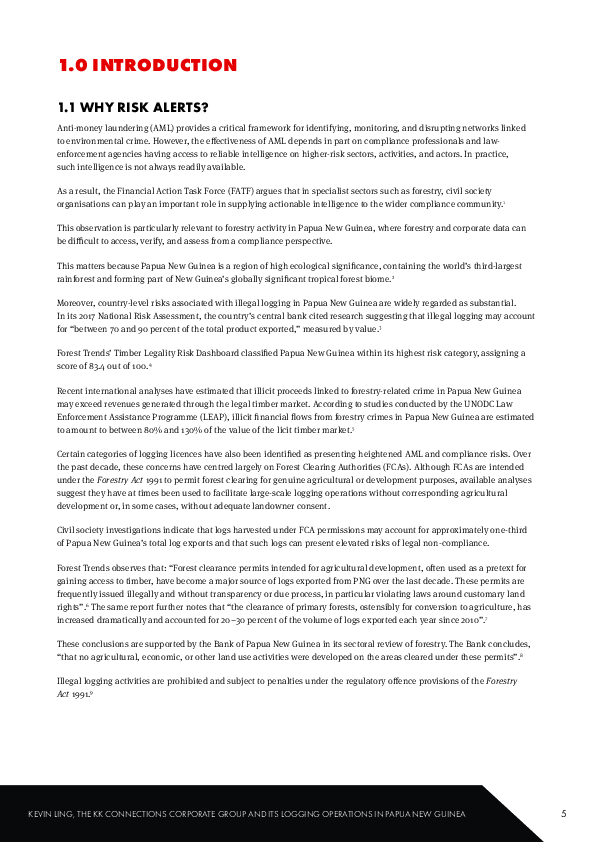
      East New Britain has been among the top three provinces in Papua New Guinea for log exports over the past decade,
      with a significant proportion of logs extracted under Forest Clearing Authorities (FCAs).10 Analysis of national export data
      indicates that East New Britain accounted for approximately 45% of total FCA-related log exports in Papua New Guinea
      between 2016 and 2023.11


      IMAGE: Papua New Guinea’s East New Britain Province12


KEVIN LING, THE KK CONNECTIONS CORPORATE GROUP AND ITS LOGGING OPERATIONS IN PAPUA NEW GUINEA                                        6
      As in other regions of Papua New Guinea, reported irregularities have been identified in forestry projects in East New
      Britain operating under FCAs. Investigations and satellite imagery have documented what appears to be extensive selective
      logging under FCA permits, rather than forest clearance for agricultural development as required by law, particularly
      within the Makolkol, Dengnenge, and Mengen areas.13 Court proceedings, including complaints concerning landowner
      consent and alleged procedural irregularities in licence issuance, further indicate elevated systemic risk factors in East
      New Britain.14

      KK Group is one of the most active forestry participants in East New Britain and, more broadly, within Papua New Guinea.
      The logging monitor Société Générale de Surveillance (SGS) observed that: “KK Connections Ltd group of companies
      topped the [national] log volume export in 2022 with 273,126 m3 followed by Rimbunan Hijau (PNG) Ltd group of
      companies with 261,404 m3”.15

      Given the scale of the KK Group’s operations in a sector and province exhibiting elevated signals of risk, it was shortlisted
      for further examination.

      This involved an in-depth corporate mapping exercise drawing on contemporary and historical corporate filings from
      Papua New Guinea and Malaysia. Data on shareholders, directors, managers, and related entities were tabulated and
      incorporated into network diagrams. SGS monitoring data were then used to identify concessions associated with KK
      Group entities and close affiliates. Together, this generated a structured map of relevant actors and operations. Each actor
      and operation was subsequently examined using verified open-source intelligence, including Commission of Inquiry
      reports and transcripts, court decisions, Ombudsman Commission reports, Auditor General reports, published research,
      and media reporting. These materials were triangulated to develop a risk profile of the group.


      1.3 REPORT STRUCTURE
      This report is structured in four parts.

      Section 2 outlines the corporate structure of the KK Group based on available registry filings and export monitoring
      data. It identifies core entities and associated companies operating in Papua New Guinea and summarises the Group’s
      organisational footprint within the forestry sector.

      Section 3 examines identified risk factors relevant to the Group’s compliance profile. It first reviews legacy risk indicators
      associated with the Kerawara Group, given documented historical personnel and operational linkages. It then considers
      evidence relating to aspects of the KK Group’s contemporary operations, including material arising from Commissions
      of Inquiry, judicial decisions, and civil society reporting concerning concession activity conducted under Forest Clearing
      Authority permits.

      Section 4 identifies areas of potential exposure for external organisations linked to KK Group operations, including
      financial institutions, professional service providers, trading partners, and project collaborators. These relationships
      are considered from a risk-based due-diligence perspective.

      Section 5 summarises the report’s findings and highlights their relevance for stakeholders applying compliance,
      monitoring, and enhanced due-diligence frameworks to the forestry-sector in Papua New Guinea.


KEVIN LING, THE KK CONNECTIONS CORPORATE GROUP AND ITS LOGGING OPERATIONS IN PAPUA NEW GUINEA                                          7
      2. KK GROUP CORPORATE STRUCTURE
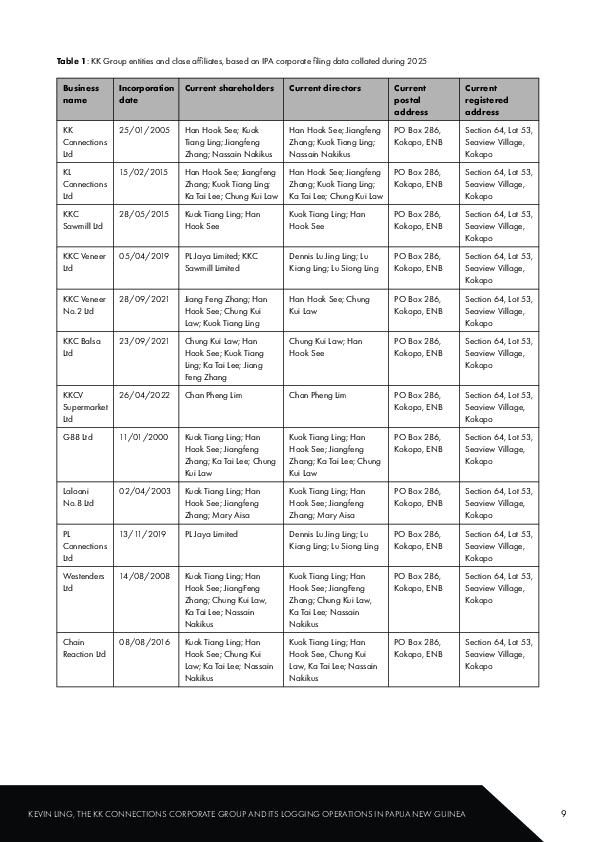
      The KK Group comprises a cluster of related companies registered in Papua New Guinea and headquartered at Section
      64, Lot 53, Seaview Village, East New Britain Province (see Table 1). The group operates primarily in logging, sawmilling,
      veneer production, and agricultural activities.

      The group was founded by Kuok Tiang Ling, who uses the anglicised name Kevin Ling. Ling is a Malaysian national based
      in East New Britain Province and was previously a senior employee of the Kerawara Group, a Malaysian-owned forestry
      operator active in the same province.


      2.1 CORE KK GROUP ENTITIES
      The KK Group does not appear to maintain a publicly accessible company website. No publicly available evidence could be
      identified of annual reports or other forms of voluntary corporate disclosure online. Statutory filings are available through
      Papua New Guinea’s corporate registry; however, these filings are limited to basic company information. Historical corporate
      records predating the 2022-23 upgrade of the corporate register are not currently accessible.

      The Papua New Guinea Forest Authority is legally required to maintain a public register of forestry licences and
      participants. At the time of review, such a register was not publicly accessible.

      As a result of these information constraints, the corporate structure of forestry operators in Papua New Guinea must be
      reconstructed using the limited filings available through the national corporate registry administered by the Investment
      Promotion Authority (IPA). These records can then be triangulated with export monitoring data published by SGS, which
      allow forestry concessions and export volumes to be identified. Independent databases, including PNGi Portal, PNGi
      Forests, and OCCRP’s Aleph, further supplement the limited official sources.

      Through a manual corporate-mapping exercise drawing on available filings and databases, the core companies that appear
      to comprise the KK Group or are closely affiliated, are outlined in Table 1.


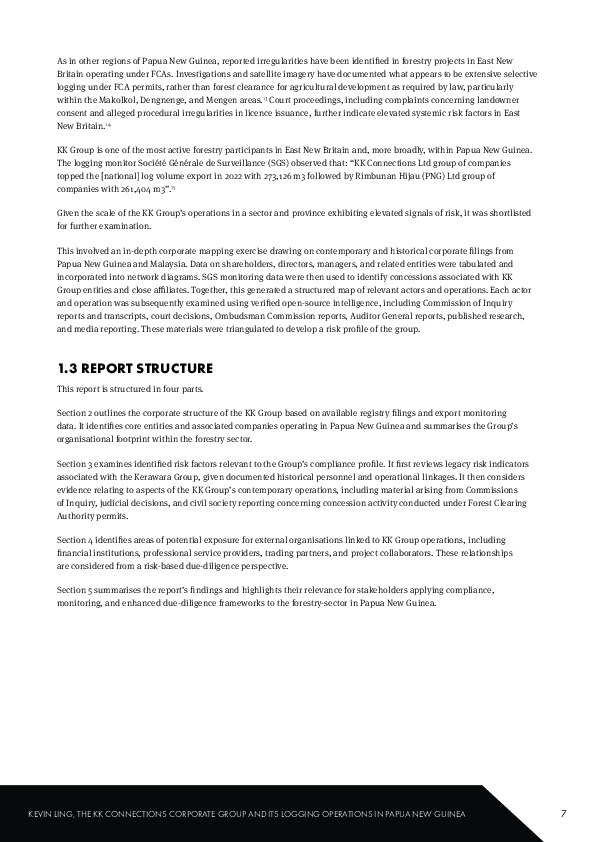
      IMAGE: Tropical rainforest logs from the Mengen FCA concession waiting for export, 2023


KEVIN LING, THE KK CONNECTIONS CORPORATE GROUP AND ITS LOGGING OPERATIONS IN PAPUA NEW GUINEA                                         8
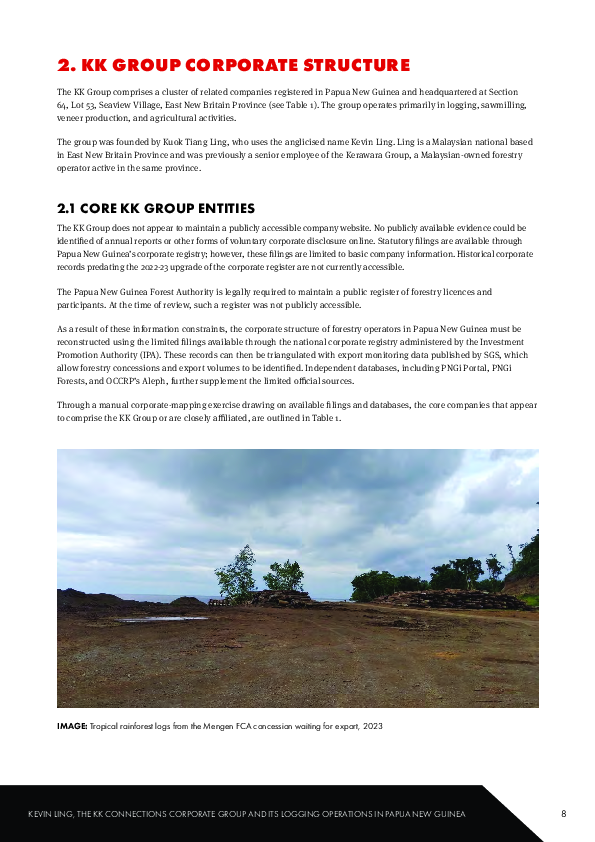
      Table 1: KK Group entities and close affiliates, based on IPA corporate filing data collated during 2025


       Business        Incorporation     Current shareholders          Current directors            Current       Current
       name            date                                                                         postal        registered
                                                                                                    address       address

       KK              25/01/2005        Han Hook See; Kuok            Han Hook See; Jiangfeng      PO Box 286,   Section 64, Lot 53,
       Connections                       Tiang Ling; Jiangfeng         Zhang; Kuok Tiang Ling;      Kokopo, ENB   Seaview Village,
       Ltd                               Zhang; Nassain Nakikus        Nassain Nakikus                            Kokopo

       KL              15/02/2015        Han Hook See; Jiangfeng       Han Hook See; Jiangfeng      PO Box 286,   Section 64, Lot 53,
       Connections                       Zhang; Kuok Tiang Ling;       Zhang; Kuok Tiang Ling;      Kokopo, ENB   Seaview Village,
       Ltd                               Ka Tai Lee; Chung Kui Law     Ka Tai Lee; Chung Kui Law                  Kokopo

       KKC             28/05/2015        Kuok Tiang Ling; Han          Kuok Tiang Ling; Han         PO Box 286,   Section 64, Lot 53,
       Sawmill Ltd                       Hook See                      Hook See                     Kokopo, ENB   Seaview Village,
                                                                                                                  Kokopo

       KKC Veneer      05/04/2019        PL Jaya Limited; KKC          Dennis Lu Jing Ling; Lu      PO Box 286,   Section 64, Lot 53,
       Ltd                               Sawmill Limited               Kiong Ling; Lu Siong Ling    Kokopo, ENB   Seaview Village,
                                                                                                                  Kokopo

       KKC Veneer      28/09/2021        Jiang Feng Zhang; Han         Han Hook See; Chung          PO Box 286,   Section 64, Lot 53,
       No.2 Ltd                          Hook See; Chung Kui           Kui Law                      Kokopo, ENB   Seaview Village,
                                         Law; Kuok Tiang Ling                                                     Kokopo

       KKC Balsa       23/09/2021        Chung Kui Law; Han            Chung Kui Law; Han           PO Box 286,   Section 64, Lot 53,
       Ltd                               Hook See; Kuok Tiang          Hook See                     Kokopo, ENB   Seaview Village,
                                         Ling; Ka Tai Lee; Jiang                                                  Kokopo
                                         Feng Zhang

       KKCV            26/04/2022        Chan Pheng Lim                Chan Pheng Lim               PO Box 286,   Section 64, Lot 53,
       Supermarket                                                                                  Kokopo, ENB   Seaview Village,
       Ltd                                                                                                        Kokopo

       G88 Ltd         11/01/2000        Kuok Tiang Ling; Han          Kuok Tiang Ling; Han         PO Box 286,   Section 64, Lot 53,
                                         Hook See; Jiangfeng           Hook See; Jiangfeng          Kokopo, ENB   Seaview Village,
                                         Zhang; Ka Tai Lee; Chung      Zhang; Ka Tai Lee; Chung                   Kokopo
                                         Kui Law                       Kui Law

       Laloani         02/04/2003        Kuok Tiang Ling; Han          Kuok Tiang Ling; Han         PO Box 286,   Section 64, Lot 53,
       No.8 Ltd                          Hook See; Jiangfeng           Hook See; Jiangfeng          Kokopo, ENB   Seaview Village,
                                         Zhang; Mary Aisa              Zhang; Mary Aisa                           Kokopo

       PL              13/11/2019        PL Jaya Limited               Dennis Lu Jing Ling; Lu      PO Box 286,   Section 64, Lot 53,
       Connections                                                     Kiong Ling; Lu Siong Ling    Kokopo, ENB   Seaview Village,
       Ltd                                                                                                        Kokopo

       Westenders      14/08/2008        Kuok Tiang Ling; Han          Kuok Tiang Ling; Han         PO Box 286,   Section 64, Lot 53,
       Ltd                               Hook See; JiangFeng           Hook See; JiangFeng          Kokopo, ENB   Seaview Village,
                                         Zhang; Chung Kui Law,         Zhang; Chung Kui Law,                      Kokopo
                                         Ka Tai Lee; Nassain           Ka Tai Lee; Nassain
                                         Nakikus                       Nakikus

       Chain           08/08/2016        Kuok Tiang Ling; Han          Kuok Tiang Ling; Han         PO Box 286,   Section 64, Lot 53,
       Reaction Ltd                      Hook See; Chung Kui           Hook See, Chung Kui          Kokopo, ENB   Seaview Village,
                                         Law; Ka Tai Lee; Nassain      Law, Ka Tai Lee; Nassain                   Kokopo
                                         Nakikus                       Nakikus


KEVIN LING, THE KK CONNECTIONS CORPORATE GROUP AND ITS LOGGING OPERATIONS IN PAPUA NEW GUINEA                                           9
      KK Group entities comprise companies predominantly engaged in timber harvesting, log export, and associated
      agricultural and infrastructure projects in Papua New Guinea.

      Corporate filings and testimony before the Commission of Inquiry into Special Agriculture and Business Leases (SABL
      Commission) indicate that a relatively small and recurring group of individuals appear across multiple entities as founders,
      directors, shareholders, or key personnel.

      Kuok Tiang Ling (also known as Kevin Ling) is identified in SABL Commission proceedings as the founder and Managing
      Director of key group entity, KK Connections Ltd.16 Ling confirmed to the inquiry that he had previously worked as a senior
      employee of the Kerawara Group until approximately 2006, after which he established KK Connections Ltd.17

      In his testimony, Ling described himself as the principal of KK Connections and outlined the company’s role as a developer
      and contractor across projects in East New Britain Province.18 He stated that KK Connections was involved in road
      construction, logging operations, and agricultural developments associated with SABL-related projects.19

      Corporate registry records identify several key KK Group shareholders and directors, including Kuok Tiang Ling (Malaysian
      national, born 02/1966), Nassain Nakikus (Papua New Guinea national, born 11/1955), Han Hook See (Malaysian national,
      born 08/1963), and Jiangfeng Zhang (Chinese national, born 10/1976).

      A fifth individual, Ray Chee Keong Cheong, was identified in a 2013 media report as General Manager of KK Connections
      Ltd, following his participation in site inspections of KK Connections’ road and bridge construction works in the Inland
      Baining area.20 Judicial and corporate records indicate that, prior to his reported role at KK Connections Ltd, Cheong served
      as a Director at Kerawara Limited.21

      Attention will now turn to the risks associated with KK Group entities or personnel.


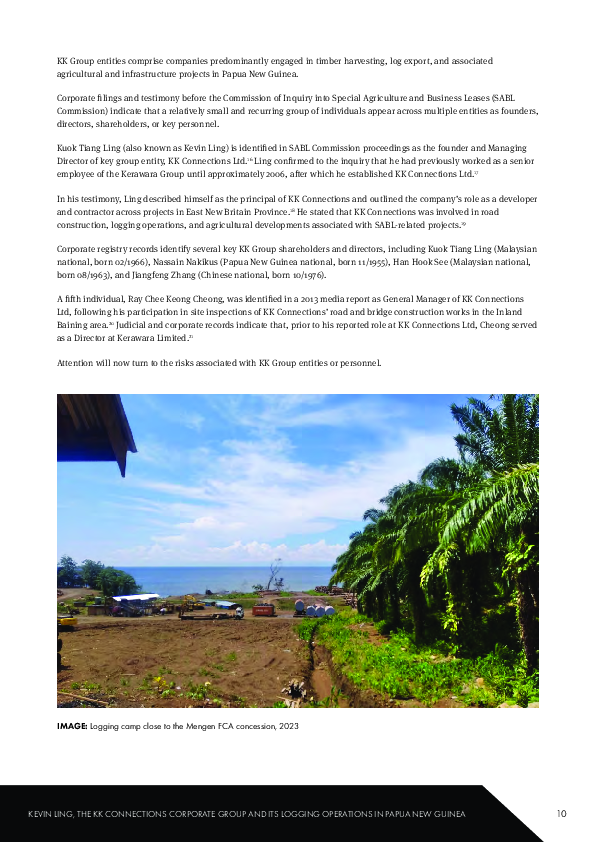
      IMAGE: Logging camp close to the Mengen FCA concession, 2023


KEVIN LING, THE KK CONNECTIONS CORPORATE GROUP AND ITS LOGGING OPERATIONS IN PAPUA NEW GUINEA                                         10
      3. IDENTIFIED RISK FACTORS
      As one of Papua New Guinea’s most active forestry participants over the past fifteen years, and given its involvement in
      large-scale round log exports, the KK Group is assessed as presenting a baseline moderate-to-high risk profile based on
      systemic environmental considerations.

      Risk is not an accusation of wrongdoing. Rather, it is an estimation—based on environmental, organisational, and
      personnel circumstances—of the potential for wrongdoing. The riskier the circumstances, the greater the potential for
      wrongdoing. High-risk environments and/or high-risk actors therefore require enhanced levels of due diligence to ensure
      that all operations are compliant with the law.

      This baseline profile for the KK Group reflects country-level estimates of illegal logging prevalence and documented
      governance weaknesses in the forestry sector, including in East New Britain Province. These factors increase the likelihood
      that forestry participants may be involved in improper activity. They do not constitute confirmation that any such activity
      has occurred.

      This preliminary risk estimate may be mitigated or heightened by group-specific indicators identified through further review.

      This section summarises the available evidence supporting an assessment that the KK Group presents elevated
      organisational risk indicators from a compliance perspective.


      3.1 LEGACY RISKS: THE KERAWARA GROUP
      This section summarises publicly documented risk factors associated with the Kerawara Group. Kerawara is a forestry
      participant that is separate from the KK Group. It is included in the risk profile as Kerawara Group is reported to have
      historical operational and personnel linkages with the KK Group.


      3.1.1 - Kerawara Group and KK Group - the Ties
      As noted, the KK Group has had historical operational and personnel linkages with the Kerawara Group, a Malaysian-
      owned forestry participant that was particularly active during the 1990s and 2000s, with a concentration of operations in
      East New Britain Province.22 The Kerawara Group’s principal entity was Kerawara Limited, registered on 27 August 1992.
      Its operations were supported by related companies, including Hugo Sawmilling Ltd and Seribu Daya (PNG) Ltd, which
      were involved in the harvesting, processing, and export of round logs. Other entities associated with the Kerawara Group
      included Richard Gault Industries.

      Corporate records, judicial decisions and Commission of Inquiry evidence indicate that Kuok Tiang Ling (also known as
      Kevin Ling) and Ray Chee Keong Cheong held senior roles within Kerawara’s corporate network. When questioned at the
      Commission of Inquiry into Special Agriculture and Business Leases (COI SABL), Kevin Ling stated that prior to 2006 he
      had been employed by the Kerawara Group before establishing KK Connections Ltd.23

      A decision of the National Court of Papua New Guinea records that Kevin Ling also served as General Manager of
      related entity Hugo Sawmilling in or around 200124, while corporate filings show that Ray Cheong was a director of Hugo
      Sawmilling between 2002 and 2004. Both Kerawara Limited and Hugo Sawmilling were engaged in logging and the export
      of round logs.25 Politician and businessman Sir Hugo Berghuser was a shareholder in Hugo Sawmilling until 2001
      (see 3.1.2).

      Judicial records further indicate that Ray Cheong served as a director and senior officer within Kerawara-linked entities
      in the late 1990s and early 2000s and was subsequently named in court proceedings relating to Kerawara’s forestry
      operations.26


KEVIN LING, THE KK CONNECTIONS CORPORATE GROUP AND ITS LOGGING OPERATIONS IN PAPUA NEW GUINEA                                         11
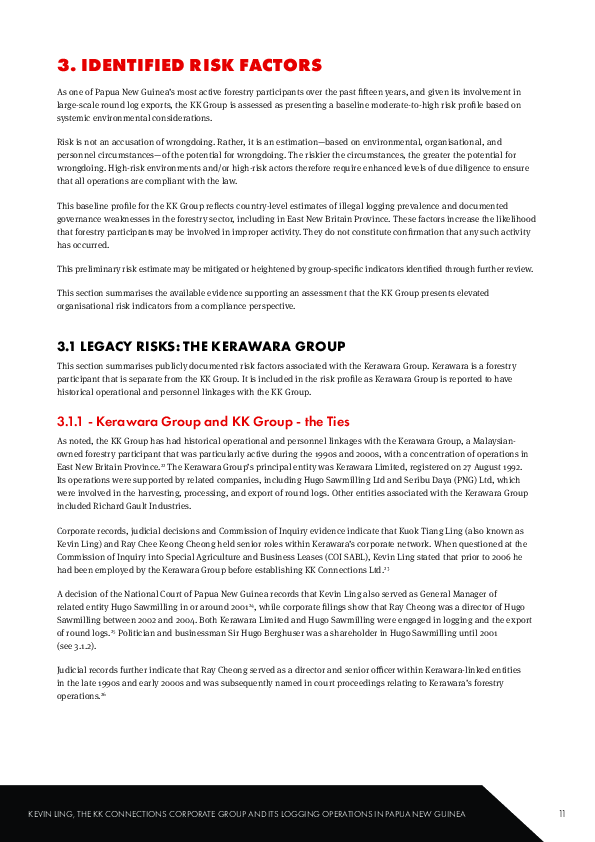
      Table 2: Shareholders and Office Holders, Kerawara Limited, 1998-200627

       Year     Shareholders                                    Directors                                    Secretary

       1998     You Hu Hwong (50%), Yih Wei Hwong (50%)         You Hu Hwong, Yih Wei Hwong                  Hwong You Soon
                                                                                                             (James Hwong)

       1999     Tung Leh Ling (50%), Bin Lopidi Genol (50%)     Tung Leh Ling, Bin Lopidi Genol              Hwong You Soon

       2000     Tung Leh Ling (50%), Bin Lopidi Genol (50%)     Tung Leh Ling, Bin Lopidi Genol              Hwong You Soon

       2001     Kong Fah Chong (50%), Kee Hui Lim (50%)         Kong Fah Chong, Kee Hui Lim, Boon Shin Kok   Hwong You Soon

       2002     Kong Fah Chong (100%),                          Kong Fah Chong, Ray Cheong, William Gary     Hwong You Soon

       2003     Kong Fah Chong (100%),                          Kong Fah Chong, Ray Cheong, William Gary     Hwong You Soon

       2004     Kong Fah Chong (100%),                          Kong Fah Chong, Ray Cheong, William Gary     Hwong You Soon

       2005     Kong Fah Chong (100%),                          Kong Fah Chong                               Hwong You Soon

       2006     Kong Fah Chong (100%),                          Kong Fah Chong                               Hwong You Soon


      Table 3: Shareholders and Office Holders, Hugo Sawmilling, 1998-200628

       Year     Shareholders                                          Directors                                   Secretary

       1998     Sir Hugo Berghuser (51%), Kerawara Limited (49%)      Sir Hugo Berghuser, Kong Fah Chong

       1999     Sir Hugo Berghuser (51%), Kerawara Limited (49%)      Sir Hugo Berghuser, Kong Fah Chong

       2000     Sir Hugo Berghuser (51%), Kerawara Limited (49%)      Kong Fah Chong

       2001     Sir Hugo Berghuser (51%), Kerawara Limited (49%)      Kong Fah Chong

       2002     Yih Siang Hwong (51%), Kerawara Limited (49%)         Kong Fah Chong, Ray Cheong, William Gary

       2003     Yih Siang Hwong (51%), Kerawara Limited (49%)         Kong Fah Chong, Ray Cheong, William Gary

       2004     Yih Siang Hwong (51%), Kerawara Limited (49%)         Kong Fah Chong, Ray Cheong, William Gary

       2005     Yih Siang Hwong (51%), Kerawara Limited (49%)         Kong Fah Chong

       2006     Yih Siang Hwong (51%), Allan Wong Tin Chai (49%)      Allan Wong Tin Chai                         Fausto Galamiton


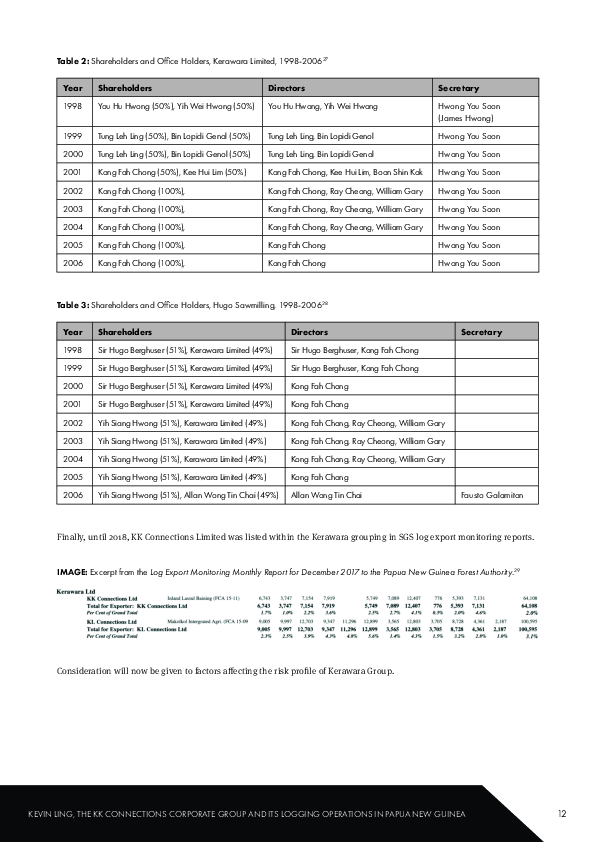
      Finally, until 2018, KK Connections Limited was listed within the Kerawara grouping in SGS log export monitoring reports.


      IMAGE: Excerpt from the Log Export Monitoring Monthly Report for December 2017 to the Papua New Guinea Forest Authority.29


      Consideration will now be given to factors affecting the risk profile of Kerawara Group.


KEVIN LING, THE KK CONNECTIONS CORPORATE GROUP AND ITS LOGGING OPERATIONS IN PAPUA NEW GUINEA                                        12
      3.1.2 - Sir Hugo Berghuser and the Barnett Commission of Inquiry
      Kerawara Group maintained historical ties with politician and businessman Sir Hugo Berghuser. From a compliance
      perspective, such associations may give rise to heightened political exposure risk. These risks are amplified by the official
      scrutiny of Sir Hugo Berghuser in the Barnett Commission of Inquiry.

      In 1987, Justice Tos Barnett was commissioned to lead the landmark Commission of Inquiry into Aspects of the Forestry
      Industry30. Forestry expert Dr Colin Filer summarised the Inquiry’s findings as follows: “The Barnett Inquiry found that the
      logging industry of the 1980s was dominated by a set of unequal and unfair relationships between foreign (mostly Asian)
      logging companies and ‘landowner companies’ that were typically established by local politicians to serve their own
      personal interests rather than those of the majority of landowners in each logging concession.”31

      During the course of the Inquiry, a number of proposed timber projects came to Justice Barnett’s attention that were
      considered sufficiently serious to warrant Interim Report No. 7.32

      This interim report documents evidence reviewed by the Commission indicating that Sir Hugo Berghuser MP’s company,
      Superior Tropical Timbers, was at the time heavily indebted and in receivership. The Commission records that Sir Hugo
      developed a proposal under which he would obtain a logging and marketing agreement to operate a Timber Rights
      Purchase (TRP) area on the Rai Coast of Madang, with the intention that the TRP would subsequently be assigned to a
      foreign developer.33 The Commission stated that the MP would “use his ‘good offices’ with the Ministers for Forests to
      obtain approval to assign the contract to the selected contractor”.34

      An internal document reviewed by the Commission indicated that the foreign operator would be incentivised through a
      proposed transfer-pricing arrangement that could reduce Papua New Guinea tax liabilities on exported logs. In return,
      “Mr Berghuser anticipated receiving K300,000 per annum once his contractual rights in the Rai Coast had been sub-
      contracted ... this sum would be used by the bank to offset Sir Hugo’s substantial indebtedness”.35

      Justice Barnett also referred to allegations of a conspiracy involving the then Forestry Minister and Tropical Timbers to
      influence the contract tender process for operation rights over the Rai Coast TRP area by excluding two Malaysian bidders.

      In his conclusions, Justice Barnett stated: “I regard Sir Hugo’s claim that he intends and has always intended, to carry
      out or ‘control’ the operation himself, with the assistance of an unnamed American friend in Singapore as nonsense”.36
      He further observed that “the clear references to proposed transfer pricing raise an element of criminal liability”.37 There is
      no publicly available evidence that Sir Hugo Berghuser was subsequently prosecuted in relation to these matters.

      From an AML perspective, any commercial relationship between a forestry operator and a politically exposed person (PEP)
      may elevate corruption and governance risk exposure. This risk is heightened where official inquiries have raised serious
      concerns regarding probity within the sector and the politically exposed persons role in that sector.


      3.1.3 - Illegal Logging and Alleged Collusion with National Forestry
      Authority Officers
      Further risk indicators relevant to Kerawara’s profile emerge from a decision of the National Court of Papua New Guinea,
      which found that Kerawara Pty Ltd and Richard Gault Industries Pty Ltd were involved in unlawful logging activities and
      collusive conduct with national forestry officials.38

      In Rafflin v Richard Gault Industries Pty Ltd & Kerawara Pty Ltd (1998), the Court recorded that Richard Gault Industries
      Pty Ltd held Timber Licence No. 15-8 over the Warongoi Timber Area, while Kerawara Pty Ltd acted as its joint operational
      partner.39 Justice Woods concluded that the two companies entered the land and removed timber without the consent of
      the landholders, resulting in judgment against them for unlawful logging and trespass.40


KEVIN LING, THE KK CONNECTIONS CORPORATE GROUP AND ITS LOGGING OPERATIONS IN PAPUA NEW GUINEA                                           13
      Justice Woods further noted that both defendants failed to substantively engage with the proceedings:

                 “Whilst the 1st [Richard Gault Industries] and 2nd defendants [Kerawara Pty Ltd] did respond with
                 pleadings early in this matter they have failed to continue with pleadings or appear at mentions over the
                 past year or more in spite of being served with the process and the court has been forced to accept that
                 they are not interested in defending the claims.”41

      The affected plaintiff leaseholders had acquired State Leases in 1991 over the relevant land portions under the Warongoi
      Cocoa Block Scheme, described by the Court as “a project, planned by the Department of Primary Industry, the Provincial
      Government and the Agriculture Bank for the economic development of the area into cocoa production by way of
      smallholder blocks”.42

      The Court found that, one year after the agricultural leases were issued, the Minister for Forests granted a Timber Licence
      over the Warongoi Timber Area to Richard Gault Industries Pty Ltd without lawful authority. In 1993, the defendants
      entered the plaintiffs’ land and “cut down and removed trees,” without separate consent from the plaintiffs.43

      Justice Woods held that the State had no authority to issue a Timber Permit over the plaintiffs’ land and observed that the
      National Forest Authority appeared to have “a very naïve understanding of land rights”.44

      The judgment also addressed the relationship between the defendant companies and forestry officials, stating:

                 “There is evidence that the Lands Department officers in East New Britain had queried the right of the
                 defendant companies to enter onto and log the subject land, but they were overruled by officers of the
                 Department of Forests ... the defendant companies clearly acknowledge that they had no agreement
                 with the lessees to enter and log the land. The evidence suggests that the directors and other officers of
                 the two defendant companies colluded with officers of the Forest Authority to ignore the concerns of
                 the Lands Department officers and deliberately ignored the rights of the landowners and took timber
                 belonging to the plaintiffs”.45

      On the basis of these findings, the Court declared:

                 “The first and second defendants were not entitled to enter onto the land of the plaintiffs and carry on
                 logging operations thereon. I declare that the first and second defendants logging operations on the
                 lands of the plaintiffs were unlawful. I order that the first and second defendants are restrained from
                 entering and carrying on logging operations on the plaintiffs’ lands. I find that there has been a trespass
                 by the first and second defendants, with the active encouragement and support of the Department of
                 Forests and the National Forest Authority, onto the lands of the plaintiffs and that the first and second
                 defendants are liable to pay damages to the plaintiffs for this trespass”.46

      Richard Gault Industries Pty Ltd, Kerawara Pty Ltd, and the State were held liable for K2,306,611.81 in damages.47


      3.1.4 - Ray Cheong and Contempt of Court
      In Daiva v Pukali; Ome Ome Forests Ltd v Cheong (2002), the National Court found senior Kerawara-linked officers and a
      Kerawara executive guilty of contempt of court after funds were withheld from a landowner company in breach of court
      orders and payments were made to individual landowners rather than to the company itself.48 The Court held Ray Chee
      Keong Cheong—who was later reported to hold senior roles within the KK Group—personally liable for contempt in relation
      to breaches of consent orders concerning landowner royalties.49 The judgment further emphasised that the corporate veil
      may be lifted where officers are responsible for unlawful conduct.50

      The complainant was Ome Ome Forests Ltd, a landowner company. Ray Cheong, Jackson Hwong, and William Garey were
      named as the first three defendants.51 Jackson Hwong was Managing Director of Kerawara Limited, while Ray Cheong and
      William Garey were Directors of Kerawara Limited and Hugo Sawmilling Ltd.52


KEVIN LING, THE KK CONNECTIONS CORPORATE GROUP AND ITS LOGGING OPERATIONS IN PAPUA NEW GUINEA                                       14
      The Court observed that Ome Ome had entered into a forestry extraction and marketing agreement with Hugo Sawmilling
      Ltd. Under that agreement, Hugo Sawmilling was required to pay Ome Ome royalties and premiums for each log extracted
      and exported.53 The Court noted that Hugo Sawmilling acted as contractor and Kerawara Limited as subcontractor.54
      A dispute subsequently arose concerning the management of Ome Ome, and legal proceedings commenced in 2001.55

      During the proceedings, Hugo Sawmilling and Kerawara were ordered to withhold royalties and premiums pending resolution
      of the dispute. They were subsequently ordered to release payments totalling K547,000 and to meet Ome Ome’s legal costs.56
      Ome Ome alleged that these orders were not complied with despite service and repeated requests for compliance.57

      Ray Cheong and Jackson Hwong denied knowledge of the relevant court orders. Justice Kandakasi rejected that defence, stating:

                 “I find that both Mr. Cheong and Mr. Hwong have deliberately failed to comply with the orders of this
                 Court especially, those made by consent on the 13th of July, which ordered the payments to be made
                 and released to Ome Ome. I find that, their claim of not being served is simply an attempt at trying to
                 avoid being found guilty of contempt.”58

      With respect to William Garey, the Court found that payments had been made to individual shareholders of Ome Ome
      rather than to the company itself. The Court accepted that divisions existed within Ome Ome concerning the contractor
      and subcontractor arrangements. Justice Kandakasi held that payments were made to shareholders supportive of Kerawara
      Limited and found Garey in contempt. He stated:

                 “I find further that his motivation was to please part of the management and the shareholders
                 [of Ome Ome] that were with him and his company and thereby sideline those who were against
                 him and his company.”59

      The Court noted that Ome Ome’s legal fees had ultimately been paid and therefore excluded that issue from the
      contempt findings.60

      The three defendants argued that, because they were not parties to the original proceedings between Ome Ome, Kerawara
      Limited, and Hugo Sawmilling, they could not be held personally liable. Justice Kandakasi rejected this argument, stating:

                 “... not only did the defendants fail to comply with the orders but they also have failed to retain [the
                 withheld moneys] and [instead] made payments to Ome Ome’s shareholders and not Ome Ome
                 despite the clear terms of the orders. There is no evidence of the defendants drawing to the board of
                 directors of the two companies as to the existence of the orders and the need to comply with them
                 or do something about them to avoid being in contempt. If however, this was done, there should be
                 a board decision regarding the compliance or otherwise of the orders but there is no evidence. This
                 is critical because the payments to the [favoured Ome Ome] shareholders were not payments to
                 the plaintiff [Ome Ome Forests Ltd] going by the separate legal personality principle. Consequently,
                 both HSL [Hugo Sawmilling] and KL [Kerawara] could still be liable to Ome Ome for the amounts
                 due to it but was wrongly paid to the shareholders. It could also amount to a fraud against these
                 two companies to the extent of the payment, which could land the defendants within the ambit of
                 section 421 of the Companies Act 1997. Since the conduct of the defendants were criminal in nature
                 both from the perspective of section 421 of the Companies Act 1997 [misusing company assets] and
                 the contemptuous conduct, I do not consider it appropriate that they should hide behind and take
                 advantage of the corporate veil .... I consider it appropriate to add to the list of circumstances in which
                 the corporate veil could be lift[ed], cases where a crime including contempt of Court is committed. It
                 does not really matter who the crime is committed against ... Applying this to the present case, I find that
                 the defendants were the persons who deliberately decided not to comply with the orders. Not only that,
                 they also chose to act in direct breach of the orders by failing to retain and pay to Ome Ome premiums
                 and other payments due to it. Instead, they chose to and did pay to persons not entitled to receive the
                 payments. This deprived Ome Ome of the amount of money due to it ... I find that the defendants have
                 been correctly named as the defendants to the contempt charges which have been established beyond
                 any reasonable doubt. I therefore return a verdict of guilty against them.”61


KEVIN LING, THE KK CONNECTIONS CORPORATE GROUP AND ITS LOGGING OPERATIONS IN PAPUA NEW GUINEA                                         15
      From a compliance and governance perspective, this judgment is significant. It records criminal contempt findings against
      senior officers of Kerawara and Kerawara-linked entities, including Ray Cheong, who was later reported to hold senior
      roles within the KK Group entities, including as a director of Loloani No. 8 Limited and as General Manager of KK
      Connections Limited.62

      Further adverse observations concerning Kerawara Limited were recorded during the 2002–2004 Department of National
      Planning and Monitoring forestry review, which was supported by the World Bank. The findings are outlined in the
      following section.


      3.1.5 Review Findings Published by the Department of National Planning
      and Monitoring
      The Department of National Planning and Monitoring (DNPM) conducted a review of Papua New Guinea logging projects
      in 2003. As part of that process, a report was issued concerning Timber Permit 3-27 (Iva Inika). The report identifies Imi
      Development as the landowner company holding the Timber Permit over the Iva Inika area, with Kerawara Limited named
      as the logging and marketing contractor.63 The field review was undertaken in July 2003, and the final report was issued in
      November 2003 after stakeholders were reportedly given an opportunity to respond to preliminary findings.

      Under the logging and marketing agreement, the DNPM noted that Kerawara Limited was required to pay royalties, log
      export duties, reforestation levies, agricultural levies, and infrastructure development levies. Imi Development was
      required to apply these levies toward reforestation, agricultural projects, and agreed infrastructure works.64 The agreement
      also required Kerawara Ltd to construct specified roads and bridges and to deliver certain infrastructure benefits directly
      to landowners.65

      The review recorded a number of concerns relating to Kerawara’s compliance with permit conditions and regulatory
      requirements. It was alleged in the report that: “The company appears to be operating without a current and valid
      environmental plan”.66 The review further stated that there was no evidence that Kerawara had implemented the required
      Environmental Monitoring and Management Programme.67

      Kerawara was reportedly required under the Timber Permit to construct ten permanent bridges or concrete causeways.
      The review team claimed that “there were no permanent bridges or concrete causeways sighted during the field visit”.68
      The report also recorded that Kerawara had not allegedly upgraded the road from the Hiritano Highway to the Timber
      Rights Permit area. The company reportedly stated that the relevant land was privately held and could not lawfully
      be developed.

      The review also documented landowner allegations that logging activities had taken place outside the Timber Rights
      Permit area.

      Further concerns were recorded in relation to regulatory compliance requirements. The report noted that: “The Forestry
      Regulations require the lodgement of a Performance Bond and delivery of an original copy to the PNGFA Managing
      Director. There is no evidence within the PNGFA files that Kerawara Ltd has complied with this requirement”.69

      Concerns were also raised regarding employment practices. The report stated: “Logging camp and log pond personnel
      included a significant proportion of expatriates. In some cases they were undertaking jobs restricted to PNG Citizens by
      the Department of Labour and Industrial Relations, for example driving logging trucks”.70

      The review further observed alleged structural governance weaknesses within oversight arrangements, noting that:
      “PNGFA field staff have had to develop a close relationship with logging company field managers with respect to being
      provided with accommodation, meals, etc”.71

      Landowner representatives also raised concerns regarding communication and financial transparency. The report records:
      “A particular concern raised by Imi Development Ltd officials is the lack of regular consultation between the company officials
      and Kerawara Ltd on the financial status of the Landowner Company and records of log shipments in the last 6 months”.72


KEVIN LING, THE KK CONNECTIONS CORPORATE GROUP AND ITS LOGGING OPERATIONS IN PAPUA NEW GUINEA                                           16
      The report also recorded landowner claims that eight reserve police officers were present locally and were allegedly “paid by
      Kerawara Ltd, who refer to the General Manager of Kerawara Ltd as their boss”.73 The Royal Papua New Guinea Constabulary
      stated that the officers were present to monitor drug trafficking and address law-and-order concerns in the community.

      Finally, women in the landowner community specifically voiced concerns regarding the “mis-use and abuse of royalty
      monies by men” and a lack of community development from funds allocated to the landowner company.74


      3.1.6 Forestry and Conservation Project (FCP) Review Findings (2003)
      A 2003 independent Forestry and Conservation Project (FCP) Review, commissioned by the Government of Papua
      New Guinea with World Bank involvement, examined three timber operations: Kiunga/Aiambak, Bonua Magarida,
      and Simbali.75

      The Review Team alleged significant breaches of the Forestry Act across all three projects. In relation to the Simbali project
      in East New Britain Province, Kerawara Limited and Hugo Sawmilling Limited were identified as subcontractors, and SSG
      PNG Services Limited was also reported to be participating in operations within the project area.76

      The Review Team claimed that SSG PNG Services Limited, Kerawara Limited, and Hugo Sawmilling Limited were operating
      under approvals issued to a different entity and were therefore allegedly operating “without legal right,” to an extent that,
      in the Review Team’s assessment, could individually justify deregistration and disqualification from participation in the
      forestry sector.77

      This key finding was accompanied by a range of other conclusions.

      The Timber Authority for Simbali reportedly authorised logging over 40 hectares, with a maximum harvest of 1,000 m3.
      The Review Team found that “by January 2003 in excess of 34,000 m3 has been exported from Simbali,” with “more than
      2,000 m3 of logs at the beach, apparently ready for shipment,” indicating that the approved harvest limit had potentially
      been exceeded by “nearly forty times”.78

      Although the Timber Authority was granted for a small-scale cocoa development, the Review Team found “there is little
      evidence of the proposed cocoa development” and concluded that “what has been presented as a modest agriculture
      development is in fact proceeding as a full scale logging operation”.79

      The Review Team argued that: “The involvement of Kerawara Limited and Hugo's Sawmilling, as subcontractors, is in
      breach of section 87(4)” of the Forestry Act, which prohibits subcontracting under a Timber Authority”.80

      The review further stated that: “The harvesting and sale of logs from roadline clearing areas required a separately
      approved TA and the failure to obtain this is in breach of the Act”.81

      The Review Team also documented oversight concerns, noting that: “There appears to have been no attempt by the PNGFA
      to advise the Chairman of the PFMC or the provincial minister of the known abuses in the Simbali area,” and that further
      Timber Authority applications were being processed even after breaches had been identified.82

      As a result of these findings, the Review Team recommended that “logging at Simbali” be halted; that “no further export
      approval should be given”; that logs be “seized under section 123”; and that “an action for damages under section 127
      should be commenced against Kerawara Limited and Hugo Sawmilling for the full value (with no deductions) of all logs
      illegally harvested.”83 The Review Team also explicitly contemplated deregistration and disqualification from future
      participation in the forestry sector.84 It is unclear what steps if any were taken by the state in response to these findings.


KEVIN LING, THE KK CONNECTIONS CORPORATE GROUP AND ITS LOGGING OPERATIONS IN PAPUA NEW GUINEA                                          17
      3.1.7 DNPM Individual Project Review – TP 13-38 Buhem Mongi Busiga (2004)
      The previously referenced Department of National Planning and Monitoring (DNPM) “Review of Current Logging Projects”
      produced an Individual Project Review Report (IPRR) No. 3 for Timber Permit (TP) 13-38 Buhem Mongi Busiga, based on a
      field review conducted in August 2003 and a final report was issued in March 2004.85

      The Timber Permit holder and marketer was Low Impact Logging Ltd, with Willis Kent Ltd acting as logging contractor.
      The report does not indicate that this project was a Kerawara operation; it is referenced here because the DNPM review
      records Ray Chee Keong Cheong as a Director of Willis Kent Ltd and explicitly notes that he “is also a Director of Kerawara
      Ltd”.86 Ray Chee Keong Cheong was subsequently reported to hold senior roles within KK Group entities, including as a
      Director of Loloani No. 8 Limited and as General Manager of KK Connections Limited.

      The DNPM review notes that although Willis Kent Ltd acted as logging contractor, “the responsibility for meeting the terms
      and conditions of the Project Agreement and the Timber Permit remain with Low Impact Logging Ltd”.87

      A number of compliance concerns were identified by the Review Team:

      The Review Team described Willis Kent Ltd’s licence application as “flawed,” noting that the application specified the project as TP
      13-31 Buhem Mongi, which had “expired on 4 January 1997... Despite these flaws, PNGFA issued the licence to Willis Kent Ltd”.88

      The Review Team further stated that it asked “the company and the PNGFA for a copy of the logging and marketing
      agreement (if any) but was not provided with one”.89 The absence of such documentation limited verification of third-party
      contractual arrangements.

      Although an Environmental Management and Monitoring Programme (EMMP) had been approved, the report records:
      “There is an approved EMMP but as there is no Environmental Monitoring Officer employed on site, the programme is not
      being followed or supervised for compliance”.90

      With respect to the Wangidu sub-log pond, the Review Team reported that it was “created without DEC’s [Department
      of Environment and Conservation] approval as required in the project’s Environmental Plan approval conditions”.91

      The review also stated: “The Forestry Regulations and the Project Agreement require the lodgement of a Performance
      Bond by Timber Permit holders. The Regulations require the delivery of an original copy to the PNGFA Managing Director.
      There is no evidence within the PNGFA files that Low Impact Logging Ltd has complied with this requirement”.92

      In addition, the report notes: “Under the terms and conditions of the Licence, Willis Kent Ltd is required to lodge a
      performance bond. There is no evidence that this has been done”.93

      Finally, the report relays landowner concerns over the close relationship between the contractor, Willis Kent Ltd, and
      PNGFA officers: “Concern was also expressed over the close relationship between the PNGFA monitoring officers and the
      expatriate personnel belonging to the Logging Contractor [Willis Kent Ltd]. Landowners would like to see PNGFA staff
      totally independent of the Logging Contractor”.94


      3.1.8 Conclusion
      This section has documented corporate and personnel linkages between the Kerawara Group and the KK Group.

      The legacy linkages between Kerawara and KK are relevant given that the KK Group was founded by Kevin Ling, who
      previously is reported to have held a senior managerial role within the Kerawara Group, and was later joined at KK Group,
      according to public records, by Ray Cheong.

      From a compliance perspective, these corporate and personnel links may elevate the risk that operational practices and
      governance approaches associated with one group could be replicated within successor or affiliated entities.

      The historical material reviewed regarding Kerawara Group includes judicial findings and oversight reports recording
      allegations and determinations relating to unlawful logging, governance failures, regulatory breaches, and contempt of court.

      The data collected for this report indicates that several of these risk indicators documented in relation to the Kerawara
      Group also appear in connection with aspects of the KK Group’s operations.


KEVIN LING, THE KK CONNECTIONS CORPORATE GROUP AND ITS LOGGING OPERATIONS IN PAPUA NEW GUINEA                                                18
      3.2 CONTEMPORARY RISKS: THE KK GROUP
      By the end of 2024, the KK Group of companies had exported approximately three million cubic metres of logs from sixteen
      large-scale logging projects in Papua New Guinea since commencing operations in or around 2008. The majority of this activity
      has been concentrated in East New Britain Province, which accounts for fourteen of the Group’s sixteen log export projects.


      Table 4: Logging concessions tied to the KK Group95


                                                   Licence Type


                                                                                                 Contractor/


                                                                                                                                      Log Exports
                  Concession


                                       Area (Ha)


                                                                                                                   Company
                                                                            Acquired


                                                                                                 Exporter
       Province


                                                                  Number


                                                                                       (years)
                                                                  Licence


                                                                            Year(s)


                                                                                                                   Parent
                                                                                       Period
       E.N.B.     Toriu                30,830      FCA            15-04     2008       10        KK CONNECTIONS    KERAWARA LIMITED   924,221
                  Headwaters                                                                     LIMITED

       E.N.B.     Makolkol             23,656      FCA            15-09     2016       5         K L CONNECTIONS   KK CONNECTIONS     493,513
                                                                                                 LIMITED           LIMITED

       E.N.B.     Dengnenge 'A'        n/a         FCA            15-10     2016       8         LALOANI NO. 8     KK CONNECTIONS     314,324
                  Int. Agric Project                                                             LIMITED           LIMITED

       E.N.B.     Dengnenge B          n/a         FCA            15-16     n/a        n/a       K L CONNECTIONS   KK CONNECTIONS     184,118
                  Agro Forestry                                                                  LIMITED           LIMITED

       E.N.B.     Utnari Land          n/a         FCA            15-21     n/a        n/a       KK CONNECTIONS    No parent          184,286
                  Agro-Forestry                                                                  LIMITED

       E.N.B.     Suikol               n/a         FCA            15-13     n/a        n/a       WESTENDERS        KK CONNECTIONS     15,711
                                                                                                 LIMITED           LIMITED

       E.N.B.     Taraiwara            22,800      FCA            15-14     2018       10        KK CONNECTIONS    No parent          403,958
                  (Ext) Agro                                                                     LIMITED
                  Reforestation

       E.N.B.     Inland Lassul        n/a         FCA            15-11     n/a        n/a       KK CONNECTIONS    No parent          7,859
                  Baining                                                                        LIMITED

       E.N.B.     Mengen               n/a         FCA            15-22     n/a        n/a       KK CONNECTIONS    No parent          77,214
                  Integrated                                                                     LIMITED

       E.N.B.     Makolkol             n/a         TA             15-90     n/a        n/a       K L CONNECTIONS   KK CONNECTIONS     18,788
                  Kamarere                                                                       LIMITED           LIMITED

       E.N.B.     Vunapalading         n/a         TA             15-94     n/a        n/a       KK CONNECTIONS    No parent          2,266
                  Teak Plantation                                                                LIMITED

       Central    Ormand Lako          19,621      TRP            03-30     1988       40        SUPER GREEN       KK CONNECTIONS     161,248
                                                                                                 LIMITED           LIMITED

       E.N.B.     Seraji &             31,850      TRP            15-58     1970       40        KK CONNECTIONS    No parent          275,220
                  Extension                                                                      LIMITED

       E.N.B.     Inland Pomio         63,668      TRP            15-49     1989       40        KK CONNECTIONS    No parent          1,576
                  (Galae)                                                                        LIMITED

       E.N.B.     Inland Pomio         63,668      TRP            15-49     1989       40        CHAIN REACTION    KK CONNECTIONS     12,584
                  (Galae)                                                                        LIMITED           LIMITED

       W.N.B.     Extended             57,100      TRP            14-41     n/a        n/a       G88 LIMITED       KK CONNECTIONS     20,225
                  Mengen                                                                                           LIMITED


KEVIN LING, THE KK CONNECTIONS CORPORATE GROUP AND ITS LOGGING OPERATIONS IN PAPUA NEW GUINEA                                                       19
      The company has also commissioned a veneer facility, KKC Veneer Mill, in East New Britain. When fully operational, the
      mill is reportedly expected to process approximately 200,000 cubic metres of logs annually and to produce veneer, wood
      chips, pellets, and plywood.96

      The KK Group’s logging activities have primarily been conducted under Forest Clearing Authority (FCA) permits issued
      pursuant to the Forestry Act 1991.97 Logging under FCA permits is legally permissible where forest clearance is incidental
      to an approved agricultural or development project. FCAs are not intended to be issued for the primary purpose of timber
      extraction. The Act does not authorise selective logging under FCA permits, and permits may be suspended where the
      approved agricultural project is “not progressing according to the development plan or implementation schedule”.98

      FCA projects account for approximately 84% of the KK Group’s recorded exports.99 Nearly one-third of total exports derive
      from a single concession, the Toriu Headwaters FCA project, which generated 924,221 cubic metres of exports between
      2008 and 2018.100

      Other company operations have been conducted under Timber Authorities (accounting for less than 1% of exports) and
      Timber Rights Purchase agreements (approximately 15%).101

      One of the earliest systematic examinations of the KK Group’s forestry operations was undertaken during the Commission
      of Inquiry into Special Agriculture and Business Leases (2011–2013).


      3.2.1 The Commission of Inquiry into Special Agricultural and Business Leases
      (SABL)
      The 2013 Commission of Inquiry into Special Agriculture and Business Leases (SABL) was established in response to
      mounting public concern that approximately 5.2 million hectares of customary land had been alienated through SABLs,
      often in connection with agro-forestry projects that were alleged to lack adequate safeguards.102 The Commission reported
      that the majority of SABLs reviewed were issued in breach of laws designed to protect the rights of customary landowners
      and were associated with documented environmental and human rights concerns.103

      The KK Group’s logging operations were referenced in the inquiry in connection with SABL leases 903C and 904C in East
      New Britain Province, which had been issued to a locally owned company, Toriu Timber Limited.104 PNG export records
      indicate that KK Connections Limited exported logs from the Inland Lassul Baining FCA (15-11) and the Toriu Headwaters
      FCA (15-04), which appears to correspond to the FCA licences associated with the SABL land.105

      According to testimony presented to the SABL Commission of Inquiry by Allan Balbal, who served as District Lands
      Coordinator for Gazelle District in East New Britain, Toriu Timber Limited was closely involved in the preparation of
      the Land Investigation Report (LIR).106 The LIR is a key document containing factual findings relating to customary
      land proposed for an SABL, including ownership, boundaries, consent, and intended land use. Mr Balbal stated that
      the landowner company “were chipping in” to cover expenses incurred by lands officers conducting awareness activities
      and preparing the LIR.107

      In a 2012 report, Greenpeace suggested that it was unlikely that Toriu Timber Limited — as a company reportedly owned by
      local villagers — would have had the financial capacity to fund such expenses “without the direct financial assistance of
      the proponent, Malaysian logging company KK Connections Ltd, which eventually acquired the sublease.”108 In evidence
      to the Commission of Inquiry, KK Connections denied involvement in the landowner identification and consent process.109

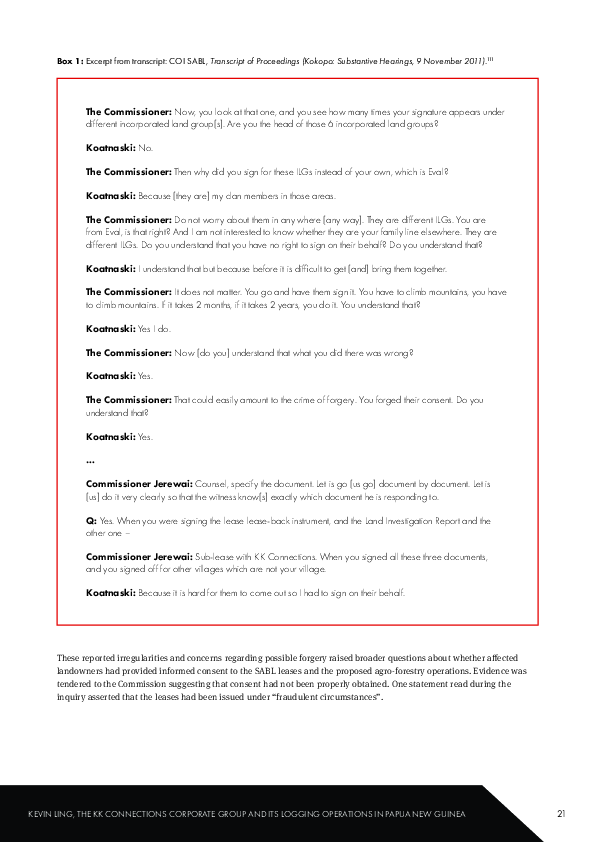
      The Commission of Inquiry also reported concerns regarding the authenticity of certain signatures on environmental and
      land investigation documents submitted during the SABL approval process. During cross-examination, the Vice Chairman
      of Toriu Timber Limited, Lucas Koatnaski, acknowledged signing documents on behalf of six different Incorporated Land
      Groups (ILGs), despite being the chair of only one (Evar).110


KEVIN LING, THE KK CONNECTIONS CORPORATE GROUP AND ITS LOGGING OPERATIONS IN PAPUA NEW GUINEA                                      20
      Box 1: Excerpt from transcript: COI SABL, Transcript of Proceedings (Kokopo: Substantive Hearings, 9 November 2011).111


             The Commissioner: Now, you look at that one, and you see how many times your signature appears under
             different incorporated land group[s]. Are you the head of those 6 incorporated land groups?

             Koatnaski: No.

             The Commissioner: Then why did you sign for these ILGs instead of your own, which is Eval?

             Koatnaski: Because [they are] my clan members in those areas.

             The Commissioner: Do not worry about them in any where [any way]. They are different ILGs. You are
             from Eval, is that right? And I am not interested to know whether they are your family line elsewhere. They are
             different ILGs. Do you understand that you have no right to sign on their behalf? Do you understand that?

             Koatnaski: I understand that but because before it is difficult to get [and] bring them together.

             The Commissioner: It does not matter. You go and have them sign it. You have to climb mountains, you have
             to climb mountains. If it takes 2 months, if it takes 2 years, you do it. You understand that?

             Koatnaski: Yes I do.

             The Commissioner: Now [do you] understand that what you did there was wrong?

             Koatnaski: Yes.

             The Commissioner: That could easily amount to the crime of forgery. You forged their consent. Do you
             understand that?

             Koatnaski: Yes.

             ...

             Commissioner Jerewai: Counsel, specify the document. Let is go [us go] document by document. Let is
             [us] do it very clearly so that the witness know[s] exactly which document he is responding to.

             Q: Yes. When you were signing the lease lease-back instrument, and the Land Investigation Report and the
             other one –

             Commissioner Jerewai: Sub-lease with KK Connections. When you signed all these three documents,
             and you signed off for other villages which are not your village.

             Koatnaski: Because it is hard for them to come out so I had to sign on their behalf.


      These reported irregularities and concerns regarding possible forgery raised broader questions about whether affected
      landowners had provided informed consent to the SABL leases and the proposed agro-forestry operations. Evidence was
      tendered to the Commission suggesting that consent had not been properly obtained. One statement read during the
      inquiry asserted that the leases had been issued under “fraudulent circumstances”.


KEVIN LING, THE KK CONNECTIONS CORPORATE GROUP AND ITS LOGGING OPERATIONS IN PAPUA NEW GUINEA                                   21
      Box 2: Excerpt from transcript: COI SABL, Transcript of Proceedings (Kokopo: Substantive Hearings, 28 October 2011).112


              We the undersigned Qaqet formerly Baining, leaders and elders of the Qaqet-Baining tribe of the East New
              Britain, duly swear on oath and declare that the granting of above portions under SABL, under forest clearance
              license issued to the Toriu Timbers Limited was done without the informed consent of or generally consent
              by the landowners. Portions 904C and 903C, milinch Pondo, fourmil Rabaul in the northwest Gazelle area
              of East New Britain as per gazette number G37 dated 26 February 2010, spanning 11,240 hectares and
              42,240 hectares respectively were approved under fraudulent circumstances. The gullibility of the traditional
              landowners was taken advantage of by the facilitators. The initiator of the project is the East New Britain
              Provincial Administration and KK Connections as the project developer. There was never any free prior and
              informed consent described as FPIC given by the traditional landowners of the area as required by law for any
              part of their land to be facilitated for the purpose of SABL. As well, we as leaders were never notified nor gave
              consent for this huge land areas to be facilitated under SABL.


      Questions were also raised over whether those landowner leaders that were involved directly in negotiations, had sufficient
      independent advice. When Vice Chairman of Toriu Timbers, Lucas Koatnaski, was asked by the Commission about who
      explained the sub-leasing benefits and conditions, the witness informed the Commission that it was the developer KK
      Connections. When asked if they obtained independent legal advice, the leader confirmed they did from a law firm, but
      one which also acted for the developer KK Connections.


      Box 3: Excerpt from transcript: COI SABL, Transcript of Proceedings (Kokopo: Substantive Hearings, 9 November 2011).


              The Commissioner: May I interrupt? And who explained these things to you?

              Koatnaski: It is between us, the landowner groups and the developers.

              The Commissioner: Translator ...

              Q: So you did not receive any legal representative, a lawyer, to explain the contents?

              Koatnaski: We got our lawyer who prepared this document.

              Q: Okay, so who is your lawyer?

              Koatnaski: Kivu and Associates.

              Q: Yes, they are the ones that are actually on that particular document — they have actually prepared
              that document.

              The Commissioner: Kivu and Associates, sorry, it is on that document.

              Q: It is on the document. It is separated — flip back a few pages and you will see the names and address.

              The Commissioner: All right. Was Kivu and Associates your lawyers only, or KK Connections’ lawyer
              as well?

              Koatnaski: They are the law firm representing the developer and us too.


KEVIN LING, THE KK CONNECTIONS CORPORATE GROUP AND ITS LOGGING OPERATIONS IN PAPUA NEW GUINEA                                       22
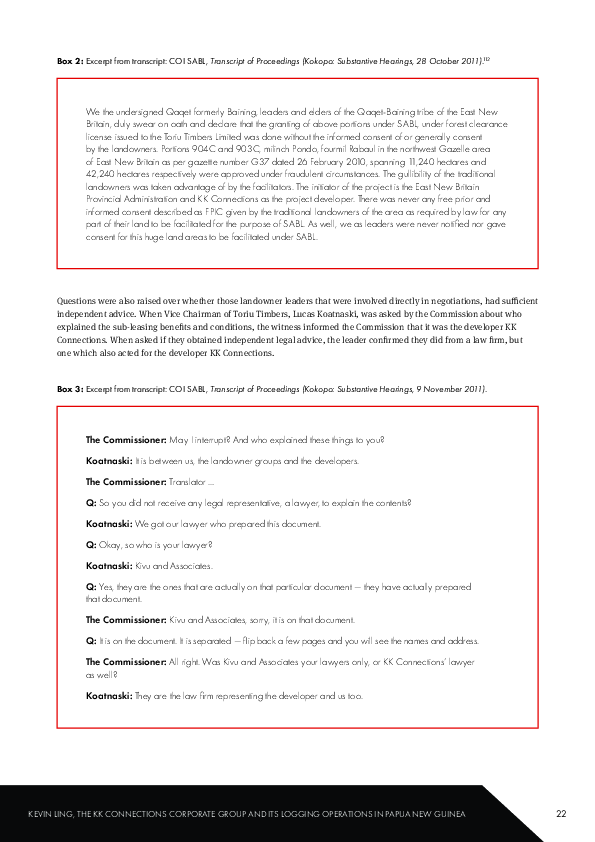
      The Commission noted with concern the potential information asymmetries and inequalities in business knowledge.
      Commissioner Alois Jerewai stated:

             “This seems to be the methodology of these people, including KK Connections, to represent [sub-lease] figures in a
             way that is unclear to a person not of sufficient sophistication to be able to tell the difference. Take Mr Koatnaski.
             He cannot even speak English and had to be examined with an interpreter, with English translated into Pidgin so
             that he could understand. Yet he is the [Vice] Chairman of the Board of Directors of the landowner company, Toriu
             Timbers. He represents figures without explaining what they are in the format that [KK Connections manager] Mr
             Yayaa had presented...”.113

      In summarising the evidence provided to the Commission of Inquiry, Commissioner Jerewai stated that the inquiry had
      identified a number of issues affecting the validity of the SABL leases. These included landowners’ names being placed
      on consent forms without their knowledge or agreement; the landowner company acting without the authority of the
      landowners, and without prior consultation or consent, in entering into the sub-lease agreement with KK Connections; and
      agricultural development plans being changed “five or six times” from one type of development to another without prior
      consultation with relevant government agencies.114 The Commission also found alleged inconsistencies in the description
      of the currency in relation to the payment of export levies, with different documents referring either to USD or Papua New
      Guinean kina.

      Finally, the Commission noted evidence of questionable agricultural development:

             “Our agriculturalist visited the Toriu area where you claim to have this development. His name is Mr Simon Sipo, who
             holds a degree in Agricultural Science. While he confirms that a road of reasonable standard has been constructed,
             the agricultural development on both sides of the road is pathetic, to say the least. He observed numerous skidder and
             tractor tracks, which indicate the extraction of your forests rather than agricultural development.”115

      The Commissioner indicated that there was no clear agreement on what development would in fact be delivered following
      forest clearance. He observed when addressing Lukas Koatnaski, the Vice Chairman of the landowner company Toriu
      Timbers Limited:

             “There is nothing in the agreement that speaks of the KK Connection as a developer that commits them to develop
             your agriculture ... this sublease gives this people, KK Connection ... 60 years occupation of your land and because of
             that they can go and take your timber ... yet you have not nailed them down to a specific agriculture development”.116

      When challenged on these inquiry findings for a 2017 Global Witness report, Stained Trade, lawyers for KK Connections
      maintained that the company and its subsidiary and related companies did not hold any SABL leases and that while
      one of its logging operations was being carried out under an SABL held by a landowner company, this SABL had not
      been declared illegal.117 KK Connections stated it and its related companies had not been involved in any illegal logging
      operations in Papua New Guinea.118

      In summary, the SABL Commission of Inquiry hearings indicate that significant asymmetries existed between the KK
      Group and affected landowner communities in terms of expertise, information, and capacity. The evidence presented also
      suggested that certain government offices were operating with limited resources and, in some instances, appeared reliant
      on logistical or operational support from forestry operators.

      Taken together, these structural factors arguably contribute to an elevated risk environment for logging operations, in which
      landowning communities and oversight bodies face constraints in effectively monitoring activities or enforcing compliance.

      Subsequent evidence has identified compliance concerns relating to aspects of the KK Group’s operations conducted under
      Forest Clearing Authorities.


KEVIN LING, THE KK CONNECTIONS CORPORATE GROUP AND ITS LOGGING OPERATIONS IN PAPUA NEW GUINEA                                         23
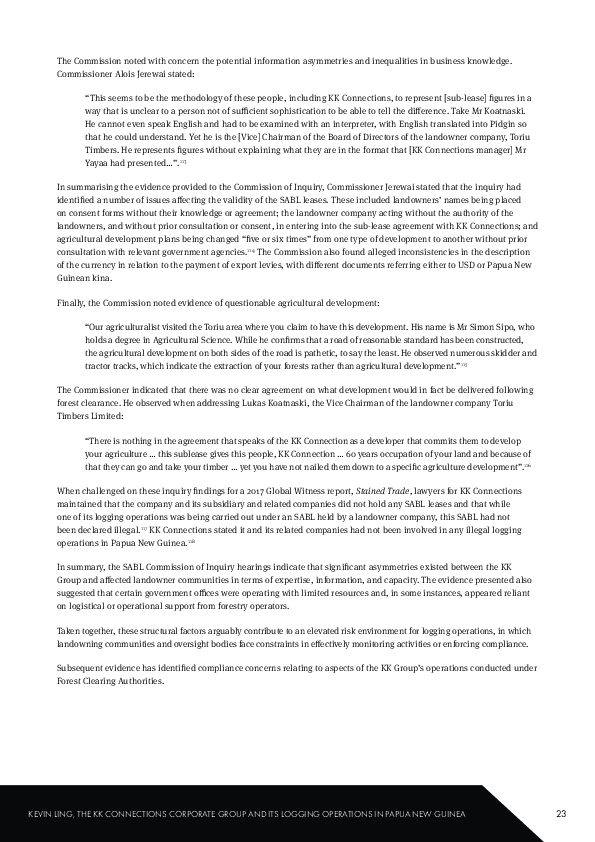
      3.2.2 KK Group and Forest Clearing Authority Compliance
      Forest Clearing Authority (FCA) permits have generated sustained controversy in Papua New Guinea in recent years.
      Published research and sectoral reviews have raised concerns that, in some cases, FCA permits are being used to facilitate
      large-scale selective logging rather than forest clearance genuinely linked to agricultural development projects.119 There is
      also documented evidence indicating that landowner consent processes have, at times, not been properly obtained.120

      Following an extensive review of academic literature, government documentation, and data sources — including analysis
      from Global Forest Watch — Forest Trends stated that in PNG “the failure of nearly all of these operations to result in
      viable agricultural projects indicates they are being used to access timber while avoiding the rules for sustainable forest
      management established under the Forestry Act.”121

      A 2018 report by Global Witness, A Major Liability, documented case studies of alleged illegal logging in PNG and
      highlighted potential reputational and regulatory risks for China’s timber sector as a major purchaser of PNG timber.122

      Global Witness reported that its investigators visited two KK Connections logging sites in East New Britain Province — the
      Malkolkol and Dengnenge FCA areas. According to the report, satellite imagery indicated patterns consistent with selective
      logging rather than comprehensive forest clearance for agricultural conversion.123 Global Witness stated that “the absence of
      large-scale agricultural clearance happening in those titles ... strongly suggests that these permits were obtained fraudulently.”124

      Additionally, Global witness highlighted that Kerawara Ltd. exported timber worth over PGK 16 million (around USD
      5 million) from FCA 15-10 in East New Britain Province in 2017, even though the operation appeared to involve logging
      rather than agricultural clearance, in breach of the permit’s terms.125 PNG export records for 2017 show the exporter from
      FCA 15-10 as Laloani No.8 Limited, which is listed as a member of the Kerawara company group.126

      When responding to questions from Global Witness, legal representatives for KK Connections stated that FCAs 15-09 and 15-10
      had been obtained following landowner consent and submission of applications to the Provincial Forest Management Council
      and the National Forest Board.127 The firm further stated: “The current Managing Director of PNG Forest Authority (Papua New
      Guinea Forest Authority) has given evidence testifying that there is no fraud or illegality on the grant of the FCA [15-09].”128

      The legal representatives did not address the separate allegation that FCA 15-10 was being subject to selective logging
      rather than forest clearance for agricultural development.129

      Act Now! has also recently published a detailed analysis of the Mengen FCA project, the most recent FCA permit issued
      to the KK Group.130 Entitled A New Forest Grab, the report outlines a number of significant concerns regarding the Mengen
      FCA project. It states that although the project’s logging licence is formally linked to a proposed agricultural development,
      available analysis indicates that the Mengen project is operating in practice as a large-scale logging venture, with selective
      harvesting of high-value primary rainforest generating the principal revenue stream.131 The report questions whether the
      proposed timber plantation and agricultural components are genuine and economically viable.132

      The report further states that there is limited observable evidence of land clearance consistent with agricultural conversion
      within the project area to date.133 In contrast, satellite imagery and field observations are cited as indicating extensive
      selective logging activity across substantial portions of the concession.134 The report notes that selective logging is not
      authorised under an FCA permit.135

      While documentation suggests that certain landowners have provided signed consent, the report also records sustained
      and documented opposition to the project from multiple landowner groups within the affected area.136

      The Mengen FCA is reported to overlap with areas of recognised environmental significance, including the Nakanai Karst
      region, which has been included on the Tentative World Heritage List.137

      Finally, the report references allegations that police personnel have acted in support of company operations in the area,
      including claims that landowners have experienced pressure or suppression of dissent. These matters are presented in the
      report as serious governance concerns.138

      Prior to publication, Act Now contacted KK Connections Limited for comment on its findings. No response was received.139


KEVIN LING, THE KK CONNECTIONS CORPORATE GROUP AND ITS LOGGING OPERATIONS IN PAPUA NEW GUINEA                                               24
      3.2.3 KK Group and Landowner consent
      One of the largest logging projects involving KK Connections is the Dengnenge ‘A’ FCA in East New Britain Province.
      Between 2018 and 2022, the company is recorded as having exported almost 240,000 cubic metres of logs under FCA
      permit 15-10, which was issued in 2016.140 This permit was referred to in the aforementioned Global Witness report,
      due the absence of evidence pointing to large-scale agricultural clearance.

      FCA permit 15-10 was issued to the landowner company Dengnenge Resources Development Limited.141 Laloani No.8
      Limited appear to have then been contracted by Dengnenge to undertake logging operations in the permit area. For 2016
      and 2017, PNG export records list Laloani No.8 Limited is listed under the Kerawara corporate grouping, from 2018 it is
      listed under the KK Connections corporate grouping.142

      However, the permit — FCA 15-10 — was declared invalid and void by the National Court of Papua New Guinea in February
      2019. In judicial review proceedings initiated by a group of landowners who stated that they had not consented to the
      issuance of the FCA, the Court found that mandatory requirements under the Forestry Act 1991 had not been satisfied prior
      to the grant of the licence.143

      The Court determined that incorrect forms had been used to verify landowner ownership and consent, and that signatures
      on those forms had not been witnessed by an authorised official.

      The Court described these deficiencies as “critical” and “crucial,” concluding that the defects rendered the FCA application
      made by Dengnenge Resources Development Limited invalid.144 The judgment further stated that overlooking such errors
      would “be detrimental to the landowners and their interests over their customary land”.145

      These findings reflect concerns similar to those documented during the SABL Commission of Inquiry regarding consent
      verification processes implemented by landowner companies looking to facilitate outsourced logging operations.

      The Court awarded costs against all defendants in the proceedings, including KK Connections Limited and Laloani
      No. 8 Limited.

      While the FCA permit was declared void, logging export data indicates logs were exported in 2020, 2021, and 2022,146 under
      contracting arrangement with KK Connections Limited and Laloani No.8 Limited.

      Ongoing logging conducted under FCA permits declared void by the courts has been identified by the Bank of Papua
      New Guinea as an area of elevated money-laundering risk147. This does not mean that logs extracted after FCA 15-10 was
      declared void were illegally harvested. However, the factual circumstances indicate that there is a risk that such extraction
      may have occurred.


      3.2.4 Conclusion
      Taken together, the material reviewed in this section indicates that the KK Group has been a significant participant in
      Papua New Guinea’s forestry sector, with a substantial proportion of its export activity associated with projects operating
      under FCA permits, a licensing pathway that has attracted sustained scrutiny in national inquiries and sectoral reviews.

      Evidence considered by the Commission of Inquiry into Special Agriculture and Business Leases (2011–2013), subsequent
      civil society reporting, and judicial findings in relation to FCA 15-10 (Dengnenge ‘A’) highlight concerns in some concession
      areas regarding landowner consent processes, the adequacy of documentation supporting licence approvals, and the
      relationship between authorised agricultural development objectives and observed logging activity.

      These issues arise within a forestry governance environment widely recognised as presenting institutional capacity
      constraints and implementation challenges. While they do not in themselves establish wrongdoing by the KK Group,
      they indicate features of the Group’s operating context that, from an AML and due-diligence perspective, reasonably
      warrant closer scrutiny.


KEVIN LING, THE KK CONNECTIONS CORPORATE GROUP AND ITS LOGGING OPERATIONS IN PAPUA NEW GUINEA                                         25
      4. RISK EXPOSURE OF OUTSIDE ORGANISATIONS
      A range of external organisations have been exposed to KK Group forestry operations, which are mapped in this section.
      No suggestion is made that these organisations have engaged in any improper conduct. However, organisations with
      ongoing commercial relationships with the KK Group are strongly encouraged to take the findings outlined in this report
      into account as part of their compliance and risk-review processes, particularly in light of the risk profile documented in
      Section Three.


      4.1 FINANCE AND PROFESSIONAL SERVICES
      Several financial institutions and professional service providers are referenced in documentation relating to KK Group
      operations. No suggestion is made that these organisations have engaged in any improper conduct.

      For example, the Mengen Project is one of 17 current and past logging operations on New Britain Island associated with
      companies within the KK Connections corporate group. In documentation submitted in support of the Forest Clearing
      Authority (FCA) application for the Mengen Project, Australia and New Zealand (ANZ) Bank was listed as the “proposed
      banker” for KK Connections Limited.148

      ANZ notified ACT NOW! in 2023 that it did not have a banking relationship with the companies identified. The bank further
      indicated that it has a “limited appetite” for the forestry sector in Papua New Guinea and will generally only consider
      customers certified by the Forest Stewardship Council (FSC). ANZ declined to comment on whether it had previously held
      banking relationships with KK Connections or related entities.149

      The aforementioned FCA application for the Mengen concession also listed Sojitz Corporation, a major Japanese trading
      company, as a potential purchaser of timber.150 Sojitz has previously been criticised for purchasing wood originating from
      illegal logging concessions in Papua New Guinea. An investigation by Global Witness in 2017 reported that the company
      stated it would “not handle wood obtained through illegal logging” and would “seek to mitigate any negative impact”
      on human rights.151

      Sojitz Corporation was previously a secured creditor of KK Connections Limited. On 10 December 2010, KK Connections
      Limited registered a fixed charge in favour of Sojitz Corporation under Section 222 of the Companies Act 1997.152 The charge
      secured liabilities arising under a sales contract note, with a maximum prospective liability of US$1,000,000. It was
      secured over vehicles and equipment owned by KK Connections Limited and was signed by Han Hook See in the capacity
      of Secretary/Director of the company.

      Records indicate KK Group companies have also received financing from another non-bank lender Heduru Moni Limited.153
      Reported financing includes:

         •   Asset financing to K L Connections (2019) for seven Toyota Landcruisers;154

         •   Asset financing to KK Connections (2017–2018) for four Isuzu trucks and twenty-one Toyota Landcruisers.155

      The total value of this financing is estimated to exceed K6 million (approximately US $1.6 million).156 When asked by ACT
      NOW! and Jubilee Australia, Heduru Moni did not reply to questions regarding these transactions or disclose its policies in
      relation to lending to the logging sector.157

      In addition to finance, KK Group has received professional services from Jb & Co. a public accountant in Papua New Guinea,158
      which specialises in providing secretarial, accounting and audit services.159

      Corporate filings also indicate KK Connections has received legal services from Blake Dawson, an international law firm
      later acquired by Ashurst.160

      No suggestion is being made that these companies are involved in any wrongdoing by providing these services.


KEVIN LING, THE KK CONNECTIONS CORPORATE GROUP AND ITS LOGGING OPERATIONS IN PAPUA NEW GUINEA                                         26
      4.2 VENTURE PARTNERS
      KK Group companies have collaborated with external partners in several reported projects, which will now be briefly
      summarised.


      4.2.1 Shin Yang Group
      The Shin Yang Group is a major Sarawak timber conglomerate which operates under the Ling family.161 There is no evidence
      available that Kuok Tiang Ling (Kevin Ling), the founder of KK Connections Ltd, is a member of, or related to, Shin Yang’s
      Ling family. The shared surname “Ling” appears in this context to reflect a common family name rather than a documented
      familial relationship.

      KK Group’s relationship with the Shin Yang Group occurs through Papua New Guinea company KKC Veneer Limited.

      The shares in KKC Veneer are held by two entities, PL Jaya Limited (95%) and KKC Sawmill Limited (5%).162 Its board
      consists of Dennis Lu Jing Ling, Lu Kiong Ling, and Lu Siong Ling, who are all directors or executives in the Shin Yang
      Group. KKC Veneer’s secretary is Dana Foon Ling, who appears to be daughter of Shin Yang’s Group Managing Director.

      The primary shareholder of KKC Veneer, PL Jaya Limited is closely tied into the Shin Yang Group. Its shareholders include
      Dennis Ling Lu Jing (26.83%), Lu Kiong Ling (26.84%), Lu Siong Ling (26.38%), and Malaysian registered entity, Indah
      Asiamas SDN BHD (19.5%).163

      Indah Asiamas SDN BHD Malaysian filings indicate it is based at Shin Yang Group’s headquarters, while email contacts are
      all Shin Yang Group email addresses. Indah Asiamas SDN BHD is jointly owned by Ling Pau Pau, Derek Ling Lu Yung and
      Alfred Ling Lu Khiing, each holding 33.33% of the issued shares.164

      The minority shareholder of KKC Veneer is KKC Sawmill Limited, a KK Connections Group entity jointly owned by Kevin
      Ling and Han Hook See.165

      KKC Veneer Mill, it appears was set up to commission a veneer mill at Kurindal in Lasul-Baining, Gazelle district of East
      New Britain Province. When fully operational, the mill is reportedly expected to process approximately 200,000 cubic
      metres of logs annually and to produce veneer, wood chips, pellets, and plywood.166

      The project was launched in 2023 by Papua New Guinea Prime Minister Marape who noted significant tax exemptions
      offered to the joint venture. “The company deserves incentives from my government like export without levy, tax
      deductible if you build road, health and school to help people”, the Prime Minister reportedly said.167


KEVIN LING, THE KK CONNECTIONS CORPORATE GROUP AND ITS LOGGING OPERATIONS IN PAPUA NEW GUINEA                                      27
      IMAGE: Papua New Guinea Prime Minister on a visit to the KKC Veneer mill in March 2023 Copyright © 2026 PM James Marape
      News Page


      A field investigation for this report indicates that the mill is no longer operational. According to local sources, the mill shut
      down in or around June 2024. It appeared heavy machinery had been removed from the mill site. It was claimed by local
      sources, that unanticipated costs had made the project unviable, leading to the site shutdown.


      4.2.2. Ningbo Yongli
      Corporate records and project documentation indicate that KK Group personnel have had links with a timber company
      connected to China-based interests in Ningbo.

      Ningbo ND Import and Export Co Ltd is the only shareholder of PNG ND Resources Investment Co which is a PNG registered
      holding company.168 PNG ND Resources Investment Co in turns holds 100% of the shares (from at least 2014) in Tian Suyn
      Limited, a logging company operating in Papua New Guinea.169

      Corporate registry records indicate that Tian Suyn Limited had overlapping directors and shareholders with KK Group
      entities predominantly throughout the period 2014 to 2017. Han Hook See and Kuok Tiang Ling were directors and share-
      holders of Tian Suyn Limited during this period.170 The board included representatives of PNG ND Resources Investment
      Co alongside Ling and See.

      Export and forestry records show that between 2010 and 2017, Tian Suyn Limited exported logs from multiple concessions,
      including the Suikol-Makolkol Forest Clearing Authority area in East New Britain Province and the Rai Coast Timber Rights
      Purchase agreement area in Madang Province.171 The exports appear to have occurred when Tian Suyn Limited had directors
      and shareholder from the KK Group, alongside PNG ND Resources Investment Co.172


KEVIN LING, THE KK CONNECTIONS CORPORATE GROUP AND ITS LOGGING OPERATIONS IN PAPUA NEW GUINEA                                             28
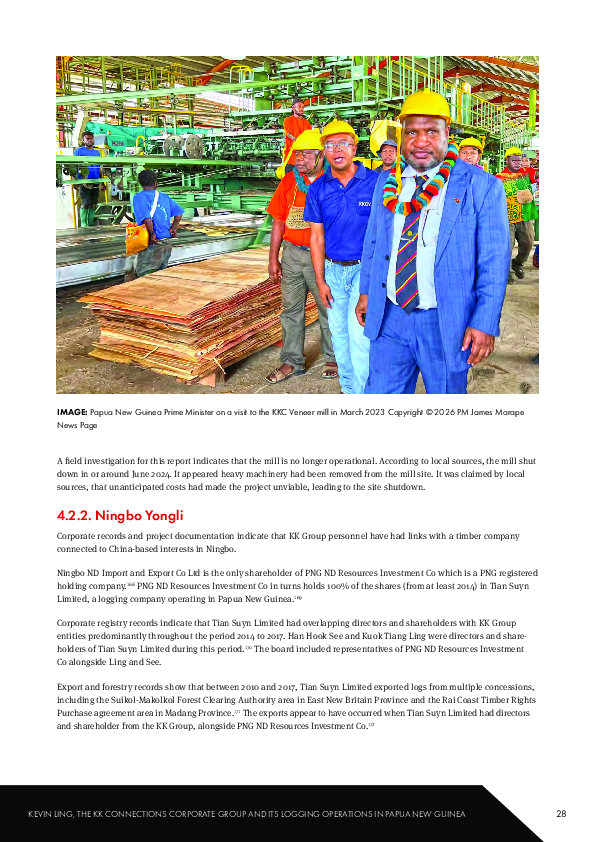
      5. CONCLUSION

      5.1 THE KK GROUP
      Section Three of this report has identified a number of circumstances relating to KK Group entities and personnel that may
      contribute to an elevated initial risk profile, particularly when considered against wider systemic risk factors affecting the
      forestry sector in Papua New Guinea.

      First, KK Group entities have historical corporate and personnel links with the Kerawara Group. Judicial findings and
      oversight reports have previously associated Kerawara Group operations with illegal logging activity, collusive practices,
      and regulatory breaches. Court records further indicate that certain Kerawara officers—including one individual later
      reported to have served as a General Manager within the KK Group—were found guilty of criminal contempt of court.

      Second, aspects of KK Group logging operations in East New Britain have been identified as raising concern in publicly
      available sources. Evidence presented to the Special Agriculture and Business Lease Commission of Inquiry, and in related
      judicial proceedings, identified procedural failures in the processes through which landowner consent was obtained for
      leases and permits connected to operations involving KK Group entities. While responsibility for these procedural failures
      was primarily attributed to government officers and landowner companies, Commissioner Alois Jerewai noted concerns
      regarding apparent landowner dependencies on KK Group, in a relationship the Commissioner claimed was marked by
      inequalities in sectoral expertise and resources.

      In addition, research published by organisations including Global Witness and Act Now! has raised questions regarding
      whether certain operations associated with KK Group entities meet the criteria of genuine forest clearance activities as
      contemplated under the Forestry Act 1991.

      Fourth, one of the largest logging operations associated with KK Connections—the Dengnenge ‘A’ Forest Clearing Authority
      (FCA 15-10)—was declared invalid and void by the National Court, after the Court identified critical deficiencies in the
      statutory processes used to verify landowner ownership and consent. Notwithstanding this ruling, export records indicate
      that substantial volumes of logs were exported under this permit between 2019 and 2022.

      Taken together, these cumulative factors support the classification of KK Group as a higher-risk forestry sector participant
      within the context of broader systemic risks affecting Papua New Guinea’s forestry governance environment.

      Importantly, a higher-risk classification does not imply involvement in unlawful activity. Rather, it indicates that available
      information points to features that warrant enhanced scrutiny by regulators, financial institutions, and other gatekeepers
      in order to support effective compliance and risk-management processes.

      Accordingly, organisations engaged in monitoring forestry sector risks, or interacting with activities linked to KK Group
      entities, should consider applying enhanced due-diligence measures proportionate to sectoral risk conditions.


      5.2 THE WIDER CONTROL ENVIRONMENT IN PAPUA NEW GUINEA
      This Risk Alert also highlights wider structural weaknesses in Papua New Guinea’s control environment. These systemic
      issues form part of the context in which the country has been placed on the Financial Action Task Force (FATF) grey list.

      Most fundamentally, there are significant limitations in the availability and accessibility of corporate and market data.
      Papua New Guinea does not currently maintain a public beneficial ownership register, and existing company filings
      contain limited information, much of which is unaudited and only accessible through a paywalled system. In addition,
      registry accessibility and data usability declined following system changes introduced in 2022-23, at a time when many
      jurisdictions were moving toward greater transparency and digital availability of corporate information.


KEVIN LING, THE KK CONNECTIONS CORPORATE GROUP AND ITS LOGGING OPERATIONS IN PAPUA NEW GUINEA                                          29
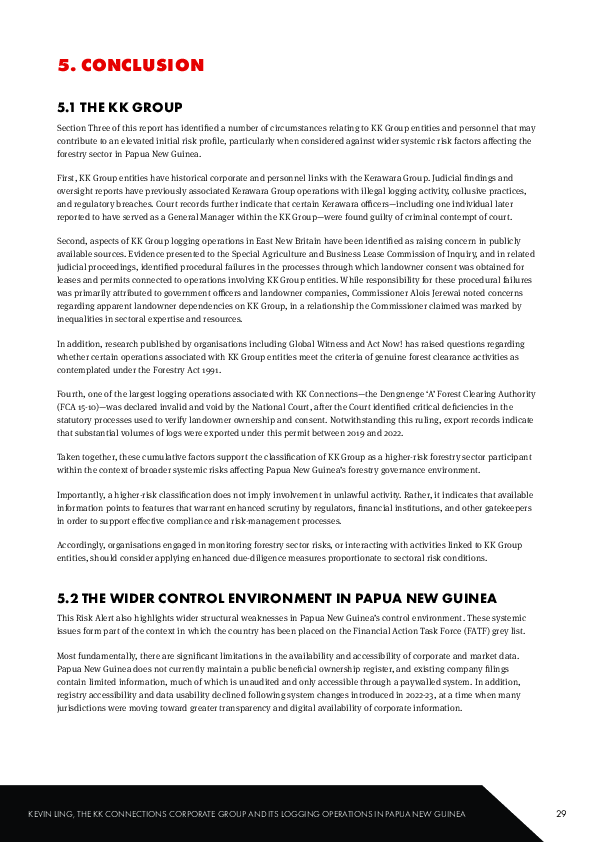
      Given the recognised risks associated with the forestry sector, the absence of a comprehensive public register of forestry
      licences and participating entities represents a further constraint on effective due-diligence activity.

      As a result, organisations undertaking risk assessments in relation to forestry participants in Papua New Guinea face
      significant verification challenges. The specialist resources required to overcome these data gaps are not routinely
      available to many private-sector actors. As a result, it is almost certain that risks are systematically going undetected,
      allowing illicit financial flows emanating from Papua New Guinea to move out of the country undetected and into global
      financial and asset systems.

      There is therefore a clear need to strengthen Papua New Guinea’s registry infrastructure and information systems,
      including improvements to corporate transparency mechanisms and the publication of a comprehensive public register
      of forestry licences and sector participants.


KEVIN LING, THE KK CONNECTIONS CORPORATE GROUP AND ITS LOGGING OPERATIONS IN PAPUA NEW GUINEA                                      30

      ENDNOTES
      1    Financial Action Task Force (FATF), (2021). Money Laundering from Environmental Crime. Paris: FATF.
      2    Climate Change and Development Authority (CCDA), (2025). First Biennial Transparency Report to the United Nations Framework
           Convention on Climate Change. Port Moresby: CCDA.
      3    Bank of Papua New Guinea (2017), Money Laundering and Financing of Terrorism National Risk Assessment, Port Moresby: BPNG, p.93.
           See also Bank of Papua New Guinea (2020). Money Laundering and Terrorist Financing Sector Risk Assessment: Forestry Sector - Papua
           New Guinea. Port Moresby: BPNG.
      4    Forest Trends (2021). Timber Legality Risk Dashboard: Papua New Guinea. Washington, DC: Forest Trends, p.1.
      5    FATF (2021). Money Laundering from Environmental Crime, p. 36.
      6    Forest Trends (2021). Timber Legality Risk Dashboard: Papua New Guinea, p. 1.
      7    Ibid, p. 4.
      8    Bank of Papua New Guinea (2020). Money Laundering and Terrorist Financing Sector Risk Assessment: Forestry Sector - Papua New
           Guinea. Port Moresby: BPNG, p.24.
      9    Forestry Act 1991 (No. 30 of 1991) (Papua New Guinea).
      10   This is based on data provided in Société Générale de Surveillance monthly logging reports issued to the Papua New Guinea Forest
           Authority.
      11   ACT NOW! and Jubilee Australia (2025). The FCA Logging Scandal: A Summary Paper on the Abuse of Forest Clearing Authorities to
           Facilitate Large-Scale Tropical Forest Logging in Papua New Guinea. Port Moresby and Sydney: ACT NOW! and Jubilee Australia, p. 10.
      12   TUBS, CC BY-SA 3.0 <https://creativecommons.org/licenses/by-sa/3.0>, via Wikimedia Commons
      13   ACT NOW! (2023). A new forest grab: The Mengen Integrated Agriculture Project. Port Moresby: ACT NOW!, p. 13; Global Witness (2018).
           A major liability: Illegal logging in Papua New Guinea threatens China’s timber sector and global reputation. London: Global Witness, p. 13.
      14   ACT NOW! (2023). A new forest grab: The Mengen Integrated Agriculture Project. Port Moresby: ACT NOW!.
      15   SGS PNG Ltd (2023). Log Export Monitoring Monthly Report for December 2022 to the Papua New Guinea Forest Authority. Port Moresby:
           SGS PNG Ltd, p. 4.
      16   Commission of Inquiry into Special Agriculture and Business Leases (2011). Transcript of Proceedings, Waigani – Commissioner Jerewai
           (Part 1, 22 September 2011). PNGi Portal. Waigani: Department of Prime Minister & NEC p. 129.
      17   Ibid, p. 130.
      18   Ibid, pp. 128, 129.
      19   Ibid, pp. 128, 134.
      20   Tiden, G. (2013). ‘Bridge Links Provinces’, Post-Courier, 30 May, p. 8.
      21   Daiva v Pukali; Ome Ome Forests Ltd v Cheong [2002] PGNC 61; N2289 (8 October 2002)
      22   Forest Trends (2006). Logging, Legality and Livelihoods in Papua New Guinea: Synthesis of Official Assessments of the Large-Scale
           Logging Industry. Volume I. Washington, DC: Forest Trends.
      23   Commission of Inquiry into Special Agriculture and Business Leases (2011). Transcript of Proceedings, Waigani – Commissioner Jerewai
           (Part 1, 22 September 2011). PNGi Portal. Waigani: Department of Prime Minister & NEC, p. 130
      24   Maoko v Ling [2008] PGNC 19; N3293 (26 March 2008).
      25   Forestry and Conservation Project Review Team (2003). Final Report: Kiunga/Aiambak, Simbali and Bonua Magarida, p.14; Masalai
           (2004). Forestry officers conspire with loggers to defraud the State, no. 25, 18 January, pp. 1, 3.
      26   Daiva v Pukali; Ome Ome Forests Ltd v Cheong [2002] PGNC 61.
      27   Kerawara Limited, Annual Returns, 1998-2006
      28   Hugo Sawmilling Limited, Annual Returns, 1998-2006
      29   SGS PNG Ltd (2018). Log Export Monitoring Monthly Report for December 2017 to the Papua New Guinea Forest Authority. Port Moresby:
           SGS PNG Ltd, p. 5.
      30   Commission of Inquiry into Aspects of the Forestry Industry (1989). Final Report, Volume 1, July 1989; Commission of Inquiry into
           Aspects of the Forestry Industry (1989). Final Report, Volume 2, July 1989.
      31   Filer, C. (2013). ‘Asian investment in the rural industries of Papua New Guinea: What’s new and what’s not?’, Pacific Affairs, 86(2),
           pp. 305–325, p. 310
      32   Commission of Inquiry into Aspects of the Forestry Industry (1989). Final Report, Volume 1, p. 14; Commission of Inquiry into Aspects
           of the Forestry Industry (1989). Final Report, Volume 2, p. 314.
      33   Commission of Inquiry into Aspects of the Forestry Industry (1989). Interim Report, No 7, pp.9-14.
      34   Ibid, p.12.
      35   Ibid.
      36   Ibid, p.15.
      37   Ibid.
      38   Rafflin v Richard Gault Industries Pty Ltd; Kerawara Pty Ltd [1998] PNGLR 394 (3 November 1997).
      39   Ibid.
      40   Ibid.
      41   Ibid.
      42   Ibid.
      43   Ibid.


KEVIN LING, THE KK CONNECTIONS CORPORATE GROUP AND ITS LOGGING OPERATIONS IN PAPUA NEW GUINEA                                                             31
      44   Ibid.
      45   Ibid.
      46   Ibid.
      47   Ibid.
      48   Daiva v Pukali; Ome Ome Forests Ltd v Cheong [2002] PGNC 61; N2289 (8 October 2002)
      49   Ibid.
      50   Ibid.
      51   Ibid.
      52   Ibid.
      53   Ibid.
      54   Ibid.
      55   Ibid.
      56   Ibid.
      57   Ibid.
      58   Ibid.
      59   Ibid.
      60   Ibid.
      61   Ibid.
      62   Ibid.
      63   Department of National Planning and Monitoring (2003). Review of Current Logging Projects Carried Out Under the Auspices of the
           Department of National Planning and Monitoring: Finalised Individual Project Review Report No. 1, Timber Permit (TP) 3-27 Iva Inika.
           November 2003, p. 1.
      64   Ibid, p. 2
      65   Ibid, p. 1.
      66   Ibid, p. 5.
      67   Ibid, p. 9.
      68   Ibid, p. 8.
      69   Ibid, p. 9.
      70   Ibid.
      71   Ibid, p. 11.
      72   Ibid, p. 12.
      73   Ibid, p. 14.
      74   Ibid.
      75   Forestry and Conservation Project Review Team (2003). Final Report (Kiunga/Aiambak, Simbali and Bonua Magarida). February 2003.
      76   Forestry and Conservation Project Review Team (2003). Final Report.
      77   Ibid, p.14.
      78   Ibid, pp. 8-9.
      79   Ibid, p.9.
      80   Ibid, p.8.
      81   Ibid, p.8.
      82   Ibid, p.9.
      83   Ibid, p.13.
      84   Ibid, pp.13-14.
      85   Department of National Planning and Monitoring (2004). Review of Current Logging Projects: Finalised Individual Project Review Report
           No. 3 – TP 13-38 Buhem Mongi Busiga. March 2004.
      86   Ibid, p. 14.
      87   Ibid, p. 2.
      88   Ibid, p. 7.
      89   Ibid, p. 2.
      90   Ibid, p. 13.
      91   Ibid, p. 8.
      92   Ibid, p. 13.
      93   Ibid, p. 14.
      94   Ibid, p. 18.
      95   This is based on data provided in Société Générale de Surveillance monthly logging reports issued to the Papua New Guinea Forest
           Authority and, for 2024, the PNGFA’s own internal monitoring data.
      96   The National (2023). ‘Veneer Mill Shines Light on Bainings’. The National. Available at: https://www.thenational.com.pg/veneer-mill-
           shines-light-on-bainings/ (accessed 21 January 2026).
      97   Commission of Inquiry into Special Agriculture and Business Leases (2011). Transcript of Proceedings, Waigani – Commissioner Jerewai
           (Part 1, 22 September 2011). PNGi Portal. Waigani: Department of Prime Minister & NEC; Forest Trends (2021). Illicit Harvest, Complicit
           Goods: The State of Illegal Deforestation for Agriculture. Washington, DC: Forest Trends; Forest Trends (2021). Timber Legality Risk
           Dashboard: Papua New Guinea. Washington, DC: Forest Trends.


KEVIN LING, THE KK CONNECTIONS CORPORATE GROUP AND ITS LOGGING OPERATIONS IN PAPUA NEW GUINEA                                                        32
      98   ACT NOW! and Jubilee Australia Research Centre (2025). The FCA Logging Scandal: A Summary Paper on the Abuse of Forest Clearing
          Authorities to Facilitate Large-Scale Tropical Forest Logging in Papua New Guinea. Published May 2025, p. 20.
      99 This is based on data provided in Société Générale de Surveillance monthly logging reports issued to the Papua New Guinea Forest
          Authority and, for 2024, the PNGFA’s own internal monitoring data.
      100 Ibid.
      101 Ibid.
      102 Commission of Inquiry into the Special Agriculture and Business Lease (SABL) (2013). Final Report. Port Moresby, 24 June 2013,
          pp. 2, 4, 9, 34, 235.
      103 Ibid, pp. 9, 12, 49, 134, 185, 235, 239, 245.
      104 Ibid, pp. 15, 42.
      105 PNGi Forests, KK Connections (Port Moresby: PNGi Forests, n.d.). Available at: https://pngiforests.org/company/kk-connections
          (accessed 12 April 2026).
      106 Commission of Inquiry into Special Agriculture and Business Leases (2011). Transcript of Proceedings, Part 1 (Kokopo: Introductory
          Hearings, 24 October 2011). PNGi Portal. Waigani: Department of Prime Minister & NEC, pp. 27, 42, 44.
      107 Ibid, p. 43.
      108 Greenpeace Australia Pacific (2012). Up for Grabs: Millions of hectares of customary land in PNG stolen for logging. Ultimo, NSW:
          Greenpeace Australia Pacific, p.43.
      109 Commission of Inquiry into Special Agriculture and Business Leases (2011). Transcript of Proceedings, Waigani – Commissioner Jerewai
          (Part 1, 22 September 2011). PNGi Portal. Waigani: Department of Prime Minister & NEC, p. 135.
      110 Commission of Inquiry into Special Agriculture and Business Leases (2011). Transcript of Proceedings (Kokopo: Substantive Hearings,
          9 November 2011). PNGi Portal. Waigani: Department of Prime Minister & NEC.
      111 Ibid.
      112 Commission of Inquiry into Special Agriculture and Business Leases (2011). Transcript of Proceedings (Kokopo: Substantive Hearings,
          28 October 2011). PNGi Portal. Waigani: Department of Prime Minister & NEC.
      113 Commission of Inquiry into Special Agriculture and Business Leases (2011). Transcript of Proceedings (Kokopo: Substantive Hearings,
          12 November 2011). PNGi Portal. Waigani: Department of Prime Minister & NEC.
      114 Commission of Inquiry into Special Agriculture and Business Leases (2011). Transcript of Proceedings (Waigani: Substantive Hearings,
          16 November 2011). PNGi Portal. Waigani: Department of Prime Minister & NEC.
      115 Commission of Inquiry into Special Agriculture and Business Leases (2011). Transcript of Proceedings (Kokopo: Substantive Hearings, 9
          November 2011). PNGi Portal. Waigani: Department of Prime Minister & NEC.
      116 Ibid.
      117 Commission of Inquiry into Special Agriculture and Business Leases (2011). Transcript of Proceedings (Kokopo: Substantive Hearings,
          9 November 2011). PNGi Portal. Waigani: Department of Prime Minister & NEC.
      118 Ibid.
      119 Global Witness (2017). Stained Trade: How U.S. Imports of Exotic Flooring from China Risk Driving the Theft of Indigenous Land and
          Deforestation in Papua New Guinea. August 2017, p. 41.
      120 Global Witness (2017). Stained Trade, p. 41
      121 Global Witness (2018). A Major Liability: Illegal Logging in Papua New Guinea Threatens China’s Timber Sector and Global Reputation.
          August 2018; Global Witness (2017). Stained Trade; ACT NOW! (2023). A New Forest Grab; ACT NOW! and Jubilee Australia Research
          Centre (2025). The FCA Logging Scandal; Forest Trends (2021). Illicit Harvest, Complicit Goods.
      122 ACT NOW! (2023). A New Forest Grab, p.6.
      123 Forest Trends, Timber Legality Risk Dashboard: Papua New Guinea, p. 6.
      124 Global Witness (2018). A Major Liability.
      125 Ibid, p. 21.
      126 Ibid, pp. 14, 15.
      127 Ibid, p. 14.
      128 SGS PNG Ltd (2018). Log Export Monitoring Monthly Report for December 2017 to the Papua New Guinea Forest Authority. Port Moresby:
          SGS PNG Ltd, Report 11, p. 6
      129 Global Witness (2018). A Major Liability, p. 15.
      130 Ibid, p. 31.
      131 Ibid.
      132 ACT NOW! (2023). A New Forest Grab.
      133 Ibid, pp. 5,10.
      134 Ibid, p. 5.
      135 Ibid.
      136 Ibid, p. 13.
      137 Ibid, p. 5.
      138 Ibid.
      139 Ibid, p. 17.
      140 Ibid.
      141 Ibid, p. 6.
      142 PNGi Forests, Dengnenge ‘A’ Int. Agric Project (FCA 15-10) (Port Moresby: PNGi Forests, n.d.). Available at: https://pngiforests.org/
          licence/dengnenge-a-int-agric-project (accessed 12 April 2026)
      143 Simakade Holdings Ltd v National Forest Board [2019] PGNC 18; N7703 (22 February 2019).
      144 SGS PNG Ltd (2017) (2018) (2019) (2020) (2021) (2022) (2023). Log Export Monitoring Monthly Report for December to the Papua New


KEVIN LING, THE KK CONNECTIONS CORPORATE GROUP AND ITS LOGGING OPERATIONS IN PAPUA NEW GUINEA                                                     33
          Guinea Forest Authority. Port Moresby: SGS PNG Ltd.
      145 Ibid.
      146 Ibid.
      147 Ibid.
      148 PNGi Forests, Dengnenge ‘A’ Int. Agric Project (FCA 15-10) (Port Moresby: PNGi Forests, n.d.). Available at: https://pngiforests.org/
          licence/dengnenge-a-int-agric-project (accessed 12 April 2026).
      149 Bank of Papua New Guinea (2020). Money Laundering and Terrorist Financing Sector Risk Assessment: Forestry Sector - Papua New
          Guinea. Port Moresby: BPNG, p.23.
      150 ACT NOW! (2023). A New Forest Grab, p. 21.
      151 Ibid.
      152 Ibid, p. 23.
      153 Ibid.
      154 KK Connections Limited, Fixed Charge in favour of Sojitz Corporation, Form 24 annexure (certified copy), dated 10 December 2010,
          lodged under Companies Regulation 1998 (Papua New Guinea), PNG Investment Promotion Authority (Companies Office records).
      155 ACT NOW! and Jubilee Australia Research Centre (2023). Lending to the Loggers: How the Non-Bank Sector Is Financing Forest
          Destruction in Papua New Guinea. May 2023.
      156 Ibid, p.19.
      157 Ibid, pp. 19, 20, 21.
      158 Ibid, p. 10.
      159 Ibid, p. 5.
      160 KK Connections Limited, Annual Return (Form AR-1), dated 30 June 2025, PNG Investment Promotion Authority (Companies Office
          records), Company No. 1-53019 (Papua New Guinea).
      161 JB & Co Accountants, Home (Port Moresby: JB & Co Accountants, n.d.). Available at: https://jbco.com.pg/ (accessed 13 April 2026).
      162 KK Connections Limited, Fixed Charge in favour of Sojitz Corporation, Form 24 annexure (certified copy), dated 10 December 2010,
          lodged under Companies Regulation 1998 (Papua New Guinea), PNG Investment Promotion Authority (Companies Office records).
      163 Shin Yang Group Berhad, Annual Report, 2025.
      164 KKC Veneer Limited, Annual Return, 2024.
      165 PL Jaya Limited, Certificate of Good Standing - Long Form, 15 February 2023.
      166 Indah Asiamas SDN. BHD., Corporate Information, 23 May 2024.
      167 KKC Sawmill Limited, Certificate of Good Standing - Long Form, 13 March 2023.
      168 The National (2023). ‘Veneer Mill Shines Light on Bainings’.
      169 EMTV Online (2023). ‘KKC Veneer Mill Focus on Downstream Processing’, 11 March. Available at: https://emtv.com.pg/kkc-veneer-mill-
          focus-on-downstream-processing/ (accessed 13 April 2026).
      170 PNG ND Resources Co. Limited, Certificate of Good Standing - Long Form, 15 May 2023.
      171 Tian Suyn Limited, Certified Historical Extract, 10 July 2025.
      172 Ibid.


KEVIN LING, THE KK CONNECTIONS CORPORATE GROUP AND ITS LOGGING OPERATIONS IN PAPUA NEW GUINEA                                                     34
actnowpng.org